Is My Nervous System Dysregulated? Take the Free Self-Assessment
By Tristan Siokos · Founder, Recalibrate · June 12, 2026
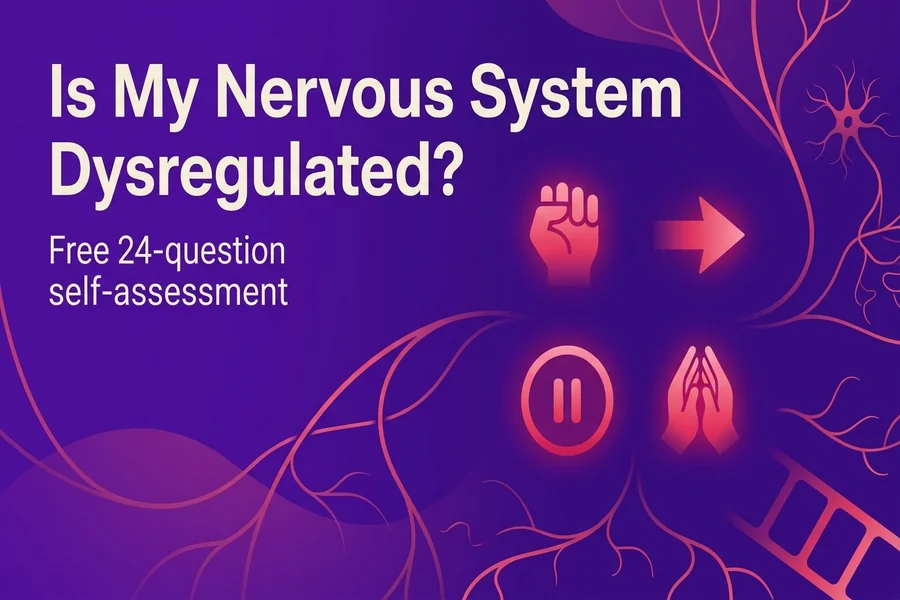
A free self-assessment that maps your nervous system across all four protective states. Built from polyvagal theory, allostatic load research and central sensitisation criteria. Identifies which state you spend most time in and the regulation protocol most likely to move the needle.
About this self-assessment
This is a free 24-question self-assessment built from polyvagal theory (Porges), the Central Sensitisation Inventory (CSI), allostatic load research (McEwen), and the diagnostic patterns described in clinical pain neuroscience.
It is not a clinical diagnosis. It is a structured way of finding out:
1. Whether your nervous system is operating outside its window of tolerance.
2. Which protective state - fight, flight, freeze or fawn - you spend the most time in.
3. Which regulation protocol is most likely to actually help you (regulation is highly individual, and the wrong protocol for your state can make things worse).
The assessment takes about 6 minutes. Be honest - the answer is only useful if the inputs are accurate.
How to score it (open the app for the live version)
For each item below, score 0–4:
- 0 = never
- 1 = rarely (less than monthly)
- 2 = sometimes (a few times a month)
- 3 = often (weekly or more)
- 4 = constantly (daily or near-daily)
Section A, Fight (sympathetic, outward):
1. Disproportionate anger or irritation at small things.
2. Clenched jaw or tight shoulders most of the day.
3. Picking fights or being short with people you love.
4. Wanting to "blow up" my life, my job, my relationship.
5. Feeling agitated or restless even at rest.
6. Defensive or argumentative reactions before thinking.
Section B, Flight (sympathetic, escape):
7. Restless mind, racing thoughts, can't slow down.
8. Compulsive busyness, can't sit still.
9. Anxiety about future events that may or may not happen.
10. Insomnia or 3 AM wake-ups with a racing mind.
11. Scanning environments for what could go wrong.
12. Heart palpitations or chest tightness at rest.
Section C, Freeze (dorsal vagal shutdown):
13. Foggy, slow, "thick" thinking.
14. Heavy fatigue that does not improve with rest.
15. Cannot start tasks even when they are urgent.
16. Emotional flatness or numbness.
17. Dissociation - looking out of your own eyes.
18. Sleeping a lot but not feeling restored.
Section D, Fawn (people-pleasing collapse):
19. Can't say no even when you should.
20. Compulsive caretaking of others; ignoring your own needs.
21. Over-explaining, over-apologising, over-justifying.
22. Loss of self in important relationships.
23. Resentment that builds and never gets voiced.
24. Saying yes when your body is screaming no.
Scoring:
- 0–24 total = mostly regulated. Brief excursions are normal.
- 25–48 = mild to moderate dysregulation; one daily regulation practice will help.
- 49–72 = significant dysregulation; multi-modal regulation work needed.
- 73–96 = severe dysregulation; consider professional support alongside daily practice.
The section with the highest sub-total is your dominant state. The regulation protocol is built around your dominant state. (Fight/flight needs downregulation. Freeze needs gentle upregulation before downregulation. Fawn needs boundary work alongside nervous-system regulation.)
What your dominant state means for the regulation protocol
Dominant Fight or Flight:
The work is downregulation. Vagal toning, slow exhales, cold exposure, HRV breathing, reducing sympathetic-driving inputs (caffeine, doom-scrolling, news), sleep architecture protection.
Dominant Freeze:
The work is gentle upregulation first. Orienting, movement, warmth, co-regulation, then slow climb up the polyvagal ladder. Trying to "calm down" a freeze state often deepens the shutdown.
Dominant Fawn:
The work is boundary work and self-reconnection in parallel with nervous-system regulation. The autonomic system is not safe to come out of fawn until the relational environment is safer.
Most people have a primary and a secondary state. Tracking which one is active today is what makes daily regulation work efficient.
Inside the Recalibrate app
The Recalibrate app includes a more comprehensive nervous-system assessment, daily state tracking, a Stability Score that combines six biological systems, and the regulation protocols matched to each dominant state - vagus-nerve exercises, polyvagal-informed somatic work, HRV breathing, pacing tools, somatic tracking, and the Neuroscience Academy curriculum.
→ Read the pillar guide on nervous system dysregulation for the full picture.
→ See how this stacks with allostatic load.
Recalibrate is an education and self-tracking tool, not a diagnostic service or a replacement for medical care.
Related articles
- The Neuro-Vagal Approach to POTS Self-Management
A patient-friendly look at POTS self-management through autonomic regulation, vagal tone, pacing, hydration, compression and clinician-guided planning.
- Activity Pacing for Chronic Pain: How to Break the Boom-Bust Cycle
The boom-bust cycle is not a willpower problem. It is a dysautonomia problem. This article explains the neuroscience behind energy crashes and gives you a step-by-step pacing protocol to build a stable baseline.
- Functional Freeze: Why You Look Fine On the Outside But Cannot Start Anything
Functional freeze is when your nervous system is in dorsal vagal shutdown but you are still going through the motions of life. It looks like procrastination from the outside and feels like drowning in cement from the inside. Here is the neuroscience and how to come out of it.