Your Brain Has a Volume Control for Pain. In Chronic Pain, It Can Get Stuck Turned Up.
By Tristan Siokos · Founder, Recalibrate · August 04, 2026
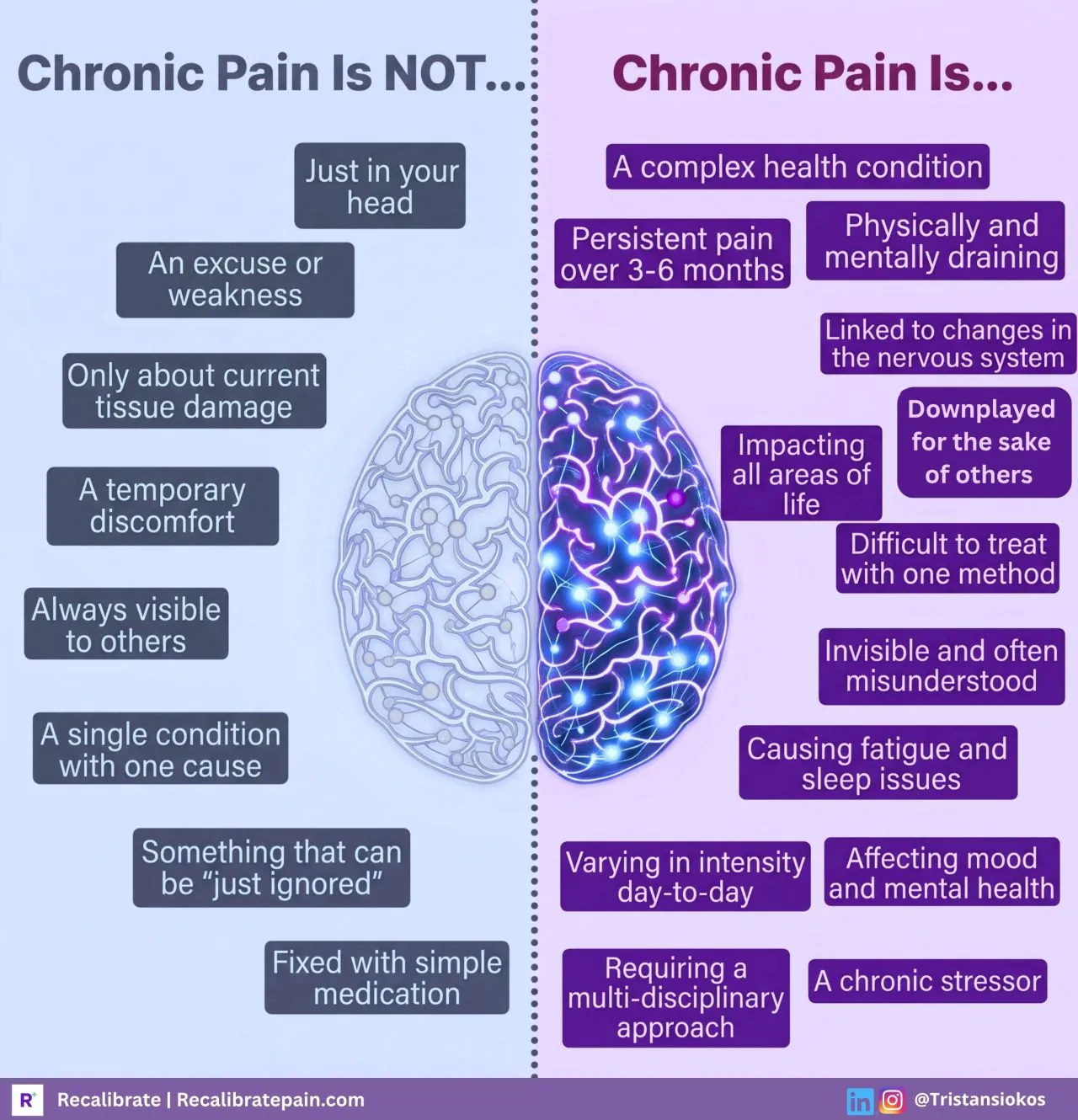
Pathways run from your brainstem into your spinal cord and set how much of a signal gets through. They can suppress it - which is why an athlete finishes the match and finds the injury afterwards. The same circuitry can amplify. Here is the neuroscience of descending facilitation, central sensitisation, and why understanding the mechanism is itself one of the best-evidenced treatments we have.
Explore the research
Your Brain Has Its Own System for Turning Pain Down
Pain is not a signal that travels from an injury to your brain unchanged, like water through a pipe. It is a signal that gets edited on the way.
Pathways run downward from your brainstem into your spinal cord, and they control how much of an incoming signal is allowed through. This is called descending modulation, and it is one of the most important pieces of neuroscience that almost nobody gets told about.
Two brainstem structures do most of the work: the periaqueductal grey (PAG) and the rostral ventromedial medulla (RVM). They project down to the dorsal horn of your spinal cord - the first relay station where incoming nerve traffic is handled - and they release opioid, serotonergic and noradrenergic signals that can suppress transmission before it ever becomes a conscious experience.
That is why a footballer can finish the match and only find the injury afterwards. Nothing was wrong with their nerves. Their brainstem was holding the volume down while the situation demanded it.
Here is the part that matters for anyone living with persistent pain: the same circuitry can run in the other direction.
Descending Facilitation: The Same Circuit, Running the Other Way
The system that turns pain down can also turn it up. That is descending facilitation, and once it is engaged an ordinary signal arrives louder than it left.
This is not an exotic malfunction. It is a normal, useful feature. After an injury, temporarily amplifying signals from the damaged area makes you protect it. The problem is when the amplification does not switch off.
What that looks like in practice:
- The same activity hurts more this month than it did last month, with no new damage
- Pain that outlasts the healing timeline of the tissue involved
- Pain intensity that tracks stress, sleep and threat rather than mechanical load
- Scans and bloods that come back "clear" while the pain gets worse
The gain has changed. The reading no longer matches the tissue. And because most of medicine is built to look at tissue, everyone keeps scanning the tissue.
Central Sensitisation: When the Spinal Cord Changes the Rules
At the same time as the descending balance shifts, the spinal cord itself changes.
Dorsal horn neurons become easier to fire. Three things happen together, and each one explains a symptom that otherwise makes no sense to anyone watching:
1. Threshold drops. Neurons that used to need a strong stimulus now respond to a weak one. Result: allodynia - touch that should not hurt does. A waistband. A bedsheet. A hug.
2. Response amplifies. The same input produces a bigger output. Result: hyperalgesia - things that should hurt a little hurt a lot.
3. Receptive fields expand. Each neuron starts answering to a larger area of the body than it used to. Result: pain spreads to places that were never injured.
This is central sensitisation, and that third point is the one people most often get wrong about themselves. When pain spreads, it usually is not a new injury turning up somewhere else. It is the map itself getting bigger.
Add descending facilitation on top of a sensitised dorsal horn and you have a system that is amplifying at two levels at once - one in the spinal cord, one from the brainstem down.
Full Body Pain Is Not a Bad Back That Spread
I have had this in my whole body for six years. Fibromyalgia, central sensitisation, hypermobility, AuDHD.
Whole-body pain is not one injury that migrated. It is a nervous system running a different set of rules - lower thresholds, higher gain, wider fields - across the entire map at once.
That distinction matters clinically, because it changes what a useful question looks like. "Where is the damage?" is the wrong question when the answer is "the volume control". The better questions are: what is holding the gain up, and what inputs bring it down?
It also matters personally. When you understand that spreading pain is a mapping change rather than new destruction happening inside you, one specific fear loses most of its power - and that fear was itself feeding the system.
The Most Damaging Assumption in Chronic Pain
The assumption that does the most harm is that pain reliably reports tissue damage.
In acute pain it is a rough approximation. In persistent pain it stops being a reliable report at all - because the reporting system has been modified. The volume has been altered, so the reading no longer matches the tissue.
Two things follow from this, and they matter enormously.
First: "your scan is normal" does not mean "your pain is not real". It means the imaging looked at the wrong layer. Nociceptive gain does not show up on an MRI. The pain is completely real, generated by real, measurable changes in a real physical system - just not the system being photographed.
Second: pain intensity is not a damage meter. So using it as one - stopping all movement whenever pain rises, treating every flare as fresh injury - trains the system in exactly the wrong direction. This is why graded, well-paced movement can hurt and still be the right thing, and why "push through it" and "avoid everything" are both wrong.
🧠 The World Health Organization now recognises this. In ICD-11, chronic primary pain is classified as a health condition in its own right - not merely a symptom of something else. That is a formal acknowledgement that the pain system itself can be the disorder.
It Stops Being Only a Nervous System Problem
Once the state is established it recruits other systems, and they hold it in place.
Sleep. Even partial sleep deprivation measurably lowers pain thresholds by the next day. Pain then wrecks sleep, which lowers thresholds further. This is one of the tightest loops in the whole picture, and one of the most modifiable.
Neuroimmune activity. Glial cells - microglia and astrocytes in the spinal cord and brain - shift into an activated state and release inflammatory mediators that keep dorsal horn neurons excitable. The nervous system's own immune cells help maintain sensitisation long after any tissue event has resolved.
The stress axis. The HPA axis and sympathetic system run continuously rather than in bursts. Recovery windows disappear. Allostatic load accumulates, and the system's baseline resets upward.
Deconditioning. Movement gets avoided, and the body adapts to being avoided - less capacity, more sensitivity, more pain per unit of activity.
Mood. Depression and anxiety follow all of the above through shared circuitry and shared neurochemistry - and then get blamed as the cause of the pain rather than recognised as another output of the same dysregulated system.
Each one feeds the next. This is precisely why a single treatment aimed at a single mechanism rarely does much on its own, and why "we tried a drug and it did not work" is not evidence that nothing works.
Understanding the Mechanism Is Itself a Treatment
This is the part that changed what I built.
A 2026 meta-analysis pooled 15 randomised controlled trials and 810 people. The intervention was not a drug, an injection or a procedure. It was teaching people how pain actually works - pain neuroscience education.
The results: pain fell. Disability fell. Kinesiophobia - fear of movement - fell. Catastrophising fell. And the effects held at three-month follow-up.
Think about what that means mechanistically. If pain were a fixed readout of tissue damage, explaining the mechanism could not change the pain. It changes the pain because the appraisal of threat is one of the inputs that sets descending gain. Reduce the threat value of a signal and you reduce the amplification applied to it.
Understanding the mechanism is itself a treatment - and it is one of very few with no side effects.
That is why the Academy sits at the centre of Recalibrate rather than off to the side: over 200 lessons across neuroscience, psychology, pain science and multi-system biology. Not content marketing bolted onto a tracker. The intervention with the cleanest risk-benefit profile we have, treated as the core of the product.
What Actually Helps From Here
If the gain is the problem, then the work is everything that changes gain. None of this is quick, and all of it is cumulative.
- Learn the mechanism properly. Not "pain is in your brain" - the actual pathways, so a flare stops reading as new damage.
- Protect sleep first. It is the single highest-leverage input on pain threshold, and it is measurable within days.
- Move in graded, predictable doses. Under your ceiling, repeated often. Repetition beats intensity, and consistency beats effort.
- Pace against load, not against pain. Pain is a lagging, distorted indicator. Plan by capacity and recovery instead.
- Train the threat appraisal. Breathwork with a longer exhale, orienting, CBT and ACT skills, and self-compassion work all act on the same descending pathways.
- Track it, so you can see it. Sensitised systems are noisy day to day. Patterns only appear across weeks, and your memory is not a reliable instrument for that.
- Do not do it alone. Bring a clinician, a carer or family into the actual data. Isolation is its own amplifier.
I spent six years learning this, most of it in the state I have just described. Then I built the thing I could not find - the one place that connects the education, the tracking, the tools, the AI insights and the care team.
💜 The future of health and pain management is education and connectivity. Your pain is real. Your nervous system is modifiable. Both of those are true at the same time, and that is the whole point.
Recalibrate is an education and self-tracking tool, not a diagnostic service or a replacement for medical care.
Related articles
- The Ache Two Days After a Hard Workout Is Not Coming From Your Muscles
Sixteen people were injected with the same irritant twice - once into muscle, once into the fascia on top of it. The fascia injection hurt 86% more at peak, lasted up to twice as long and spread across an area 65% larger. No standard scan assesses this tissue. Here is what fascia actually is, why foam rolling does not do what you were told, and what genuinely changes it.
- Central Sensitisation Explained: Why Pain Persists After Your Injury Heals
Central sensitisation is when your nervous system keeps running a protection program for a threat that no longer exists. This article explains the 4 neural mechanisms that keep pain alive and how to reverse them.
- What Is Chronic Pain? The Science-Based Guide Your Doctor Never Explained
Chronic pain is not about damage. It is a protection output from your nervous system. This evidence-based guide explains why chronic pain persists, what central sensitisation actually is, and what the biopsychosocial model means for your recovery.