The Ache Two Days After a Hard Workout Is Not Coming From Your Muscles
By Tristan Siokos · Founder, Recalibrate · August 18, 2026
Sixteen people were injected with the same irritant twice - once into muscle, once into the fascia on top of it. The fascia injection hurt 86% more at peak, lasted up to twice as long and spread across an area 65% larger. No standard scan assesses this tissue. Here is what fascia actually is, why foam rolling does not do what you were told, and what genuinely changes it.
Explore the research
The Ache Is Not Coming From Your Muscle
The ache two days after a hard workout was assumed to be muscle damage for decades. The evidence now points mostly somewhere else: the fascia, the sheet wrapped around the muscle.
The muscle repairs quietly. The covering is what hurts.
The cleanest demonstration of this is almost brutally simple. Sixteen people were injected with the same irritant twice, guided by ultrasound - once into the muscle of the lower back, once into the fascia sitting on top of it.
The fascia injection:
- Hurt 86% more at its peak
- Lasted 1.5 to 2 times longer
- Spread across an area 65% larger
Same substance. Same person. Same region. Two very different experiences, depending on which layer the needle was in.
Why Fascia Reports Damage and Muscle Barely Does
The difference is not how many nerves each tissue has. Muscle has plenty.
But look at what kind. Most of muscle's nerve supply is motor - driving contraction - plus proprioceptors reporting length and tension. It is comparatively thin on the free nerve endings that signal damage.
Fascia barely contracts, so it has almost no motor supply. What it has instead is a dense population of exactly those damage-signalling endings - and in the lower back, denser in the fascia than in the muscle beneath it.
So: same irritant, but one tissue is far better built to report it.
This single anatomical fact reframes an enormous amount of everyday pain. The tissue we assumed was the source is relatively quiet. The tissue nobody talks about is the one wired to shout.
Which Matters If You Have Ever Been Told Your Scans Are Clear
No standard scan assesses this.
An X-ray shows bone. An MRI is read for discs, tears, tumours and structural damage. Nobody measures how well your fascial layers glide, or how sensitive they have become.
So the tissue most likely to be producing your pain is the one nobody looked at - and you get told nothing is wrong.
That sentence has cost people years, and in some cases their credibility with their own family.
It can be measured, though. Researchers used ultrasound to watch the layers slide across each other in 71 people with chronic low back pain and 50 without. In the pain group, the layers slid about 20% less.
That is an objective, measurable difference in a tissue that no routine imaging pathway examines. "Clear scans" never meant "no findings". It meant "no findings in the things we photographed".
It Is Also Part of How You Know Where Your Body Is
Fascia carries position sensors. It is part of how you know where your limbs are without looking.
When it changes - sensitised, less mobile, less hydrated, less varied in its input - that sense degrades.
This is one reason people with fibromyalgia and hypermobility describe feeling clumsy, bumping into door frames, misjudging where their feet are, or saying the thing that is hardest to explain to a clinician: "my body does not feel like my own."
That is not dissociation, and it is not anxiety. It is a degraded proprioceptive signal from a tissue that is supposed to be supplying it. The same problem, from the other direction, is why gentle varied movement often improves body awareness faster than any amount of trying to concentrate on it.
It Responds Badly to Stillness - and That Is the Cruel Part of a Flare
Connective tissue starts adapting to a lack of movement within days. Not weeks. Days.
Which sets up the trap that everyone with a flare knows from the inside:
You move less because it hurts. And moving less changes the tissue.
That is not a moral failing, and it is not you being lazy. It is a tissue property interacting with a symptom. But it does mean the loop has to be broken with something, and the two obvious options are both wrong:
- Rest completely → the tissue adapts to stillness, and the next attempt at movement costs more
- Push through → you exceed what the system can currently tolerate and buy a longer flare
What works is the unglamorous middle: small amounts, in more directions, more often - well under the threshold that costs you tomorrow. Frequency and variety, not intensity.
Now the Part Almost Every Fascia Post Gets Wrong
Foam rolling and deep massage do not change the tissue.
Fascia is stiff. The force required to meaningfully deform it is far greater than a hand, an elbow or a roller can apply. Nothing is being "broken down", "released" or "smoothed out". Adhesions are not being melted.
It still helps. That is the important half of the sentence.
It works on the nerve endings rather than the material - reducing how sensitive the area is and how much tension the surrounding muscles are holding. Which is exactly why relief often arrives within seconds, and no change in a dense sheet of collagen could possibly happen that fast.
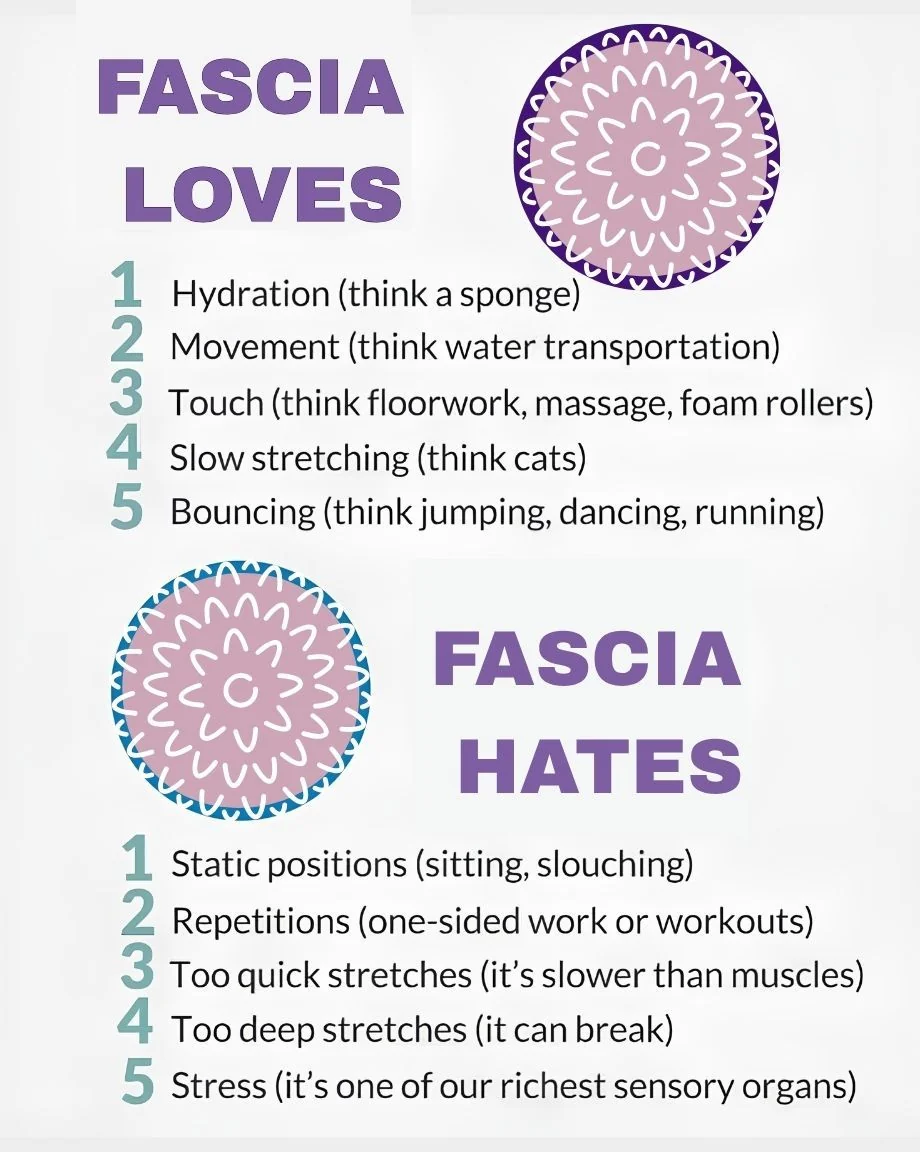
So the mechanism is neural, not mechanical. And once you know that, the whole "fascia loves / fascia hates" list reads differently:
Fascia loves: hydration, movement, touch, slow stretching, bouncing.
Fascia hates: static positions, repetitive one-sided load, fast stretches, over-deep stretches, stress.
That is not maintenance instructions for a passive material. It is a description of varied input to a sensing tissue.
So change the input. Move in more directions, more often, and stop holding one position for hours. That is what this tissue responds to 💜
Recalibrate is an education and self-tracking tool, not a diagnostic service or a replacement for medical care.
Related articles
- Your Brain Has a Volume Control for Pain. In Chronic Pain, It Can Get Stuck Turned Up.
Pathways run from your brainstem into your spinal cord and set how much of a signal gets through. They can suppress it - which is why an athlete finishes the match and finds the injury afterwards. The same circuitry can amplify. Here is the neuroscience of descending facilitation, central sensitisation, and why understanding the mechanism is itself one of the best-evidenced treatments we have.
- There Is a Muscle at the Base of Your Skull That Is Physically Attached to the Covering of Your Brain
Rectus capitis posterior minor connects through a gap in the bone to the dura mater that wraps your brain and spinal cord. The neck and the head were never two separate problems. Here is how a cervicogenic headache behaves, the one-minute test that identifies it, why it gets felt behind an eye, and the trial evidence that it responds to treatment.
- Central Sensitisation Explained: Why Pain Persists After Your Injury Heals
Central sensitisation is when your nervous system keeps running a protection program for a threat that no longer exists. This article explains the 4 neural mechanisms that keep pain alive and how to reverse them.