Leveraging Neuroplasticity in Chronic Pain Recovery
By Tristan Siokos · Founder, Recalibrate · May 2, 2026
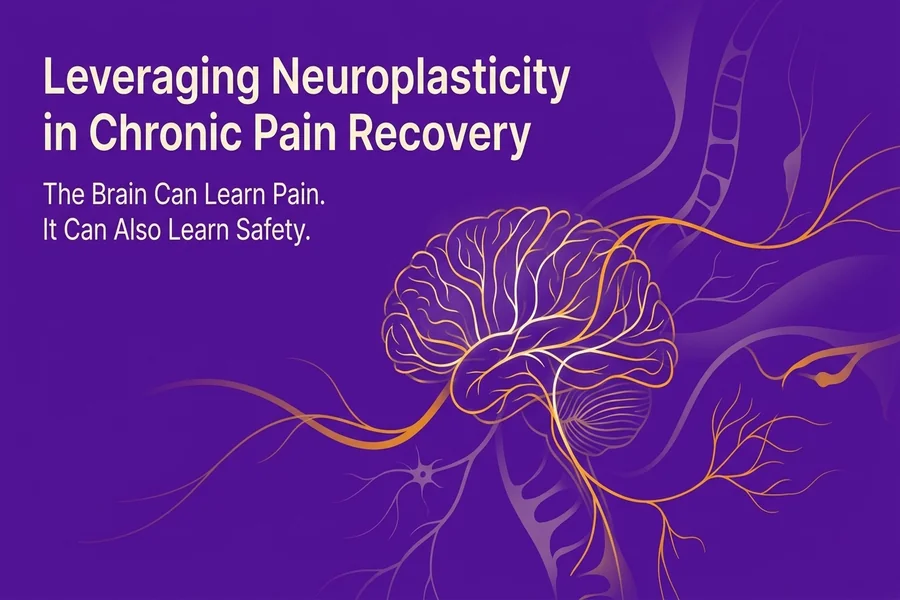
How chronic pain recovery can use neuroplasticity through education, graded exposure, attention training, regulation and repeated safety signals.
The Brain That Learned Pain Can Learn Safety
Neuroplasticity is the brain's lifelong ability to change its own structure and function in response to experience. It is usually discussed as a hopeful thing - the basis of learning and recovery. In chronic pain it is both the problem and the solution.
It is the problem because persistent pain is, in part, something the nervous system has learned. Through repeated activation, pain pathways become more efficient and more easily triggered - the system gets better at producing pain. But the same plasticity that learned the pain can also unlearn it. The brain that learned pain can learn safety. Recovery is, in large measure, a process of deliberate re-learning.
How Pain Gets Learned
Understanding how the nervous system learns pain makes the recovery strategy obvious. Neurons that fire together wire together: when pain signalling is repeated, the connections carrying it strengthen, and the circuits become sensitised and easily activated.
Layered on top of this is predictive learning. The brain learns to associate certain movements, positions, situations or emotions with pain, and begins to pre-emptively generate protection - sometimes producing pain in anticipation, before any real threat. Over time the pain becomes decoupled from tissue damage and driven increasingly by the learned pattern itself. This is discouraging only until you realise it points straight at the way out.
The Conditions for Re-Learning
Plasticity is not automatic; it happens under specific conditions, and recovery works by deliberately creating them.
Repetition - new patterns, like old ones, are built through consistent practice, not one-off effort. Safety - the nervous system will only lower its guard when it accumulates evidence that it is safe to do so, which is why graded, non-threatening experience matters. Attention and belief - what the brain expects shapes what it learns, so accurate understanding accelerates the process. Recovery - plastic change consolidates during sleep, making rest part of the mechanism.
Recovery, in other words, is a training programme for the nervous system, and it obeys the rules of how brains change.
A Structured Path to Re-Learning
Leveraging neuroplasticity in practice means applying these conditions deliberately and consistently over time - graded exposure to feared movement, repeated signals of safety, accurate education to shape expectation, and protected sleep to consolidate change.
This is the logic Recalibrate is built on. The Academy teaches how the nervous system learns and unlearns pain; the tools support graded, safe practice; and tracking lets you see the re-learning happening in your own trend, which itself reinforces the new, less threatening prediction. The brain that learned pain can learn safety - and neuroplasticity is the reason that is a scientific statement, not a slogan.
Recalibrate is an education and self-tracking tool, not a diagnostic service or a replacement for medical care.
Related articles
- How Your Brain Creates Pain: Pain Neuroscience Education Explained
Pain is not a signal from your tissues. It is a decision your brain makes based on threat assessment. This article explains the 5 brain regions running your pain system and how to change the output.
- Central Sensitisation Explained: Why Pain Persists After Your Injury Heals
Central sensitisation is when your nervous system keeps running a protection program for a threat that no longer exists. This article explains the 4 neural mechanisms that keep pain alive and how to reverse them.
- There Is a Muscle at the Base of Your Skull That Is Physically Attached to the Covering of Your Brain
Rectus capitis posterior minor connects through a gap in the bone to the dura mater that wraps your brain and spinal cord. The neck and the head were never two separate problems. Here is how a cervicogenic headache behaves, the one-minute test that identifies it, why it gets felt behind an eye, and the trial evidence that it responds to treatment.