Your Brain Does Not Take Your Word For It. It Keeps a Record of You.
By Tristan Siokos · Founder, Recalibrate · August 13, 2026
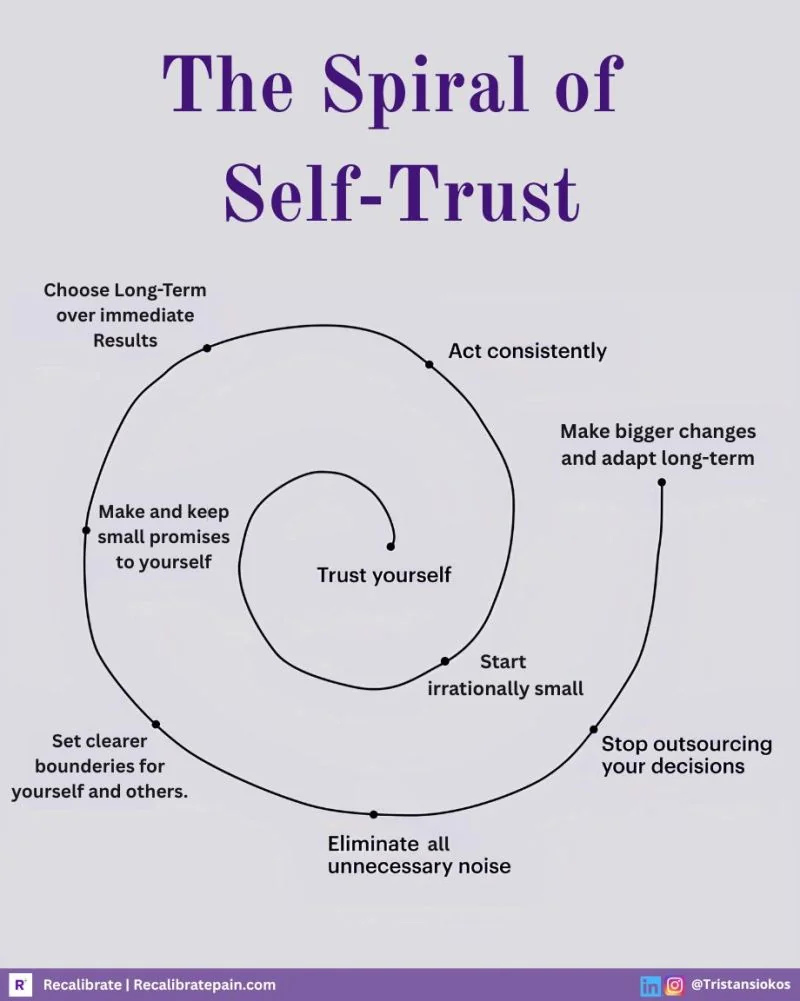
Your brain has been gathering data on you your whole life, and it believes the data over the promises. That is why big intentions fail and irrationally small kept promises work. It is also why chronic illness damages self-trust so badly - and why pacing beats pushing.
Explore the research
Self-Trust Is a Prediction, Not a Personality Trait
Self-trust feels like something you either have or you do not. A trait. A temperament. Something other people were issued and you were not.
It is closer to a prediction.
Your brain is a prediction machine. It builds models of everything it deals with repeatedly so it can anticipate rather than react - including a model of you. It has been gathering evidence on you your entire life: what you said you would do, and what then happened.
And it believes the data over the promises.
This is why "I'm really going to do it this time" changes nothing. You are offering a statement to a system that only updates on outcomes. Self-trust is not a feeling you talk yourself into. It is what the evidence added up to.
Which is also the good news, because evidence can be generated deliberately.
Why You Have to Start Irrationally Small
🌱 The brain updates on outcomes, not intentions. That single fact reorganises everything about how you should approach change.
A big promise you break teaches your brain that you are unreliable. A tiny promise you keep teaches it that you are not. And crucially, the size of the promise barely enters the calculation - what gets recorded is whether the prediction was met.
Two minutes, done, beats the hour you fully meant to do.
So the correct move is to start at a size that feels almost embarrassing. One page. Two minutes of movement. One glass of water before coffee. Not because small actions are transformative in themselves, but because the rate at which you keep promises is the variable that matters, and small promises are the only ones you can keep at a high rate while your model of yourself is still poor.
Most people invert this. They set a promise large enough to be meaningful if kept, fail it, and inadvertently run an experiment that proves the thing they were trying to disprove.
Consistency Is the Only Thing That Moves It
🔁 One kept promise is noise. Repeated ones become a pattern the brain expects.
This is where the psychology literature is unusually consistent. Decades of self-efficacy research point to one dominant source of self-belief, and it is not encouragement, affirmation or positive thinking.
It is direct experience of following through - what the research calls mastery experience. Verbal persuasion from others is one of the weakest sources. Watching someone else succeed is stronger. Doing it yourself, repeatedly, is by a wide margin the strongest.
Which means the useful question is never "how do I feel more confident?" It is "what is the smallest promise I can keep at a 90% rate for the next three weeks?"
Confidence is downstream. It arrives as a report on data you have already generated.
Boundaries and Noise Decide What Gets Recorded
⚖️ Two things quietly corrupt the record.
Boundaries. Every yes to someone else that breaks a promise to yourself gets filed as evidence against you. Your brain does not annotate it with "but they really needed help" - it logs a prediction about your own behaviour that failed. This is why chronically over-committed people often have surprisingly low self-trust despite being extremely reliable to everyone else.
Outsourced decisions. Every decision you hand to someone else is a rep you did not do. Your brain builds judgment by using it - by making a call, seeing the outcome and updating. Endless advice-seeking and comparison bury your own signal under everyone else's, and you cannot learn to trust a voice you never let speak.
None of this means becoming rigid or refusing help. It means noticing that the record is being written either way, and that a small promise to yourself is not less important than a small promise to someone else. It is the one you are being scored on.
You Never Learned to Be Helpless. You Learn to Be Capable.
🚪 Here is the part that surprises people, and it is a genuine reversal in the neuroscience.
For fifty years we called it learned helplessness - the idea that prolonged, uncontrollable adversity teaches an animal or a person to stop trying.
The neuroscience revised it. Passivity under prolonged adversity turns out to be the brain's default, unlearned reaction. It is what the brainstem does by default when adversity is prolonged. Nothing has to be learned for shutdown to occur.
What is actually learned is control. A prefrontal circuit has to detect that your actions matter - that behaviour is producing outcomes - and when it detects that, it actively switches the shutdown off.
Read that again in the first person: you never learned to be helpless. You learn to be capable, and you learn it from evidence.
That reframe is not motivational fluff. It changes the target. You are not trying to unlearn a bad belief. You are trying to supply a prefrontal detector with data showing that your actions have consequences - which is exactly what a kept promise is.
Why Chronic Illness Hits This So Hard
🩹 This is where it gets personal, and where most advice about discipline becomes actively harmful.
When your body cannot deliver what you planned, promises get broken for you, again and again. You did not choose it. You did not lack commitment. The energy was not there.
But the model does not separate "will not" from "cannot". It logs the miss.
That is what the boom-and-bust cycle is quietly doing underneath the fatigue. Not just the physical crash - a prediction model being trained on a body that could not keep its word. Over years, that produces something that looks exactly like low self-discipline and is nothing of the kind. It is an accurate model built from data collected under impossible conditions.
Not weakness. Not a character flaw.
Which is also why pacing beats pushing. Pacing is usually sold as accepting a smaller life. It is not. Pacing is making promises your body can actually keep, so the evidence finally starts running the other way. It is self-trust repair disguised as an activity strategy.
This is a spiral, not a switch. Small promise kept, better model. Slightly bigger promise, better model again. Each turn widens because the last one held - and it widens at whatever rate your body allows, which is nobody else's business.
💜 You do not decide to trust yourself. You give yourself a reason to.
Recalibrate is an education and self-tracking tool, not a diagnostic service or a replacement for medical care.
Related articles
- Mindfulness for Chronic Pain: Does It Work? Evidence-Based Guide
Mindfulness works for chronic pain but not the way most people think. It structurally changes the brain regions that manufacture pain. This guide explains the neuroscience and gives you a 4-week starter protocol.
- Activity Pacing for Chronic Pain: How to Break the Boom-Bust Cycle
The boom-bust cycle is not a willpower problem. It is a dysautonomia problem. This article explains the neuroscience behind energy crashes and gives you a step-by-step pacing protocol to build a stable baseline.
- Perspective Is Everything: The Neuroscience of How Your Brain Predicts Reality
The same event can produce panic in one person and calm in another. The difference is not the situation. It is the prediction your brain makes before the body reacts. This is predictive processing, one of the most established findings in modern neuroscience, and the reason perspective is biological, not just cognitive.