Perspective Is Everything: The Neuroscience of How Your Brain Predicts Reality
By Tristan Siokos · Founder, Recalibrate · May 5, 2026
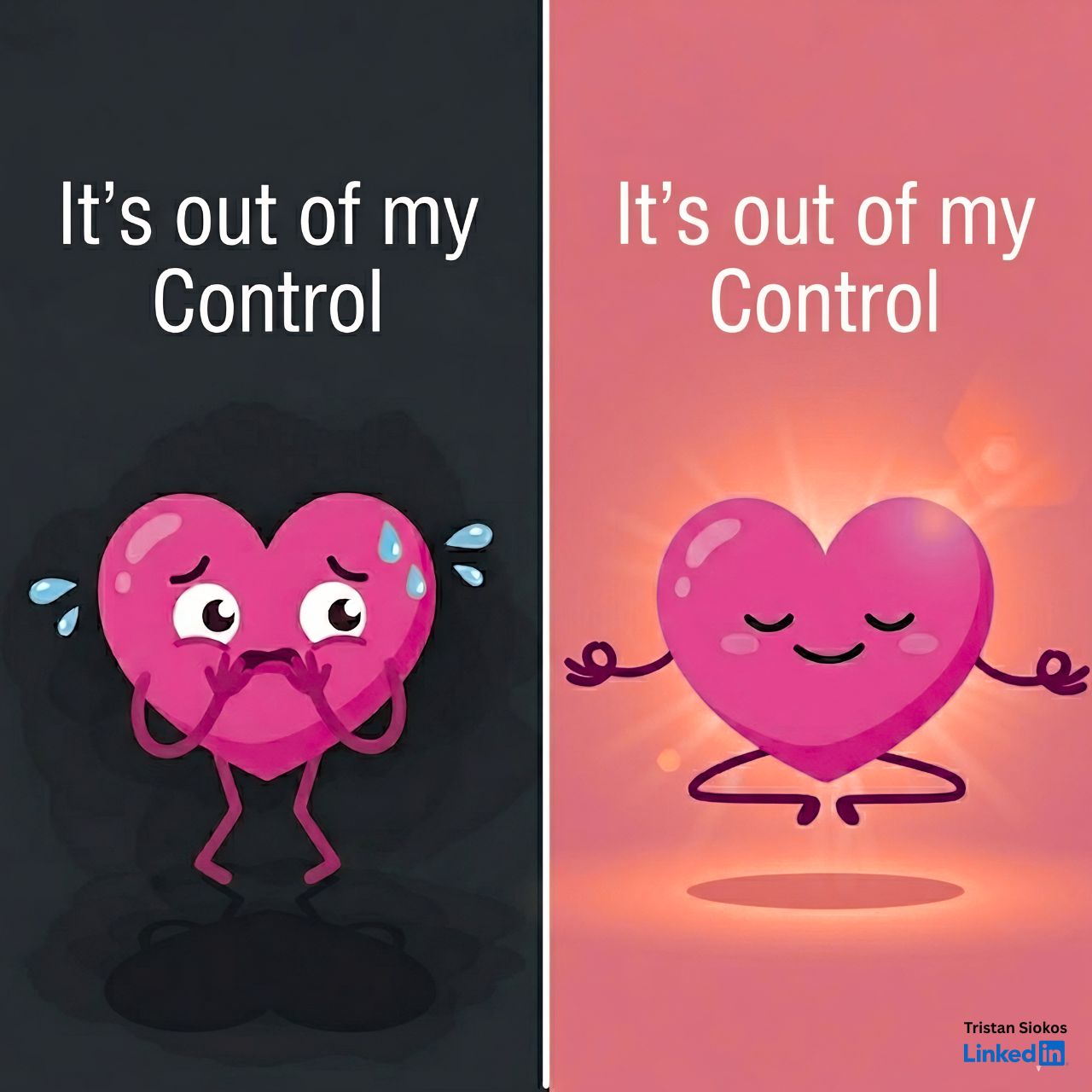
The same event can produce panic in one person and calm in another. The difference is not the situation. It is the prediction your brain makes before the body reacts. This is predictive processing, one of the most established findings in modern neuroscience, and the reason perspective is biological, not just cognitive.
Your Brain Is a Prediction Engine, Not a Reaction Machine
Here is a finding from modern neuroscience that should change how you think about your own mind: your brain does not respond to reality. It responds to its predictions about reality.
This is not philosophy. It is predictive processing, one of the most established frameworks in cognitive neuroscience over the last fifteen years. Every conscious experience you have, every emotion, every body sensation, even the experience of pain itself, begins as a prediction your brain makes a fraction of a second before the input arrives.
Your visual cortex predicts what you are about to see. Your interoceptive cortex predicts what your body is about to feel. Your amygdala predicts whether the next moment is safe or dangerous. The actual sensory data, when it arrives, is then compared against the prediction. What you consciously experience is not the raw data. It is the best guess your brain made plus a small correction signal.
This explains something that used to be mysterious. The same event, the same news, the same sentence, can produce a panic response in one person and a calm one in another. The difference is not the event itself. It is the prediction the brain made about what the event meant before the body had a chance to react.
The Threat Prediction: Why "Just Calm Down" Does Not Work
When the brain predicts danger, the response is biological and immediate.
The amygdala fires. Within 100-150 milliseconds, threat signals route to the hypothalamic-pituitary-adrenal (HPA) axis. Cortisol and adrenaline release into the bloodstream.
The prefrontal cortex narrows. Blood flow shifts away from the regions responsible for nuanced thinking and toward survival-related circuits. This is why under acute threat, you cannot think clearly, weigh trade-offs, or recall complex information.
Vision tunnels. Hearing dampens. Heart rate climbs. These are not psychological reactions. They are downstream consequences of the prediction the brain made before you were consciously aware anything was happening.
This is why "just calm down" rarely works as advice. By the time the conscious thought "I should calm down" reaches awareness, the body is already 300-500 milliseconds into a sympathetic response. The intervention has to happen at the prediction layer, not the reaction layer.
The Safety Prediction: Same Input, Different Output
When the brain predicts the same event as manageable rather than dangerous, the entire physiological cascade is different.
Vagal tone holds. The parasympathetic system stays online. Heart rate variability remains high.
The Anterior Cingulate Cortex (ACC) regulates rather than escalates. This region acts as the brain's conflict monitor. When predictions align with incoming data, it stays in a calm regulatory mode. When they violate sharply, it fires the alarm.
The prefrontal cortex stays capable of nuanced thinking. You can hold context, weigh nuance, plan, and respond rather than react.
Same input, different processing, different output. This is the core insight. Two patients with the same diagnosis can have completely different symptoms and recoveries because the interpretive layer is biological.
Why Two Siblings Can Have Completely Different Nervous Systems
Predictive processing explains something that has always been clinically obvious but biologically puzzling.
Two siblings can experience the same childhood, the same parents, the same household, and develop completely different nervous systems as adults. Two patients can be diagnosed with the same condition on the same day, undergo identical treatment, and have wildly different recovery trajectories.
The difference is the prior the brain has built. Priors are the running model your brain uses to make predictions, accumulated from every prior experience, repeated thought pattern, and learned association. They sit beneath conscious awareness and they shape every prediction the brain makes about what comes next.
A nervous system whose prior says "the world is unpredictable and threats appear without warning" will read ambiguous signals as danger. A nervous system whose prior says "I have weathered hard things before and adapted" will read the same signals as challenge.
This is not weakness or strength. It is the cumulative output of every previous prediction the brain has made, encoded in the synaptic weights of the predictive model itself.
The Good News: Perspective Is Trainable
Here is where the science gets practical. Predictions are not fixed. The brain is constantly updating its predictive model based on new data, and that updating mechanism has a name you have heard before: neuroplasticity.
Every evidence-based perspective intervention works by giving the brain new prediction data to update with.
Cognitive reframing changes the conscious narrative the brain uses to interpret events. Repeated often enough, the new narrative becomes the prior.
Mindfulness trains the brain to notice the gap between prediction and incoming sensation. Over time, this loosens the automatic identification with predictions.
Somatic practices (breath work, grounding, body scans) feed the brain interoceptive data that contradicts threat predictions, which forces a model update.
Exposure deliberately delivers data that violates a fearful prediction. When the bad outcome does not arrive, the prior weakens.
These are not motivational tools. They are prediction updating tools. The mechanism is physical. Repeat them often enough and the predictive model itself rewires.
The Limits: When Perspective Work Is Not Enough
Perspective change has real limits, and pretending otherwise is dangerous.
Some prediction priors are deeply embedded through trauma, early developmental adversity, or genetics. These do not yield to a quick reframe. They require longer interventions: trauma-focused therapy, EMDR, somatic experiencing, sometimes medication, and time.
Some situations are genuinely dangerous, and your brain is right to predict threat. The goal of perspective work is not to override accurate signals. It is to update predictions that no longer serve you, while leaving accurate ones intact.
If your nervous system is screaming at you about a real harm, that is signal, not noise. Perspective work cannot replace appropriate boundaries, safety, medical care, or in some cases, a complete change in environment. The framework is "what predictions need updating, what predictions need acting on, and what predictions need professional support to reshape".
Why This Matters For Chronic Pain and Chronic Illness
For chronic conditions, the prediction layer is everything.
The brain that has learned to expect pain produces more of it. This is not a metaphor. The pain neuromatrix is fundamentally a predictive system. Every signal from the body is interpreted through the lens of "is this a threat I should amplify?". A nervous system whose prior is "yes, always" produces louder pain output for the same input.
The brain that has learned to expect threat keeps the body in defensive mode long after the original danger has passed. Chronic muscle tension, gut dysregulation, sleep disturbance, immune dysfunction, fatigue. These are downstream effects of a predictive model stuck in threat mode.
This is why interventions that update the predictive layer (pain neuroscience education, graded exposure, somatic regulation, nervous system retraining) often outperform interventions that try to reduce the input itself. The input was never the main problem. The interpretation was.
You cannot always control what happens to you. You can train the system that decides what it means, how you think about situations, and how the body responds. That training is biological. The mechanism is predictive processing. The ceiling is what you are willing to practice.
Perspective is everything. Not because reality bends to thoughts, but because reality is always processed through them first.
Recalibrate is an education and self-tracking tool, not a diagnostic service or a replacement for medical care.
Related articles
- Daily Neural Workouts: 8 Science-Backed Techniques to Rewire Your Brain
Your brain is a prediction machine, not an archive. If you do not deliberately train new patterns, it reverts to its oldest, most dominant pathways. Here are 8 daily neural workouts - education, gratitude, curiosity, authenticity, meditation, resilience, connection and self-compassion - that fuel real, mechanism-level neuroplasticity.
- How to Be More Mindful: The Neuroscience of Stillness as Strategy
Your brain processes 11 million bits of information per second. Your conscious mind handles about 50. Mindfulness is not a passive activity - it is the active regulation of the nervous system that prevents cognitive overload. Six specific shifts: listen but do not interrupt, notice but do not react, breathe but do not rush, think but do not worry, do but do not hurry, feel but do not be bothered. The neuroscience of why each one works.
- The Neuroscience of Control: What You Can Actually Train (and What Was Never Yours)
Most people think control is about willpower. The neuroscience says otherwise. Your nervous system processes millions of inputs every second - most of them are not yours to control. But seven specific circuits absolutely are: response control, self-talk, boundaries, beliefs, vagal tone, attention and emotional regulation. Stop training what was never yours. Start training what is.