Daily Neural Workouts: 8 Science-Backed Techniques to Rewire Your Brain
By Tristan Siokos · Founder, Recalibrate · April 28, 2026
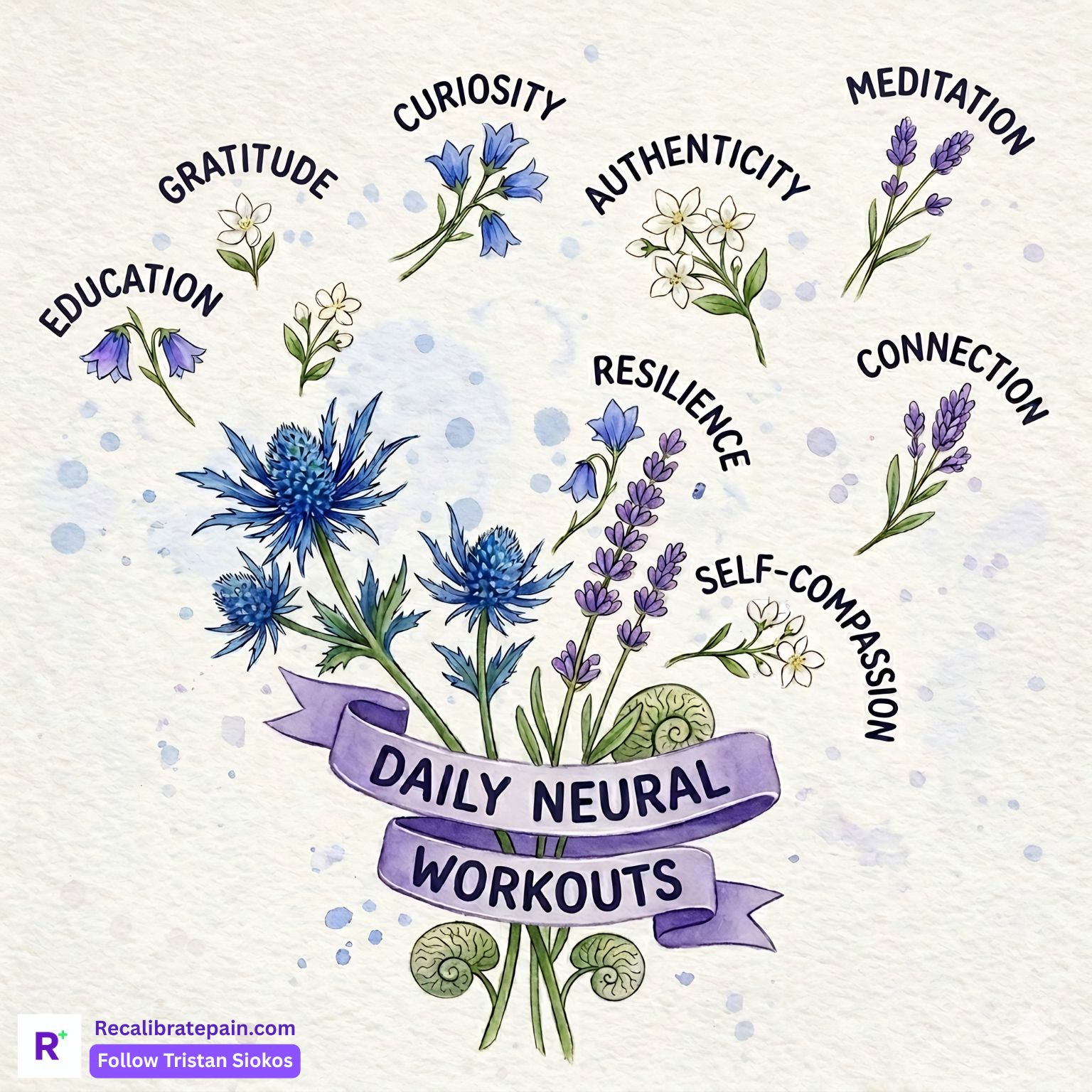
Your brain is a prediction machine, not an archive. If you do not deliberately train new patterns, it reverts to its oldest, most dominant pathways. Here are 8 daily neural workouts - education, gratitude, curiosity, authenticity, meditation, resilience, connection and self-compassion - that fuel real, mechanism-level neuroplasticity.
Your Brain Is a Prediction Machine, Not an Archive
Here is the principle that should change how you think about daily habits.
Your brain is not a passive storage device. It is an active prediction engine whose primary job is to anticipate the next moment based on patterns it has built from the past. Every thought, sensation, and behaviour you repeat strengthens the neural circuit it travels through. Every circuit you do not use gets pruned. This is neuroplasticity at the cellular level - synaptic weighting that responds to use, not to intention.
The clinical implication is heavy: if you do not deliberately train new patterns, your brain reverts to its oldest, most dominant pathways just to have something to predict from. Those default pathways are usually the ones built under stress, threat, or the formative experiences of your earliest years. They feel like "you" because they are practiced. They are not destiny. They are practice.
The eight techniques below are not motivational tricks. Each one is a mechanism-level intervention - a specific input that gives the predictive system new data to update its model with. Repeated daily, they physically rewire structure. The science is settled. The doing is the hard part.
1. Education - The Primary Trigger for Neuroplasticity
The mechanism. Novel knowledge is the single most reliable trigger for synaptogenesis - the formation of new connections between neurons. The hippocampus and prefrontal cortex respond to learning by upregulating BDNF (brain-derived neurotrophic factor), the molecular fertiliser that grows and strengthens neural circuits. Without novelty, the brain does the opposite: synaptic pruning, energy conservation, ageing.
The practice. Learn one new thing every day. A fact, a skill, a perspective, a paragraph from a book outside your usual lane. Treat it like dental hygiene - the goal is not to be impressive, the goal is daily input. Reading, podcasts, conversations with people outside your field, a YouTube explainer, a lesson in the Recalibrate Academy. All count. The brain does not care about format. It cares about novelty.
If you are not learning, your brain is pruning.
2. Gratitude - Physically Altering the Medial Prefrontal Cortex
The mechanism. Consistent gratitude practice is one of the most well-replicated findings in affective neuroscience. fMRI studies show structural and functional changes in the medial prefrontal cortex (mPFC) - the region responsible for self-referential processing and emotion regulation - within 8-12 weeks of daily practice. Baseline cortisol drops. Heart rate variability climbs. Default emotional tone shifts upward.
The practice. Three specific things, every morning or every evening. The specificity matters. "My family" does not work. "My partner remembered my coffee order without me asking this morning" does. The brain encodes specificity. Vague gratitude is rumination's cousin - it activates the same self-referential loops without the regulatory effect.
Two minutes a day. Pen and paper outperforms apps in every study. The act of writing slows the thought enough for the circuit to encode.
3. Curiosity - The Physiological Antidote to Fear
The mechanism. Curiosity and fear cannot both be in the driver's seat. A curious state activates the mesolimbic dopamine pathway (the reward and exploration system) and simultaneously dampens amygdala activation. They are mutually inhibitory at the circuit level. This is why genuine curiosity feels like the room expanding rather than narrowing.
The practice. When something stresses you, before reacting, ask: "What is interesting about this?" Even if the answer is "nothing, this is just hard". The asking itself shifts the dominant network for 30-60 seconds, which is often enough to prevent the threat response from running its full course.
Two minutes a day, applied to one stressful moment. Over weeks, the pause becomes default. The brain learns curiosity is the new prior.
4. Authenticity - Freeing Up Prefrontal Cortex Bandwidth
The mechanism. Pretending burns prefrontal cortex energy through cognitive dissonance - the constant CPU cost of holding an internal state and an incompatible external behaviour at the same time. The dorsolateral prefrontal cortex (responsible for executive function and complex problem-solving) is the most metabolically expensive region of the brain. Masking taxes it directly.
When external behaviour aligns with internal state, that bandwidth is released. You think more clearly, regulate more easily, and recover from stress faster. The metabolic savings are real and measurable.
The practice. Identify one moment a day where you almost masked - bit your tongue, performed a feeling you did not have, agreed with something you did not believe - and choose honesty instead. Calibrated honesty, not unfiltered. "Actually, I see it differently" works. "I need a moment before I answer" works. Authenticity is not bluntness. It is congruence.
5. Meditation - Operational Efficiency For The Brain
The mechanism. Meditation is the only practice that reliably shuts down the Default Mode Network (DMN) - the constellation of regions (medial PFC, posterior cingulate cortex, angular gyrus) that drives self-referential thinking, mind-wandering, and rumination. The DMN is highly active in chronic anxiety, depression, and chronic pain. Quieting it, even briefly, gives the rest of the brain room to operate.
The mechanism is not mystical. Focusing attention on immediate sensory input forces the brain into a different network configuration (the task-positive network), which is structurally incompatible with rumination.
The practice. Pause once an hour during the day and name three things you can see, three things you can hear, and three things you can feel on your skin or in your body. Thirty seconds. That is one full meditation rep. Twelve reps a day is a workout.
You do not need a cushion. You need attention.
6. Resilience - Recovery, Not Endurance
The mechanism. Most people misunderstand resilience as "the ability to keep going under stress". The neuroscience says the opposite. Resilience is the speed at which your autonomic nervous system returns to baseline after a cortisol spike. It is a recovery metric, not a tolerance metric. High resilience means fast parasympathetic re-engagement after sympathetic activation.
The practice that trains it is not endurance. It is deliberate post-stress downshifting, which teaches the vagus nerve to disengage the threat response faster next time.
The practice. After a stressful moment - a difficult conversation, a tight deadline, bad news - deliberately spend two minutes on slow exhales (inhale four, exhale six or eight) before moving on to the next task. Slow exhales directly stimulate the vagus nerve and pull the parasympathetic system back online.
You are not "calming yourself down". You are training the recovery circuit. The reps compound.
7. Connection - The Co-Regulation Wiring of the Nervous System
The mechanism. Your nervous system is not a closed loop. It is hardwired for co-regulation - the unconscious tuning of heart rate, vagal tone, and stress hormones to the people around you. This is the substance behind polyvagal theory's "social engagement system". Positive social bonds reduce systemic inflammation (lower CRP and IL-6), stabilise hormonal balance, and improve immune function within weeks of consistent practice.
Loneliness is not a feeling. It is a physiological state that the body interprets as threat. Connection is the corrective input.
The practice. One genuine interaction a day. Eye contact, a real conversation, not transactional. Could be your partner, a colleague, a stranger at the coffee shop. Five minutes counts if it is real. A 30-second "how are you really?" with someone you trust counts.
Texts, likes, scrolls do not. The nervous system needs sensory cues - voice prosody, micro-expressions, eye contact, sometimes touch. That is the input it evolved for.
8. Self-Compassion - Metabolic Efficiency For Processing Errors
The mechanism. Chronic self-criticism keeps the system on permanent high alert. The amygdala does not differentiate between an external threat and an internal one - the verbal self-attack lights up the same threat circuitry as a predator. Cortisol stays elevated. Recovery slows. Energy that could go to learning, healing, and creative work goes to defending against yourself.
Self-compassion is not soft. It is metabolically efficient error-processing. It allows the brain to register the mistake (necessary for learning) without triggering the threat response (which prevents learning).
The practice. When you make a mistake - any mistake, small or large - ask: "What would I say to a friend right now?" Then say it to yourself. Out loud if you can. The shift is not in what you say. It is in noticing the gap between how you talk to people you love and how you talk to yourself, and deliberately closing it.
The compound effect over a year is profound. The system learns it is safe to be honest about errors. Which means it learns faster. Which means it does better.
You Are What You Practice
Eight techniques. Each one is a specific input that updates the brain's predictive model. None of them require a special environment, expensive equipment, or extra hours. They require attention - which is the actual currency of neuroplasticity.
Pick one this week. Run it for seven days. Watch what shifts. Add a second. Stack them across a quarter and you have a different nervous system - measurably calmer baseline, faster recovery, sharper thinking, better mood, deeper sleep. The mechanism is not motivation. The mechanism is repetition. The brain rewires for what it practices most.
If you want this scaffolded for you with daily prompts, the science behind each technique, and the tracking to see what is actually moving for you - this is exactly what the Recalibrate ecosystem is built for. Daily Habits, the Neuroscience Academy, the Therapeutic Toolkit, and the AI companion all exist to make these practices stick.
You cannot always control what life delivers. You can control what your nervous system practices. That is the whole game.
Recalibrate is an education and self-tracking tool, not a diagnostic service or a replacement for medical care.
Related articles
- How to Be More Mindful: The Neuroscience of Stillness as Strategy
Your brain processes 11 million bits of information per second. Your conscious mind handles about 50. Mindfulness is not a passive activity - it is the active regulation of the nervous system that prevents cognitive overload. Six specific shifts: listen but do not interrupt, notice but do not react, breathe but do not rush, think but do not worry, do but do not hurry, feel but do not be bothered. The neuroscience of why each one works.
- The Neuroscience of Control: What You Can Actually Train (and What Was Never Yours)
Most people think control is about willpower. The neuroscience says otherwise. Your nervous system processes millions of inputs every second - most of them are not yours to control. But seven specific circuits absolutely are: response control, self-talk, boundaries, beliefs, vagal tone, attention and emotional regulation. Stop training what was never yours. Start training what is.
- How Self-Talk Physically Changes Your Brain: The Neuroscience of Your Internal Dialogue
Neuroscience confirms your thoughts change your neurons. Every thought triggers a neurochemical cascade. Repeat it enough and you do not just feel different. You become different. At a cellular level. Here is what is actually happening inside your brain when you talk to yourself.