The Neuroscience of Control: What You Can Actually Train (and What Was Never Yours)
By Tristan Siokos · Founder, Recalibrate · May 1, 2026
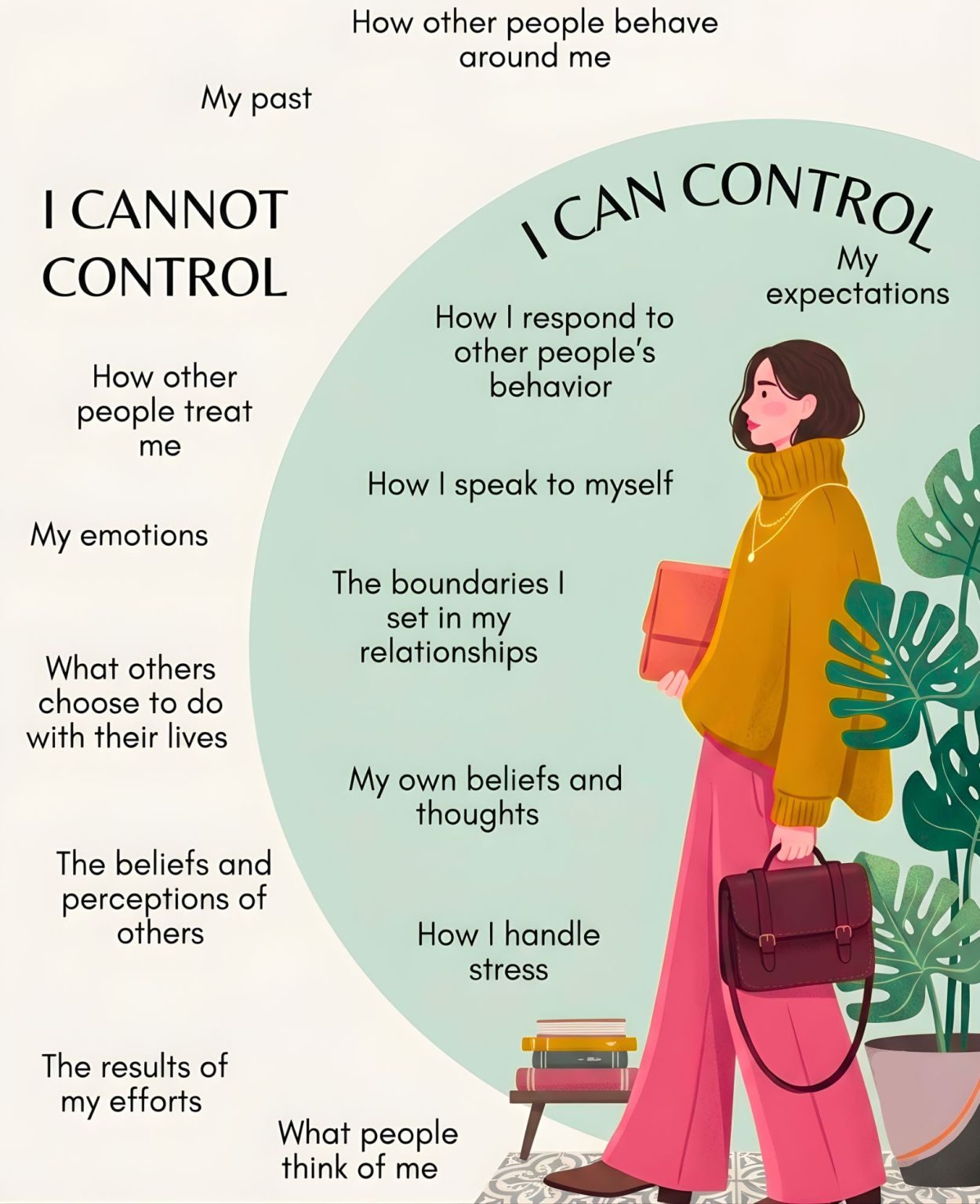
Most people think control is about willpower. The neuroscience says otherwise. Your nervous system processes millions of inputs every second - most of them are not yours to control. But seven specific circuits absolutely are: response control, self-talk, boundaries, beliefs, vagal tone, attention and emotional regulation. Stop training what was never yours. Start training what is.
Explore the research
Most People Misunderstand Control
Most people think control is about willpower. It is not.
Control is about knowing which circuits are yours to train, and which ones live in someone else's skull. That distinction is biological, not philosophical. Your nervous system processes millions of inputs every second - other people's behaviour, their perceptions of you, the outcomes of complex systems. None of those are driven by neural architecture you can access. Trying to "control" them is the wiring equivalent of pushing on a wall in another person's house.
The cost of that misallocation is enormous. Energy that could go to training the seven circuits you actually own goes to defending against ones you do not. Cortisol stays elevated. The prefrontal cortex stays starved of bandwidth. The default mode network spins on rumination loops about what other people think, what your past did to you, what the future might do.
Here is what neuroscience actually shows about the things you can control. Seven circuits, each one a specific, trainable mechanism. None of them require you to be a different person. All of them respond to repetition.
1. How You Respond to Others - The PFC's 6-Second Override
The mechanism. When something happens, your amygdala fires first. It will always fire first - within 100-150 milliseconds, before conscious awareness. This is non-negotiable. The amygdala is a threat detector and it is fast.
But there is a window. Within roughly six seconds, the prefrontal cortex (PFC) can override the amygdala's initial impulse and route the response through deliberate cognitive control instead of reactive defence. This is the neurological substrate of "responding instead of reacting".
Every time you choose a response over a reaction, you physically strengthen that override pathway through myelination - the insulation of the axons that connect the PFC to the amygdala. Faster myelinated signal = faster override next time. Repeated thousands of times across years, the override becomes near-instant. People call this "emotional maturity". It is actually trained myelination.
The practice. When the trigger lands, count to six before responding. That is not a calming trick. It is the actual amygdala-to-PFC handoff window. Two minutes a day, applied to the moments that catch you off guard.
2. How You Speak to Yourself - Biological Instructions in Real Time
The mechanism. Self-talk is not just "thinking". It is neurochemical instruction. The brain treats internal language with the same circuitry it uses to process external language - which means your inner voice produces the same neuroendocrine effects on your body that another person's voice would.
Negative self-talk activates the HPA axis (hypothalamic-pituitary-adrenal). Cortisol releases. Heart rate climbs. The amygdala stays primed for threat. Inflammatory markers (CRP, IL-6) rise on chronic exposure.
Constructive self-talk activates the PFC, dampens amygdala output, and triggers small dopamine releases through the reward system. Heart rate variability climbs. Vagal tone holds.
You are not just thinking. You are issuing biological instructions to your own nervous system in real time.
The practice. Notice one moment a day where the inner voice goes hostile, and ask: "Would I say this to a friend?" Then say to yourself what you would say to them. The first three weeks feel awkward. By week six, the new circuit is the default.
3. Boundaries - Why They Are Physiology, Not Preference
The mechanism. When you fail to set a boundary in a situation that calls for one, your brain registers the interaction as a threat it cannot resolve. The sympathetic nervous system stays activated. Cortisol stays elevated. The vagus nerve cannot pull the parasympathetic response back online because the threat - from the brain's point of view - is ongoing.
This is why people-pleasing is exhausting in a way that has nothing to do with effort. The body is in a low-grade fight-or-flight state on a permanent loop because the system never gets the all-clear signal.
Setting a boundary is not a social preference. It is a physiological requirement for nervous system regulation. The boundary itself is the parasympathetic re-entry signal - the moment the brain registers "this situation is now containable" and the cortisol can finally drop.
The practice. Identify one moment a day where you said yes when you wanted to say no, and either renegotiate it or hold the next one. Boundaries do not have to be aggressive. "I cannot take that on this week" works. "I need to think about that" works. Calibrated honesty is the substance.
4. Your Beliefs - Synaptic Connections You Can Reshape
The mechanism. A belief is not an abstract idea. It is a physical pattern of synaptic connections - a specific neural pathway that has been used so often it has become the default route for that category of thought. Strong beliefs have thick myelination, dense dendritic branching, and high baseline activation potential.
Cognitive reframing is not positive thinking. It is the deliberate construction of a new neural pathway that competes with an old one. Repeat the new pathway often enough and it wins through long-term potentiation (LTP) - the strengthening of synaptic connections through repeated firing. Meanwhile, the old pathway weakens through synaptic pruning if it is not used.
This is why beliefs feel "fixed" until they suddenly do not. The pathway has to be physically built before the new belief feels true. There is no shortcut. There is just repetition.
The practice. Pick one belief you hold that no longer serves you. Write the alternative belief down once a day for 21 days. Speak it aloud. Apply it in real moments. The neural pathway gets built whether you "believe it yet" or not. Belief follows construction, not the other way around.
5. Vagal Tone - The Trainable Recovery System
The mechanism. Your vagus nerve is the master regulator of the shift between sympathetic ("fight or flight") and parasympathetic ("rest and digest") states. Vagal tone is a measurable trait - usually proxied by heart rate variability (HRV) - that reflects how efficiently your nervous system can downshift after stress.
Low vagal tone = slow recovery, chronic sympathetic activation, anxious baseline.
High vagal tone = fast recovery, robust parasympathetic engagement, calmer baseline.
You are not "naturally anxious". Your vagal tone is undertrained. This is not motivational reframing. It is what the data show. Vagal tone responds to specific inputs:
Slow exhale breathwork (inhale 4, exhale 6-8) directly activates the vagus nerve. Cold exposure - even brief cold-water face dunks - triggers the dive reflex which engages parasympathetic dominance. Consistent moderate exercise raises baseline HRV over weeks. Singing, humming, gargling stimulate the vagus mechanically.
The practice. Two minutes of slow-exhale breathwork once a day. Cold-water face dunk in the morning if you want to accelerate. Track HRV (most fitness watches measure it now). The number moves within weeks.
6. Attention - The Most Powerful Tool Your Brain Has
The mechanism. "Neurons that fire together wire together." This is Hebbian learning - the foundational principle of neuroplasticity. What you repeatedly attend to gets wired more strongly. What you ignore atrophies.
This means attention is not a decision. It is a construction project. Every minute spent attending to anxiety builds the anxiety circuit. Every minute spent attending to gratitude builds the gratitude circuit. Every minute spent attending to your body's distress signals deepens the pain neuromatrix. Every minute spent attending to small wins, recovery progress, or evidence of safety builds the opposite circuit.
This is not "the law of attraction". It is synaptic weighting. The brain is brutally literal about what it strengthens.
The practice. Audit where your attention actually goes. The first social media scroll of the morning, the first conversation, the first 10 minutes of work. Each one is wiring. Choose two things you genuinely want stronger circuits for, and direct attention to them deliberately at two scheduled points in the day. Five minutes each. The compound effect over a year is enormous.
7. Emotional Regulation - A Top-Down Skill That Gets Faster
The mechanism. You cannot stop the limbic system from generating an emotion. That generation is automatic, fast, and below conscious awareness. Trying to "not feel" something is biologically impossible.
But you absolutely can train the PFC to observe the emotion, label it, and choose what to do with it. This is top-down regulation - executive function dampening limbic output, not by suppressing it but by integrating it into a larger response.
The neurological hallmark of trained regulation is faster amygdala-to-PFC communication and stronger PFC-to-amygdala inhibitory connections. Both of these strengthen with practice. fMRI studies of long-term meditators show measurably increased grey matter in regulatory regions and reduced amygdala reactivity to negative stimuli.
This is not suppression. Suppression makes things worse - the emotion stays subcortical and leaks out as physical symptoms, dysregulated behaviour, or chronic tension. Regulation is the opposite. It lets the emotion fully surface, names it, and channels the energy into a deliberate response.
The practice. When you notice an emotion forming, complete this sentence in your head: "I am feeling ____. The signal is telling me ____. The next right thing is ____." Three sentences. Five seconds. The naming alone (Lieberman et al., UCLA, 2007) drops amygdala activity by ~50%. The choosing builds the regulatory circuit.
The Practical Upshot: What to Train, What to Release
Seven trainable circuits. None of them require you to be a different person. All of them respond to repetition. None of them are about willpower.
What was never yours to control: how other people behave, what they think of you, the outcomes of complex systems, your past, your raw emotional generation, what others choose to do with their lives. Energy spent here is energy lost.
What is absolutely yours to train: how you respond, how you speak to yourself, the boundaries you hold, the beliefs you build, your vagal tone, where you direct your attention, how you regulate the emotions that arise.
The shift is not "stop caring about hard things". The shift is stop spending nervous system energy on circuits you cannot reach, so you have enough left to train the ones you can.
If you want this scaffolded - daily prompts on each of the seven circuits, the science behind each, and a way to track which ones are actually moving for you - that is exactly what the Recalibrate ecosystem is built for. Daily Habits, the Neuroscience Academy, the Therapeutic Toolkit and the AI companion all exist to make these practices stick.
Stop focussing on what was never yours to control. Start training what is. The mechanism is real. The practice is daily. The compound effect, over months, is a different nervous system.
Recalibrate is an education and self-tracking tool, not a diagnostic service or a replacement for medical care.
Related articles
- Daily Neural Workouts: 8 Science-Backed Techniques to Rewire Your Brain
Your brain is a prediction machine, not an archive. If you do not deliberately train new patterns, it reverts to its oldest, most dominant pathways. Here are 8 daily neural workouts - education, gratitude, curiosity, authenticity, meditation, resilience, connection and self-compassion - that fuel real, mechanism-level neuroplasticity.
- The Neuroscience of Who Gets Close to You: Your Brain's Social Map
Your brain runs a tiered architecture of relationships, and each ring activates a different neural system. From the inner-circle co-regulation engine to strangers on the internet - the science of why not everyone gets the same you, and why each ring is doing real biological work.
- How Self-Talk Physically Changes Your Brain: The Neuroscience of Your Internal Dialogue
Neuroscience confirms your thoughts change your neurons. Every thought triggers a neurochemical cascade. Repeat it enough and you do not just feel different. You become different. At a cellular level. Here is what is actually happening inside your brain when you talk to yourself.