The Neuroscience of Who Gets Close to You: Your Brain's Social Map
By Tristan Siokos · Founder, Recalibrate · May 8, 2026
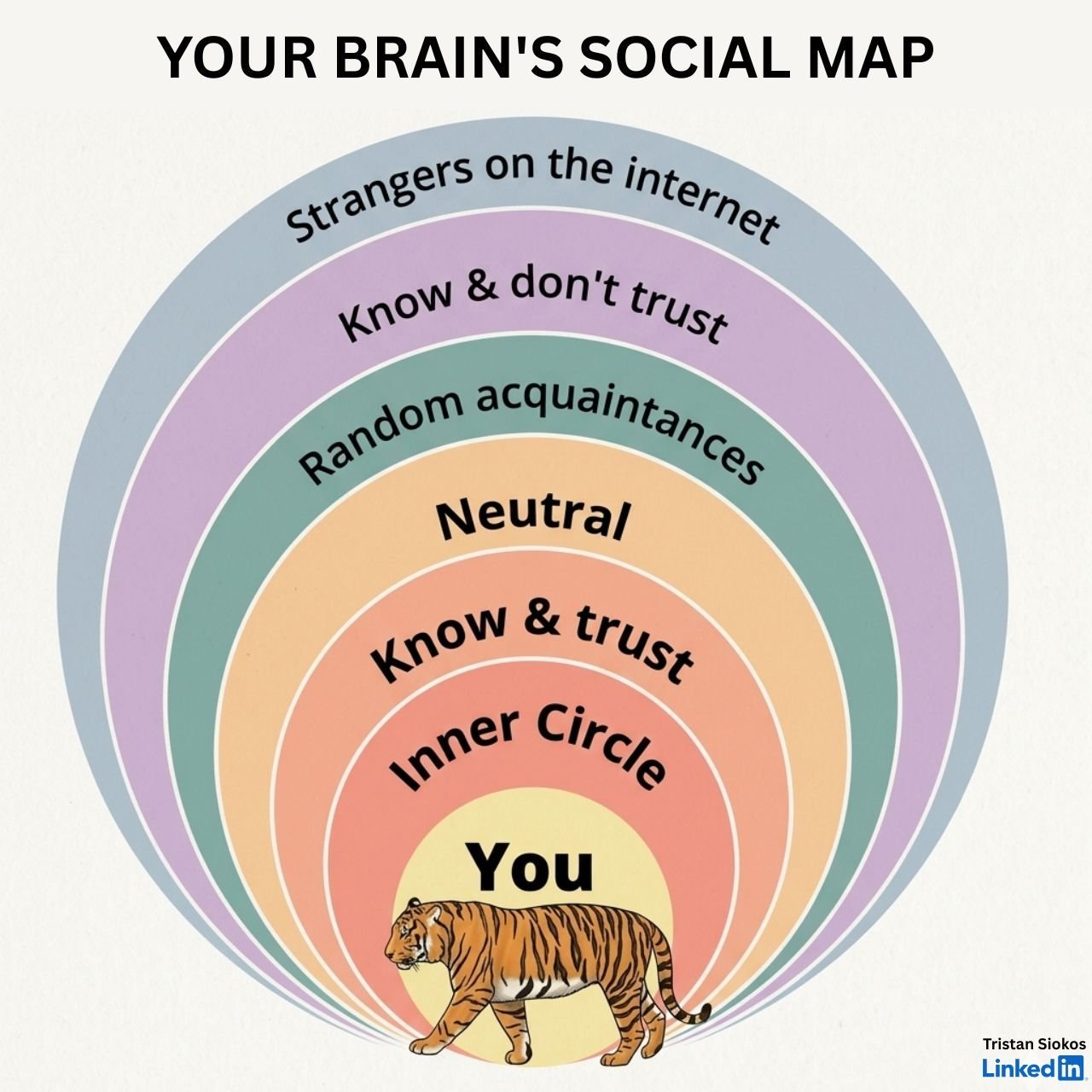
Your brain runs a tiered architecture of relationships, and each ring activates a different neural system. From the inner-circle co-regulation engine to strangers on the internet - the science of why not everyone gets the same you, and why each ring is doing real biological work.
You Do Not Give Every Person the Same Version of Yourself
You do not give every person the same version of yourself. You cannot. Your brain is physically incapable of it.
Your brain runs a tiered architecture of relationships, and each ring activates a different neural system. Every ring contributes something the others cannot. Some rings buffer your nervous system. Some keep you sharp. Some maintain your baseline. Some keep you safe. Strip out any of them and a specific kind of biological work goes undone.
This is not a hierarchy of moral worth. It is a map of metabolic load. The barista you smile at and the friend you call at 2am are doing different jobs in different parts of your nervous system. Both are real. Both are necessary. Neither replaces the other.
Here is what is actually happening at each ring, why your brain insists on this architecture, and what changes when you stop fighting it.
🐅 Inner Circle - The Co-Regulation Engine
The mechanism. Social Baseline Theory (Coan and Beckes, 2010) shows that the metabolic effort of self-regulation drops measurably in the presence of trusted others. Your brain treats a trusted person as a shared resource - it offloads part of the threat-monitoring, emotion-regulation and prediction work onto the relationship itself. The cost of being alive falls.
In one of Coan's foundational fMRI studies, participants under threat showed reduced activation across the hypothalamus, anterior insula, ventromedial PFC and right frontal pole when their hand was held by a trusted partner. The same threat. A different brain response. The brain effectively says: I do not have to do this alone, so I will not do this alone.
Trusted contact also triggers oxytocin release, which lowers cardiovascular reactivity, reduces cortisol response and dampens amygdala activity. Cortisol falls. The prefrontal cortex is freed for higher-order thought. That is why a 20-minute conversation with the right person can leave you sharper than 8 hours of solitude.
Why solitude beyond a point hurts. Extended isolation forces the brain to perform self-regulation work it was biologically built to share. The nervous system burns metabolic load it was meant to outsource. This is not weakness. It is hardware running outside its spec sheet.
The implication. Your inner circle is not a luxury, it is shared infrastructure for cognition. Investing in two or three deeply regulating relationships does more for your performance, recovery and baseline cortisol than any productivity stack you can build alone.
🧭 Known and Trusted - The Predictive Network
The mechanism. Familiar people activate cached models in the medial prefrontal cortex (mPFC). Your brain has built a working simulation of how each person thinks, what they care about, how they react under pressure, what their humour pattern looks like. When you talk with them, the brain is not starting from scratch - it is predicting from a high-fidelity model.
This is the neural basis of "this conversation is high-yield". The cached model means interactions are cheap: low ambiguity, low effort, high signal density. Ideas compound because each person is already in the other's predictive system. You skip the calibration phase that drains the bandwidth in newer relationships.
The mPFC is also the seat of mentalising - the brain's "theory of mind" engine. The longer you know someone in this ring, the more refined your mPFC model becomes. This is why a 20-minute walk with an old friend can outperform a 3-hour brainstorm with strangers.
The implication. Known-and-trusted relationships are how you never start from zero. Protect them. The brain spent years building those models and they regenerate slowly.
⚖️ Neutral - The Maintenance Layer
The mechanism. Most of your daily social interaction lives here: colleagues you barely know, the parents at your kid's school, the neighbour you nod to. Standard social heuristics - politeness scripts, cached greetings, conventional small talk - handle these efficiently.
This is not a failure of intimacy. It is bandwidth management. The brain runs neutral interactions on near-autopilot precisely so that the rings that need depth get the resources they deserve.
The implication. Trying to deeply engage every neutral contact is a fast path to social burnout. Letting neutral stay neutral is how the inner-circle and known-and-trusted rings stay topped up.
📡 Random Acquaintances - The Most Underrated Ring You Have
The mechanism. Sandstrom and Dunn (2014) showed that brief, friendly interactions with weak ties - the barista, the dog walker, the colleague you barely know - produce measurable boosts to wellbeing. People with more of these interactions report higher daily happiness on average, regardless of how many close relationships they have.
The neuroscience: micro-interactions trigger dopamine and serotonin release through the brain's reward circuitry, without the metabolic cost of deeper connection. They are biologically efficient social calories. They keep your social-recognition system calibrated, they reinforce a sense of belonging to a wider community, and they top up your baseline mood.
This is the ring most people accidentally starve themselves of. Modern life makes weak ties effortful - delivery apps, headphones, self-checkout. Removing the friction also removes the contact.
The implication. Two short, warm interactions a day with weak ties - eye contact with the cafe owner, a real "how are you" with a colleague, a smile at a stranger on the train - measurably moves your daily happiness baseline. The cost is seconds. The biological yield is real.
🛡️ Know and Do Not Trust - The Threat-Tracking Layer
The mechanism. This ring exists because forgetting these connections is biologically risky. Your amygdala and salience network keep quiet tabs on people who have hurt you, broken trust, or behaved unpredictably under pressure. The brain remembers because remembering is protective.
These are not necessarily enemies. They might be a difficult ex-colleague, a family member who is unsafe in specific contexts, an old friend who became a liability. The ring is not about hatred. It is about accurate threat modelling.
Why pretending this ring doesn't exist is dangerous. When you try to override the amygdala's correct read - "this person is not safe for me" - you create a kind of internal split. The body knows. The conscious mind argues with it. The result is dysregulation, fatigue and chronic background stress.
The implication. Honour what your nervous system has flagged. You do not have to confront. You do not have to forgive. You do need to maintain the boundary the ring is asking for. The brain is doing protective work; let it.
🌍 Strangers on the Internet - The Newest Ring in Human History
The mechanism. This ring is brand new in evolutionary terms. Your brain is processing thousands of these interactions per day - timeline scrolls, comment threads, replies, parasocial connections - far beyond what its hardware was built to handle.
Brief positive online contact can trigger genuine reward circuitry. A kind comment, a meaningful share, a thoughtful reply - these can produce real dopamine and oxytocin signals. This is why the internet is not, by default, a hostile place for the nervous system. The mechanism is real.
The cost shows up under sustained exposure. When the brain processes thousands of low-fidelity social signals every hour, with constant context-switching and partial information about each person, you accumulate a fatigue your nervous system cannot easily metabolise. The default mode network goes into overdrive. Sleep architecture breaks down. Cortisol baseline drifts upward.
This is why two hours of doom-scrolling can leave you more drained than a hard workout. The body is doing real social work the whole time, just at unsustainable volume.
The implication. This ring is real and the wellbeing it generates is real. But it is also the ring most likely to overheat your nervous system if left unbounded. Treat it like sugar: not the enemy, but easily consumed past the point of benefit.
The Diagram Is Hardware, Not Preference
Dunbar's research suggests humans can sustain about 150 meaningful relationships in total. Within that, only around 5 truly close ones. These numbers are averages - shaped by trauma, neurodivergence, life stage, parenting, grief, and a hundred other variables - but the shape of the architecture is the same in every brain we have studied.
This is hardware, not preference. The diagram is not a ranking. It is a system. Each ring does work the others cannot:
- Inner circle offloads metabolic regulation work.
- Known and trusted maintains your high-fidelity predictive models.
- Neutral preserves cognitive bandwidth.
- Weak ties boost daily mood through low-cost reward signals.
- Know and do not trust keeps your threat detection calibrated.
- Strangers on the internet add a new, fragile layer your hardware is still adapting to.
The barista you smile at builds a different layer of wellbeing than the person you call when something falls apart. Both are doing real biological work.
Not everyone gets the same you. That is not a failure of generosity. It is the rings doing what the rings are for. The inner circle gets the most of you because the inner circle is biologically capable of receiving it - and because pouring inner-circle energy into outer rings starves the rings that needed that fuel.
The system works when the right people get the right energy. That is not selfish. That is your nervous system doing exactly the job it was built to do 💜
If you want help mapping your own rings, training co-regulation skills with your inner circle, or recovering after a season of giving outer-ring energy to people who could not metabolise it, the Recalibrate ecosystem is built for that. Calming the Nervous System unpacks the polyvagal mechanics. The Academy walks through the social baseline mechanism in plain language. The app helps you track which interactions actually moved your baseline this week. The protocols help you train the circuits these rings depend on.
Use the rings the way they were built to be used. The right people get the right energy. Everyone, including you, gets more of what they actually need.
Recalibrate is an education and self-tracking tool, not a diagnostic service or a replacement for medical care.
Related articles
- Daily Neural Workouts: 8 Science-Backed Techniques to Rewire Your Brain
Your brain is a prediction machine, not an archive. If you do not deliberately train new patterns, it reverts to its oldest, most dominant pathways. Here are 8 daily neural workouts - education, gratitude, curiosity, authenticity, meditation, resilience, connection and self-compassion - that fuel real, mechanism-level neuroplasticity.
- The Neuroscience of Control: What You Can Actually Train (and What Was Never Yours)
Most people think control is about willpower. The neuroscience says otherwise. Your nervous system processes millions of inputs every second - most of them are not yours to control. But seven specific circuits absolutely are: response control, self-talk, boundaries, beliefs, vagal tone, attention and emotional regulation. Stop training what was never yours. Start training what is.
- How to Be More Mindful: The Neuroscience of Stillness as Strategy
Your brain processes 11 million bits of information per second. Your conscious mind handles about 50. Mindfulness is not a passive activity - it is the active regulation of the nervous system that prevents cognitive overload. Six specific shifts: listen but do not interrupt, notice but do not react, breathe but do not rush, think but do not worry, do but do not hurry, feel but do not be bothered. The neuroscience of why each one works.