How to Be More Mindful: The Neuroscience of Stillness as Strategy
By Tristan Siokos · Founder, Recalibrate · April 15, 2026
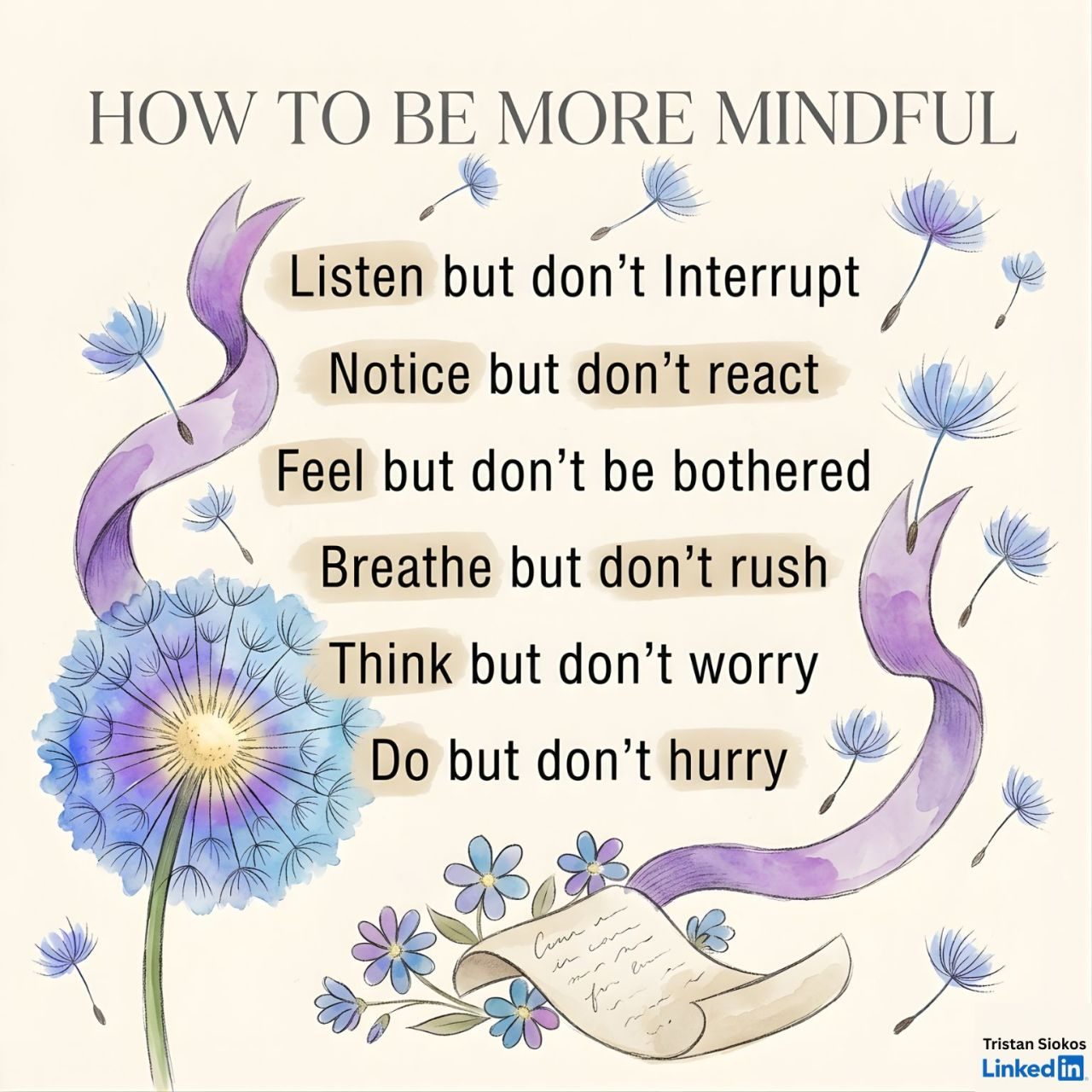
Your brain processes 11 million bits of information per second. Your conscious mind handles about 50. Mindfulness is not a passive activity - it is the active regulation of the nervous system that prevents cognitive overload. Six specific shifts: listen but do not interrupt, notice but do not react, breathe but do not rush, think but do not worry, do but do not hurry, feel but do not be bothered. The neuroscience of why each one works.
Mindfulness Is Not a Soft Skill - It Is Cognitive Load Management
Most people treat mindfulness as a passive activity. Something gentle. Something for the spa, the yoga app, the Sunday morning playlist.
This framing badly misses the mechanism. Mindfulness is the active regulation of the nervous system to prevent cognitive overload. It is a high-performance tool, not a soft one. The free part is the only thing about it that is "easy".
Here is the math behind why your biology needs it.
Your brain processes roughly 11 million bits of information per second through your senses. Your conscious mind, by contrast, can only handle about 50 bits per second. Every other bit either gets filtered out or runs in the background.
Most of that filtering is done by the prefrontal cortex (PFC) and the thalamus, gating sensory input and prioritising what reaches awareness. When you live without intention - reactive, distracted, multi-tasking, scrolling, anticipating, ruminating - you force the PFC to filter "noise" at a massive metabolic cost. The PFC is the most energy-expensive region of the brain. Run it on overload all day and you will be exhausted, dysregulated, and operating at a fraction of your capacity, even before any "real" work gets done.
Mindfulness is the deliberate practice of relieving that filter pressure. It is not absence of thought. It is selective attention. And the six shifts below each address a specific neural circuit that benefits from it.
1. Listen but do not Interrupt - Pausing the Anticipatory Response
The mechanism. When someone speaks to you and you start preparing your reply, you have just activated motor planning regions in the supplementary motor area and Broca's area. Those regions compete with the auditory cortex for processing bandwidth. The result is a kind of partial deafness - you hear the words but you do not fully integrate them, because half your brain is already drafting a response.
True listening pauses the anticipatory response. Stillness in the body and the mind allows full data integration before output. The conversation that follows is dramatically richer because you actually heard the input.
The practice. When someone is speaking, deliberately do not start thinking your reply until they have finished. The first attempt feels almost rude - the mind wants to race ahead. Within a few weeks the pause becomes default and the quality of every conversation in your life changes.
2. Notice but do not React - Strengthening Top-Down Inhibition
The mechanism. This is the gap between stimulus and response - the moment Viktor Frankl wrote about that has a clean neurological substrate.
When something happens, the amygdala generates an emotional signal within ~150ms. That signal can either escalate into a full sympathetic response (fight or flight) or get inhibited by the prefrontal cortex before it triggers the body's defensive cascade.
Every time you notice something difficult and consciously choose not to react, you are running a rep on the PFC-to-amygdala inhibitory pathway. Repeated thousands of times, this pathway physically thickens through myelination and dendritic branching. The body stays in rest and digest more reliably. Sliding into fight or flight gets harder, even under stress.
This is what people call "equanimity". It is not personality. It is myelinated inhibitory circuitry.
The practice. When something hits a nerve, name what you are noticing in a single sentence ("I am noticing irritation") before doing anything else. The naming alone drops amygdala activity ~50% (Lieberman et al., UCLA, 2007). The pause builds the circuit.
3. Breathe but do not Rush - The Vagus Nerve Kill Switch
The mechanism. Rushed, shallow, chest-driven breathing signals "threat" to the sympathetic nervous system. Heart rate climbs. Cortisol releases. The body braces. This happens whether or not there is a real threat - the brain reads the breath pattern and responds accordingly.
Slow, deliberate, diaphragmatic breathing - especially long exhales - directly stimulates the vagus nerve, which acts as a biological "kill switch" for the stress response. Within seconds, parasympathetic activation rises, cortisol drops, and heart rate variability climbs.
You do not have to "feel calm" first. The mechanism runs in the other direction: the breath drives the state. You breathe yourself calm.
The practice. Three rounds of slow box breath (inhale 4 seconds, hold 4, exhale 6, hold 2), once an hour during the day. About 60 seconds of work. The effect on baseline cortisol over a month is measurable.
4. Think but do not Worry - Distinguishing Problem-Solving from Rumination
The mechanism. Thinking is problem-solving. It has a goal, a structure, and a stop condition. It uses the prefrontal cortex and produces output.
Worrying is a recursive loop. It activates the Default Mode Network (DMN) - a constellation of regions (medial PFC, posterior cingulate, angular gyrus) that generates self-referential, future-projecting, no-resolution thought spirals. The DMN is highly active in chronic anxiety, depression and chronic pain, and it provides no resolution to the problem it is "thinking" about.
Mindfulness allows you to observe a thought as a data point without letting the DMN drag you into the loop. The thought arrives, you notice it, you acknowledge it as data, and you either act on it (problem-solving) or release it (recognising it as worry-not-thinking).
The practice. When you catch yourself looping, ask: "Is there an action I can take in the next 24 hours?" If yes, plan that action and let the rest go. If no, the loop is worry, not thinking, and the only useful move is to redirect attention. Both responses break the DMN loop.
5. Do but do not Hurry - Trading High-Beta for Flow
The mechanism. "Hurry" is not the same as "moving fast". Hurry is a psychological state of perceived scarcity - the felt sense that there is not enough time, not enough margin, not enough room for error. It pushes the brain into a high-beta brainwave state (above ~20 Hz), which decreases fine motor control, narrows perception, and reduces creative output.
The paradox: moving with intention is faster than moving in hurry, because intention keeps the brain in flow-adjacent states (mid-beta to alpha), where performance is highest and energy expenditure is lowest. Hurried work makes more mistakes. Mistakes cost more time than the speed gained.
The practice. Pick one task a day where you would normally rush, and execute it deliberately - one step at a time, full attention, no anticipation of the next step. Notice the output quality. Notice the energy state at the end. The data set you build for yourself is more persuasive than any external argument.
6. Feel but do not be Bothered - The Difference Between Sensation and Suffering
The mechanism. This shift is the deepest one and it is the foundation of pain reprocessing therapy, modern mindfulness-based stress reduction (MBSR), and the entire approach behind chronic-pain self-management.
A sensation - in the body, in the emotions - is a piece of data. The insula detects it. The somatosensory cortex locates it. That is the primary signal.
The suffering is what happens next: the secondary appraisal, where the brain decides "this is bad, this should not be happening, I cannot tolerate this, what if it gets worse?". That layer happens in the PFC, the anterior cingulate cortex, and the limbic system - and it amplifies the original signal dramatically.
Feeling but not being bothered is the practice of letting the primary sensation arrive without engaging the secondary suffering layer. This does not mean denying the sensation. It means observing it with curiosity instead of catastrophe. The original signal is allowed. The amplification is interrupted.
For chronic pain especially, this shift - over months of practice - measurably reduces pain output. The mechanism is the pain neuromatrix being given new prediction data.
The practice. When a difficult sensation arrives - physical or emotional - try saying internally, "Hello sensation. I see you. I am not going to fight you and I am not going to spiral about you." Hold curiosity for ten seconds before moving on. The sensation often resolves faster on its own when the secondary loop is not feeding it.
Stillness Is Not the Absence of Activity. It Is the Optimisation of Your Internal Architecture.
Six shifts. Each one is a specific intervention into a specific circuit. None of them require silence, robes, or a meditation cushion. All of them can be done while making coffee, in a meeting, in traffic, mid-conversation.
The free part of mindfulness is genuinely free. The practice part is the work. Stillness is not the absence of activity. It is the optimisation of your internal architecture and how you experience your world.
If you want this scaffolded - daily mindfulness prompts that map to each of these six shifts, the underlying neuroscience explained in lessons, and a way to track which ones are actually moving your stress baseline - that is exactly what the Recalibrate ecosystem is built for. Daily Habits, the Neuroscience Academy, the Therapeutic Toolkit and the AI companion all exist to make these practices stick across the months it takes for the wiring to settle.
The brain that practices mindfulness is not the brain that "feels calm". It is the brain that operates with less friction, recovers faster from stressors, and lives a fuller version of any single moment it is in.
That is the real reason your biology needs these shifts. Not for some imagined ideal of inner peace. For sharper thinking, calmer baseline, deeper relationships and the kind of high performance that does not burn you down to get there.
Recalibrate is an education and self-tracking tool, not a diagnostic service or a replacement for medical care.
Related articles
- Daily Neural Workouts: 8 Science-Backed Techniques to Rewire Your Brain
Your brain is a prediction machine, not an archive. If you do not deliberately train new patterns, it reverts to its oldest, most dominant pathways. Here are 8 daily neural workouts - education, gratitude, curiosity, authenticity, meditation, resilience, connection and self-compassion - that fuel real, mechanism-level neuroplasticity.
- Perspective Is Everything: The Neuroscience of How Your Brain Predicts Reality
The same event can produce panic in one person and calm in another. The difference is not the situation. It is the prediction your brain makes before the body reacts. This is predictive processing, one of the most established findings in modern neuroscience, and the reason perspective is biological, not just cognitive.
- The Autonomic Nervous System: Sympathetic, Parasympathetic and the Brain in Your Gut
Your heart beats, your gut digests and your blood pressure self-tunes without a single conscious command. That is the autonomic nervous system - sympathetic, parasympathetic and enteric. It is not a switch but a constantly negotiated balance, and when that balance gets stuck you get anxiety, chronic pain, fatigue, digestive problems and dysautonomia. Here is how it actually works and how to work with it.