Everyone Talks About Neuroplasticity Like It Is One Thing. There Are Actually Several Types.
By Tristan Siokos · Founder, Recalibrate · June 29, 2026
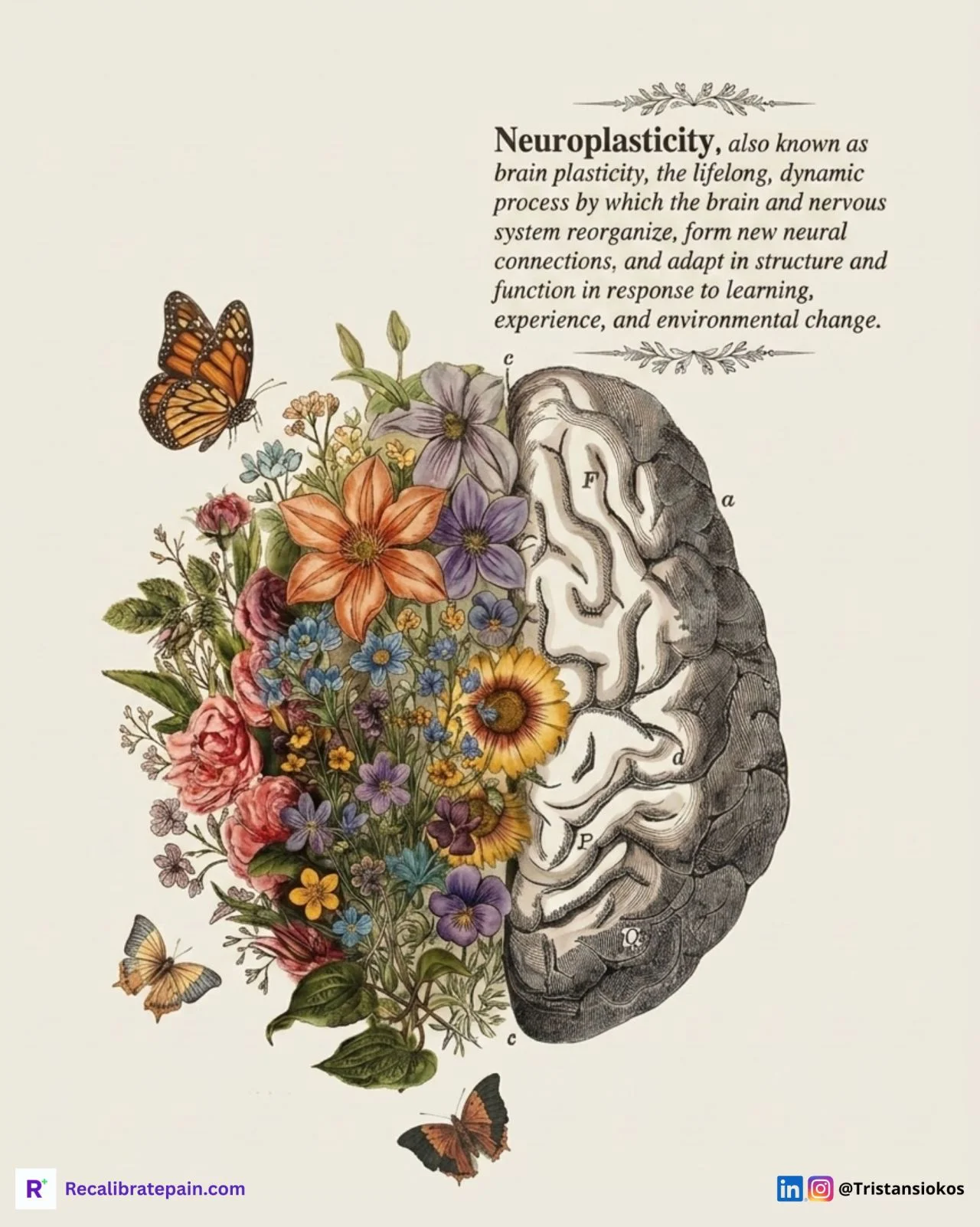
Neuroplasticity is the most used and least understood word in brain science. There are actually several distinct types - structural, functional, synaptic, homeostatic, and contested neurogenesis. And cutting across all of them: the adaptive vs maladaptive axis that changes everything for chronic illness.
Explore the research
Neuroplasticity Is Not One Thing
Neuroplasticity is the most used and least understood word in brain science.
In popular use it functions as a single idea: the brain can change. Which is true. But the precision stops there. The practical question - how, where, under what conditions, and in which direction - requires a more granular vocabulary.
There are actually several distinct types of neuroplasticity. They operate through different mechanisms, at different scales, over different timeframes. And cutting across all of them is an axis almost nobody talks about: whether the change is adaptive or maladaptive.
That last distinction is the one that matters most for anyone living with chronic pain, addiction, or a nervous system that has reorganised itself around protection rather than function.
Structural and Functional: The First Division
At the top level, plasticity divides in two.
🏗️ Structural plasticity is physical. The brain literally changes its architecture - new synaptic connections form, existing ones strengthen or prune, dendritic branches extend or retract, axons grow toward new targets. This is the substrate beneath everything else. Change at this level is slower and more durable.
🗺️ Functional plasticity is about reassignment. The same physical circuits take on different jobs. Your cortex holds an ordered map of your body - a somatotopic map in which different regions correspond to different body parts and functions. This map is not fixed real estate.
Train a skill intensively and its cortical territory expands, pressing into neighbouring regions that contract. Lose a limb and the region that represented it is rapidly recruited by adjacent areas. Lose a region to stroke and surviving areas can, over time and with rehabilitation, take over some of its functions - which is how people recover speech or movement after a stroke.
The cells in those areas did not change. Their assignment did.
Synaptic Plasticity: The Cellular Basis of Memory
At the level of individual connections, two opposing forces do the work.
⚡ Long-term potentiation (LTP) strengthens a synapse that fires in a correlated, useful pattern. Repeated co-activation of pre- and post-synaptic neurons triggers NMDA receptor opening, calcium influx, and the insertion of additional AMPA receptors into the synapse. The connection becomes faster, more sensitive, and more easily triggered. This is the cellular mechanism of learning and memory formation.
🔻 Long-term depression (LTD) does the opposite. Synapses that fire without correlation or reinforcement are weakened - AMPA receptors are removed, the connection becomes less sensitive, and the signal strength diminishes. This is not failure. It is editing.
These two processes are the cellular basis of memory - and neither works alone. LTP without LTD would saturate the brain into noise. Every connection would strengthen continuously until nothing was distinguishable from anything else. The precision of memory requires both: strengthening the signal you want and dampening the one you do not.
Homeostatic Plasticity: The Thermostat Nobody Talks About
If synaptic plasticity only ever strengthened or weakened individual connections, the network would be unstable - either running away with excitation or collapsing into silence.
⚖️ Homeostatic plasticity is the counterweight. It operates at the level of the whole cell, not individual synapses, scaling a neuron's overall sensitivity up or down to maintain a stable firing range.
When a neuron's activity has been chronically too low, homeostatic mechanisms scale up its sensitivity: more AMPA receptors inserted globally, lower firing threshold, enhanced response. When activity has been chronically too high, the opposite occurs.
This is not learning. It is network maintenance - a thermostat running underneath all the learning-related change, ensuring the system remains capable of signalling meaningfully rather than drowning in its own activity.
In chronic illness, homeostatic setpoints can settle in an abnormal position. A nervous system in sustained threat state may recalibrate its baseline upward, maintaining heightened sensitivity as a new normal. This is real physiology, not catastrophising - and it is one of the mechanisms underlying central sensitisation.
Neurogenesis: The Contested Frontier
For most of the twentieth century, the rule was absolute: you are born with every neuron you will ever have. Brain cells do not divide. Losses are permanent.
🌱 Then evidence emerged in the late 1990s that the hippocampus - the brain's memory and navigation hub - might generate new neurons in adulthood. A 2025 study found cells with the molecular signature of newly born neurons in adult human hippocampi - but with striking variability. Some adults showed robust evidence; others showed almost none.
The debate continues. What the 2025 data suggests is not that neurogenesis does not happen, but that it is far more variable between individuals than previously assumed, and that factors including exercise, stress, sleep, and environmental enrichment meaningfully modulate the rate.
Whether or not you are producing new neurons, you are certainly maintaining and modifying existing ones. Neurogenesis, if it occurs, is a small part of the plasticity story - not the main act.
Adaptive vs Maladaptive: The Axis That Changes Everything
Cutting across every type of plasticity is the distinction that most popular accounts omit entirely.
Neuroplasticity is not inherently beneficial. It is use-dependent change. Whatever you repeat, the nervous system strengthens. Whatever goes unused, it prunes.
🔄 Adaptive plasticity is what most people mean when they use the word. A musician's motor cortex expands to represent the fine movements of their trained hand. A recovered stroke patient develops new speech pathways. A meditator's insular cortex thickens with practice. The change serves function.
⚠️ Maladaptive plasticity uses the same machinery in the opposite direction. A phantom limb persists because the cortical map that represented that limb has been invaded by adjacent areas rather than properly reorganised. Addiction wires in a craving circuit through repeated dopamine pathway activation. Chronic pain syndromes potentiate pain-processing synapses through the same LTP mechanism that builds skills.
💜 For chronic pain, fibromyalgia, and central sensitisation: this is the frame that changes everything. These are not failures of willpower or imagination. They are, in part, plasticity running maladaptive - pain synapses potentiating when they should quiet, a homeostatic setpoint settled too high, a cortical map reorganised around protection.
But the nuance runs both ways. The same property that allowed these conditions to establish is why they are not permanent by default. Use-dependent change is, by definition, changeable. The work is redirecting what gets repeated.
Knowing Which Type You Mean
The practical difference between understanding your nervous system and staying stuck in confusion often comes down to precision.
When someone says their brain can change, they may mean their cortical map is reassigning itself. Or that an LTP-driven pain synapse could be weakened through therapeutic input. Or that their homeostatic setpoint is sitting in a dysregulated position and needs time and consistency to shift.
These are different things requiring different approaches and different timelines.
Structural change is slowest - weeks to months of consistent input.
Functional reassignment can happen faster with intensive, targeted practice.
Synaptic LTP/LTD operates on timescales of minutes to hours for initial changes, but stabilisation requires sleep and repetition.
Homeostatic adjustment is among the slowest - days to weeks for a setpoint to shift.
Understanding the type tells you what to expect, what to try, and why the timeline feels long even when you are doing the work.
💜 The brain that developed your current patterns is the same brain that can develop different ones. Not because neuroplasticity is optimistic. Because it is mechanistic. And mechanisms can run in more than one direction.
Recalibrate is an education and self-tracking tool, not a diagnostic service or a replacement for medical care.
Related articles
- Central Sensitisation Explained: Why Pain Persists After Your Injury Heals
Central sensitisation is when your nervous system keeps running a protection program for a threat that no longer exists. This article explains the 4 neural mechanisms that keep pain alive and how to reverse them.
- The Most Significant Growth Is Invisible: Dendritic Spines and How Your Brain Rewires Itself
Look at the roots in this image. Your brain contains the same thing, at a scale you have never been shown. Dendritic spines are the connection points along your neurons - and they form, swell, shrink and vanish continuously. Learning is the physical act of these shapes changing.
- The 4 Types of Neurons Running Your Entire Nervous System
Most people think of a neuron as one shape. There are actually four. Each one is built differently because each one does a different job, and the architecture of each cell tells you exactly what kind of work it was made for. Here is what they are and what they actually do for you.