Cortisol Is Called the Stress Hormone. It Is Really a Fuel Hormone - and It Makes Fuel by Taking Your Muscle Apart.
By Tristan Siokos · Founder, Recalibrate · August 20, 2026
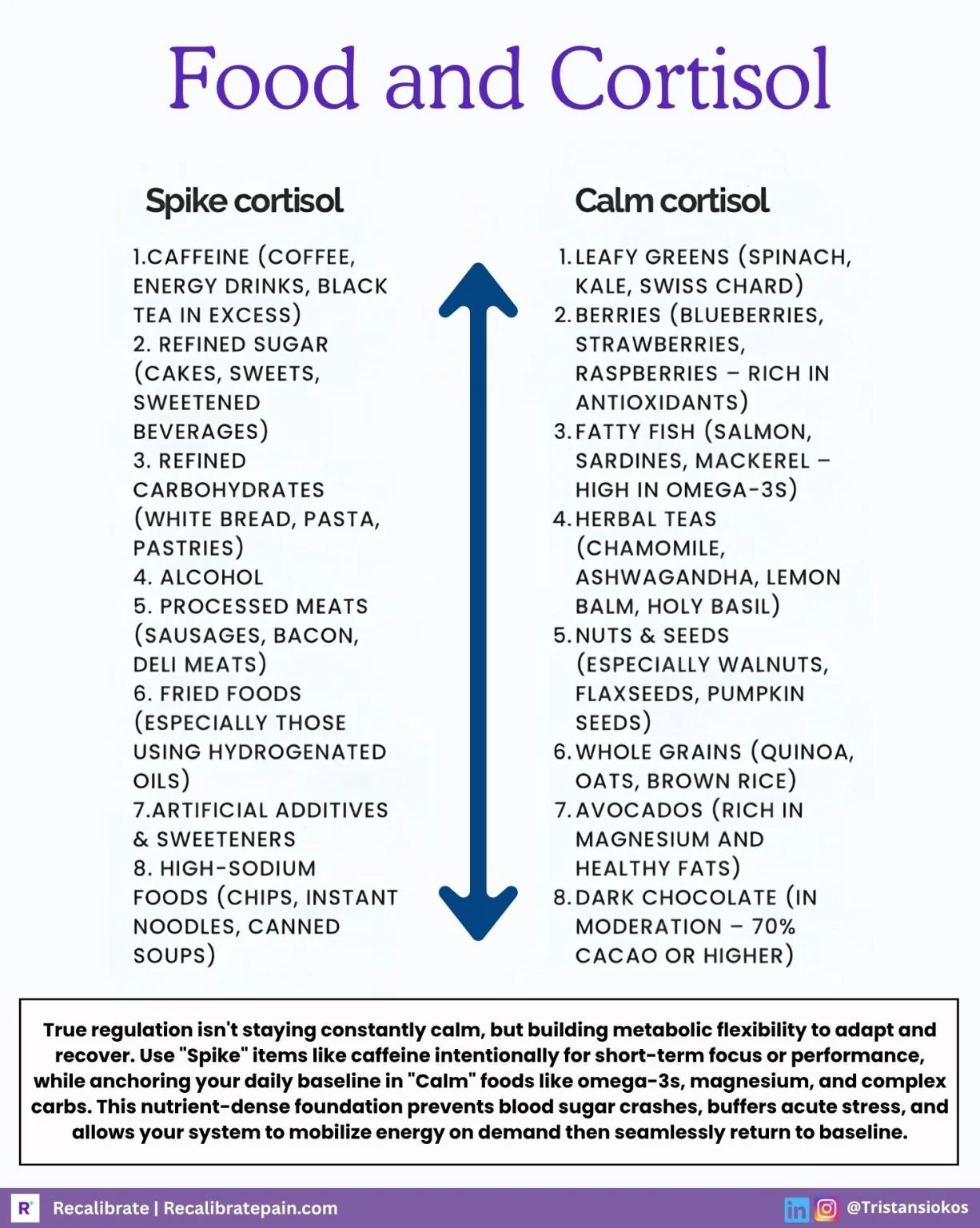
Cortisol does not give you energy. It dismantles part of your body to make some - pulling amino acids from muscle and fat from fat stores so your liver can build new glucose. That single fact explains the 3pm slump, the 3am wake-up after drinking, why under-eating raises it, and why the goal is the shape of the curve, not a lower number.
Explore the research
Cortisol Does Not Give You Energy. It Makes Energy Out of You.
Cortisol is called the stress hormone. It is really a fuel hormone - and it makes fuel by taking apart your muscle.
Start with what happens every single morning. You wake after eight hours without food, your liver's stored sugar is nearly empty, and cortisol climbs around 50% in the first 30 minutes. That is not a malfunction, and it is not anxiety. That is the hormone doing its actual job.
Here is the mechanism, and everything else in this article follows from it:
When blood sugar drops, cortisol:
1. Pulls amino acids out of your muscle and fat out of your fat stores
2. Sends them to your liver, which builds brand-new glucose from them (gluconeogenesis)
3. Blocks your muscles from taking sugar out of your blood, so what is left stays available for your brain - which cannot run on much else
So cortisol is not an alarm bell that happens to feel bad. It is a catabolic fuel-delivery system: it dismantles part of your body to keep your brain supplied.
Which is the key to the entire food question. Almost everything food does to cortisol, it does through blood sugar.
Sugar and Refined Carbs: The Trigger Is the Crash, Not the Spike
Refined sugar and white carbohydrates do not raise cortisol on the way up.
What happens is this: blood sugar climbs, insulin clears it, and in many people it overshoots - dropping below where it started. That fall is the trigger, because raising blood sugar is precisely what cortisol exists to do.
So the 3pm slump is that mechanism, not a mood. The irritability, the sudden fatigue, the craving, the short fuse - that is a hormonal response to a fuel dip you created three hours earlier at lunch.
This reframes the whole "sugar causes stress" idea. Sugar is not stressful. The crash after it is a fuel emergency, and cortisol is what gets called to solve it.
Two practical consequences:
- The problem is not the presence of carbohydrates, it is carbohydrates arriving alone
- What you eat with them decides whether you get a curve or a cliff
Alcohol, Caffeine and the Item Missing From Every Chart
🍷 Alcohol works overnight. As it clears in the second half of the night, it fragments your sleep and cortisol climbs into the gap. Which is why a night of drinking so often ends at 3am, wide awake, heart going. The drink was sedating. The withdrawal from it, six hours later, is not.
☕ Caffeine is the exception to the blood sugar rule. It raises cortisol directly rather than through glucose. Two details matter: daily drinking does not fully blunt it, and the rise is larger on days you are already stressed - exactly the days you reach for more of it.
That does not make caffeine the enemy. It makes it a tool with a cost, best used deliberately for focus or performance rather than as a substitute for fuel and sleep.
🍽️ And the item missing from every chart like this: under-eating.
A shortage of fuel is the exact problem cortisol exists to solve. So skipping meals, long gaps and chronic under-eating call it in rather than calm it down. Plenty of people trying to "lower their cortisol" are doing the one thing guaranteed to raise it.
If you are in a flare, fatigued, or in pain, this is not a small point. Under-fuelling is a cortisol intervention in the wrong direction.
Why the "Calm" Column Works
Which also explains the right-hand column of every food-and-cortisol chart.
Protein, fat, fibre and slow carbohydrates do not have magic anti-stress properties. Leafy greens are not sedatives. Avocado is not an anxiolytic.
They stop the crash - so cortisol is never called. That is the whole mechanism. Slower gastric emptying, flatter glucose curve, no overshoot, no fuel emergency, no hormonal rescue.
Which means the useful rule is not a list of foods to fear. It is structural:
- Do not eat carbohydrates naked. Pair them with protein, fat or fibre
- Do not leave long gaps and then solve them with something fast
- Anchor the day's baseline in the slow stuff, and use the fast stuff on purpose
Of everything on the typical "calm" list, only ashwagandha has trials showing it lowers the hormone itself rather than preventing the trigger. Everything else works by keeping your fuel supply boring - which is a compliment, not a criticism.
Low Is Not the Goal
One more thing worth saying, because most cortisol advice ignores it completely.
Low is not the goal.
A 2026 meta-analysis pooled 46 studies - 1,388 people with ME/CFS and 1,349 healthy controls. Their cortisol was lower at waking, lower through the day, and lower in hair samples (which reflects long-term output). Given a challenge that should force a release, they released less.
Too little is not calm. It is exhausted. That is a system that has been running on emergency fuel delivery for years and has lost its capacity to mount the response at all - and it tracks with the fatigue, the poor stress tolerance, the crashes and the terrible mornings.
So the target is the shape, not the number:
- A clean rise in the morning - enough to get you out of bed and fuelled
- A proper fall at night - low enough to let you sleep
- No crashes in between - which is mostly a food-structure and sleep problem, not a willpower problem
💜 That shape is trackable. Sleep timing, meal spacing, caffeine placement, morning light and pacing all move it - and the difference between "my cortisol is high" and "my curve is flat and I crash at 3pm" is the difference between a slogan and something you can actually change.
Recalibrate is an education and self-tracking tool, not a diagnostic service or a replacement for medical care.
Related articles
- Nature Has Been Making Painkillers for Millions of Years. Here Is the Actual Chemistry Inside Them.
Eugenol in cloves is a real local anaesthetic. Salicin in willow bark is what aspirin was built from. Every item on this list contains a compound we can name, measure and study - which is exactly why they can help you and why they can interact with your medication. Here is what each one is actually good for.
- What You Eat Directly Changes Your Nervous System's Chemistry
Food is not just fuel. Every meal is a set of molecular signals your nervous system uses to build neurotransmitters, regulate inflammation, maintain myelin, and manage stress. Here is the science behind 12 foods that directly support the system.
- Sleep and Chronic Pain: Why Pain Gets Worse at Night and How to Fix It
Your pain gets worse at night because of HPA Axis dysregulation and cortisol, not poor sleep hygiene. This article explains the neuroscience of the sleep-pain cycle and gives you a 5-step protocol to break it.