Nature Has Been Making Painkillers for Millions of Years. Here Is the Actual Chemistry Inside Them.
By Tristan Siokos · Founder, Recalibrate · August 08, 2026
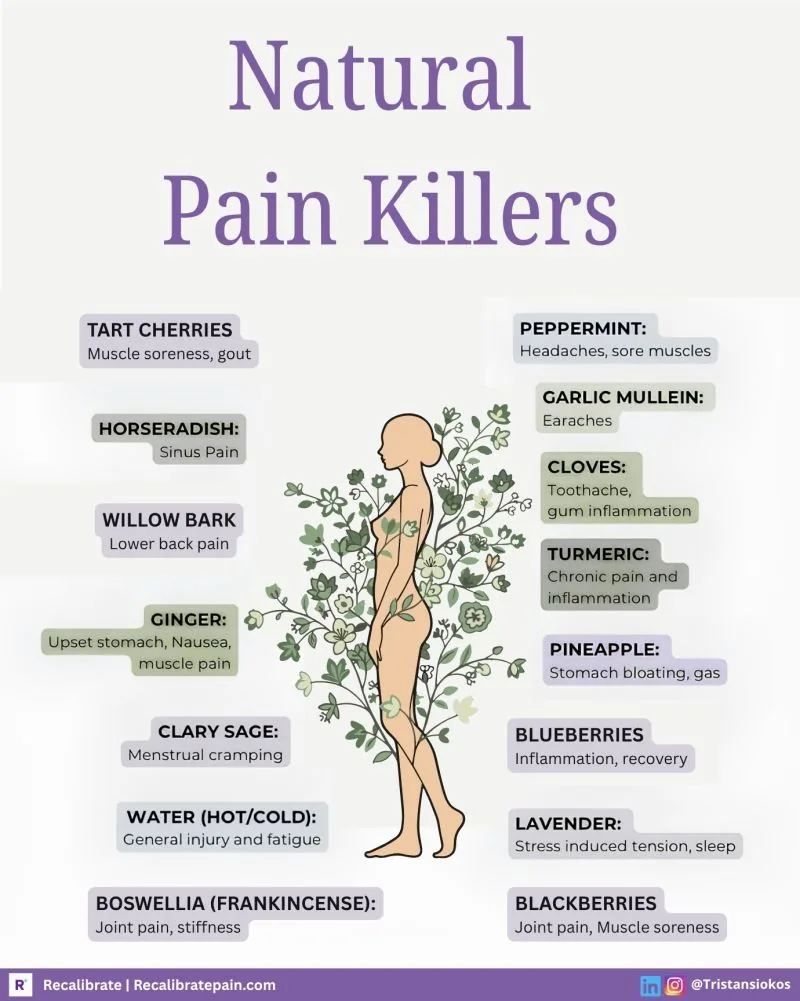
Eugenol in cloves is a real local anaesthetic. Salicin in willow bark is what aspirin was built from. Every item on this list contains a compound we can name, measure and study - which is exactly why they can help you and why they can interact with your medication. Here is what each one is actually good for.
Explore the research
There Is No Separate Category Called Natural Medicine
Nature has been making painkillers for millions of years. Most people have no idea what is actually in them.
Every item on the list below contains a compound we can name, isolate and measure. Eugenol. Salicin. Curcumin. Bromelain. Boswellic acids. These are not vague plant energies - they are molecules with known receptor targets, known absorption profiles and, in many cases, randomised controlled trials behind them.
There is no separate category called natural medicine. There is only chemistry we understand well and chemistry we are still working out.
That framing cuts both ways, and this is the part that usually gets left out: if something is pharmacologically active enough to help you, it is pharmacologically active enough to interact with your medication. Willow bark is aspirin's ancestor. Turmeric and ginger affect platelet function. These are real effects, which is exactly the point.
🌿 Here is what is inside each one, and what the evidence genuinely supports.
The Strong Evidence: Ginger, Boswellia, Curcumin, Peppermint
🫚 Ginger - gingerols and shogaols
The most consistent evidence on the whole list. It holds up across three quite different situations: pregnancy sickness, post-operative nausea and motion sickness. It acts partly on serotonin receptors in the gut and partly centrally. Also has reasonable evidence for muscle soreness and for period pain.
🌳 Boswellia (frankincense resin) - boswellic acids
Seven randomised trials in knee osteoarthritis, with real improvements in pain and stiffness. Note the timeline: benefits typically appear around four weeks, not four days. Most people who dismiss it stopped too early. It inhibits 5-lipoxygenase, a different inflammatory pathway from the one NSAIDs target.
🟡 Turmeric - curcumin
Solid evidence in knee arthritis, several trials putting it in the same range as NSAIDs for symptom relief. But curcumin's absorption is genuinely poor, so how you take it matters more than the dose: piperine from black pepper increases bioavailability substantially, and fat helps. Plain turmeric powder in food is a seasoning, not a therapeutic dose.
🌱 Peppermint - menthol and peppermint oil
Menthol applied to the temples has good support in tension headache - it acts on TRPM8 cold receptors and modulates local nociceptive input. Separately, enteric-coated peppermint oil is well established for IBS, where it works as a smooth muscle antispasmodic.
The Classics: Cloves, Willow Bark, Pineapple, Cherries
🦷 Cloves - eugenol
Eugenol is a genuine local anaesthetic - it blocks sodium channels, the same class of mechanism as lidocaine, just weaker and shorter-acting. This is why dentists have used it on toothache for over a century, and why clove oil on a painful tooth actually numbs rather than merely distracting.
🌿 Willow bark - salicin
The compound aspirin was built from. Salicin is metabolised to salicylic acid in the body. Moderate-quality Cochrane evidence for lower back pain. Important: if you cannot take aspirin or NSAIDs - allergy, ulcers, blood thinners, kidney issues - willow bark is not a loophole. It is the same pathway.
🍍 Pineapple - bromelain
A proteolytic enzyme with its best evidence for swelling and inflammation after injury and after surgery - it appears to help resolve oedema and bruising faster. Also used for bloating. Interacts with anticoagulants.
🍒 Tart cherries - anthocyanins
Strong evidence for exercise-induced muscle soreness and for gout - the gout data is genuinely interesting, with measurable reductions in urate and in attack frequency.
🫐 Blueberries and blackberries - anthocyanins
Anthocyanin-rich fruit for soreness and recovery. Blueberries are the one on this list that helps me most personally - I live with fibromyalgia and central sensitisation after a severe shoulder injury. That is an observation about me, not evidence about you, and I would rather be clear about which is which.
The Underrated: Lavender, Clary Sage, Horseradish, Garlic Mullein, Heat and Cold
💜 Lavender - linalool and linalyl acetate
Support for anxiety and sleep, including oral preparations in anxiety trials. This matters far more than it sounds: broken sleep amplifies pain the following day through measurably lowered pain thresholds. Anything that reliably improves sleep is a pain intervention, even when it is not analgesic.
🌸 Clary sage - used in aromatherapy massage for period pain, where the massage and the oil appear to work together rather than the oil alone. Worth naming that honestly - the delivery is part of the effect.
🌶️ Horseradish - glucosinolates and allyl isothiocyanate
The compounds that make it burn your sinuses are the same ones that thin mucus and open the airway. Mechanistically straightforward, immediate, and unpleasant in a useful way.
👂 Garlic mullein ear drops - performed comparably to anaesthetic drops for children's ear pain in one trial. ⚠️ Never use with a possible perforated eardrum.
🌡️ Heat and cold - the least glamorous thing on this list and among the most reliable, particularly for injury, stiffness and muscle guarding. Free, immediate, and vastly under-used relative to how well it performs.
What This Does Not Answer
Before you add anything here, three practical rules.
1. Check interactions, properly. Willow bark, turmeric, ginger, bromelain and garlic all touch platelet function or bleeding risk. If you take an anticoagulant, an NSAID, lithium, or you have a procedure coming up, ask your pharmacist. This is a two-minute conversation that occasionally matters enormously.
2. Respect the timeline. Boswellia and curcumin work over weeks. Menthol and eugenol work in minutes. Judging a slow one on day three is how people conclude nothing works.
3. Change one thing at a time and track it. If you add four supplements in one week and feel 20% better, you have learned nothing you can act on - and you are now paying for four things.
And then the honest limitation: none of these answer why you are in pain in the first place.
They act on the periphery - inflammation, nociceptive input, swelling, sleep. That can be genuinely valuable. But if the reason you hurt is a sensitised nervous system, an amplified descending gain, accumulated allostatic load and years of disrupted sleep, then turmeric is helping at the edge of the problem while the centre of it stays exactly where it was.
That is the harder problem, and it is the one we are working on as we expand Recalibrate - the tracking that tells you which of these actually did anything for you, the education that explains the mechanism underneath, and the tools that act on the system rather than the symptom.
💜 Use the chemistry. It is real, and some of it is very good. Just do not mistake the edge of the problem for the centre of it.
Recalibrate is an education and self-tracking tool, not a diagnostic service or a replacement for medical care.
Related articles
- Cortisol Is Called the Stress Hormone. It Is Really a Fuel Hormone - and It Makes Fuel by Taking Your Muscle Apart.
Cortisol does not give you energy. It dismantles part of your body to make some - pulling amino acids from muscle and fat from fat stores so your liver can build new glucose. That single fact explains the 3pm slump, the 3am wake-up after drinking, why under-eating raises it, and why the goal is the shape of the curve, not a lower number.
- What You Eat Directly Changes Your Nervous System's Chemistry
Food is not just fuel. Every meal is a set of molecular signals your nervous system uses to build neurotransmitters, regulate inflammation, maintain myelin, and manage stress. Here is the science behind 12 foods that directly support the system.
- The Panic You Feel in Your Head Is Not Adrenaline. Adrenaline Cannot Get Into Your Brain at All.
Adrenaline never reaches your brain. Neither do circulating endorphins. Dopamine fires hardest before you get the thing, not after. Ninety percent of your serotonin is in your gut. Here is what each of the ten major molecules genuinely does, where it is produced, and why the popular version of brain chemistry gets the anatomy wrong.