The Panic You Feel in Your Head Is Not Adrenaline. Adrenaline Cannot Get Into Your Brain at All.
By Tristan Siokos · Founder, Recalibrate · August 11, 2026
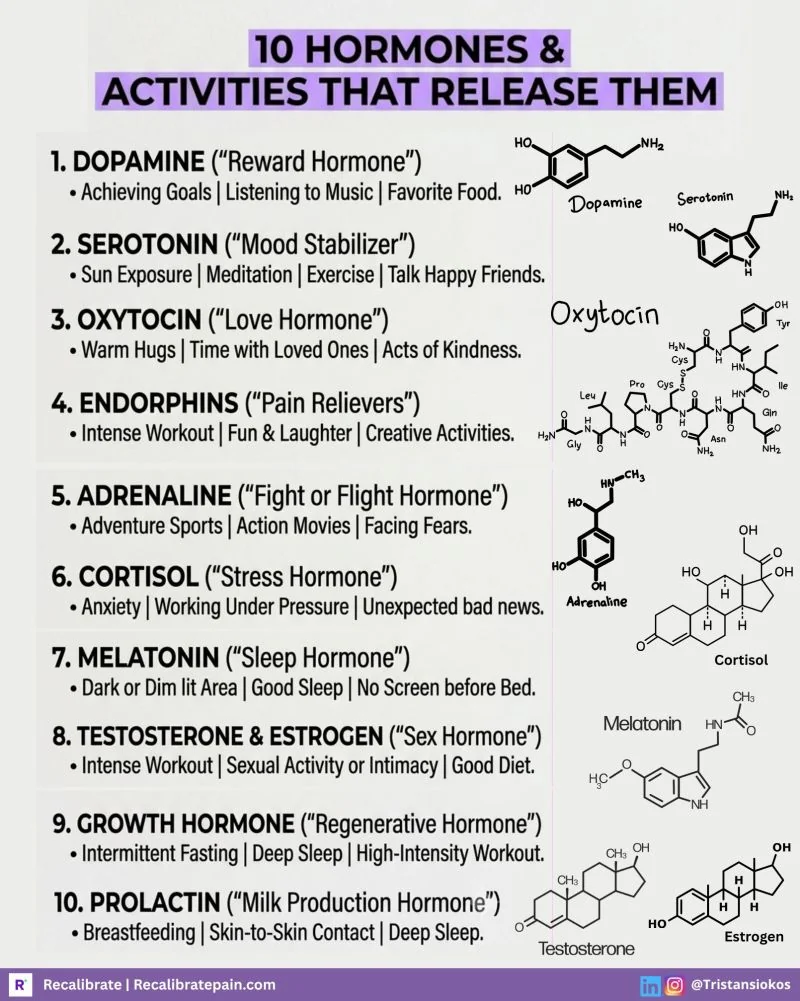
Adrenaline never reaches your brain. Neither do circulating endorphins. Dopamine fires hardest before you get the thing, not after. Ninety percent of your serotonin is in your gut. Here is what each of the ten major molecules genuinely does, where it is produced, and why the popular version of brain chemistry gets the anatomy wrong.
Adrenaline Cannot Get Into Your Brain
The panic you feel in your head is not adrenaline. Adrenaline cannot cross the blood-brain barrier. It never gets in.
This is not a technicality. It is the single most useful correction to the popular version of brain chemistry, because it separates two things people experience as one event.
The pounding heart is adrenaline in the body. Released from your adrenal glands into the bloodstream, acting on the heart, the airways, the blood vessels and the gut.
The alarm in your head is noradrenaline, released by a tiny brainstem nucleus called the locus coeruleus - roughly 15,000 neurons per side that project to almost the entire brain. That is the source of the "something is wrong" signal, the hypervigilance, the narrowed attention.
And then the two get stitched together: your body's state is reported back up the vagus nerve to the brainstem, which raises the alarm further. Body and brain are running two parallel systems that talk to each other - not one chemical doing both jobs.
That distinction changes what you do about it. You cannot think your way out of adrenaline in your bloodstream, but you can change the interoceptive report going back up - which is exactly why slow, extended exhale breathing works when reasoning does not.
🧠 Here is what each of the ten major molecules is actually doing, and where.
Dopamine and Serotonin: Both Misunderstood
🧠 Dopamine - not the reward chemical
Dopamine fires hardest before you get the thing, not after. It is the currency of anticipation, prediction and pursuit - the signal that says "this is worth going after", and then updates hard when reality does not match the prediction.
One molecule runs two entirely separate systems:
- Motivation, from the ventral tegmental area projecting to the striatum and prefrontal cortex
- Movement, from the substantia nigra projecting to the dorsal striatum
Lose the second and you have Parkinson's disease. Same molecule, different circuit, completely different consequence. This is why "boost your dopamine" is close to meaningless as advice - it does not specify which pathway.
🌊 Serotonin - mostly not in your brain
Around 90% of your body's serotonin is in your gut, where it regulates motility and secretion. It does not cross into the brain from there.
The brain makes its own, in the raphe nuclei - another small brainstem cluster projecting to almost the entire cortex. One molecule running mood in one compartment and digestion in another, which is part of why the two move together: gut symptoms and mood symptoms in chronic illness are not coincidence, and they are not "just stress".
Oxytocin and Endorphins: Two Routes, One Molecule
🪞 Oxytocin - released two ways at once
Oxytocin is produced in the hypothalamus and released along two separate routes simultaneously:
- Into the bloodstream via the posterior pituitary, acting on the body
- Along axons directly into the brain, including the amygdala, where it turns down threat reactivity
That second route is the interesting one. It means the feeling of being safe with someone is not a metaphor or a mood - it is a measurable reduction in amygdala responsiveness, delivered by a molecule travelling inside the brain rather than around the body.
🩹 Endorphins - and the myth about them
The endorphins in your bloodstream cannot cross into your brain. So the popular story - "exercise floods your brain with endorphins" - has the anatomy wrong.
Their real job is descending pain control: turning nociceptive signals down at the spinal cord before they ever reach conscious awareness. That is the same descending inhibition system that lets an athlete finish the match and find the injury afterwards.
Morphine works by borrowing the same receptors. Which tells you how powerful the endogenous system is - we built our strongest analgesics by imitating it.
Cortisol, Melatonin and the Adrenaline Correction
⚡ Adrenaline - as above, it never gets in. Body chemical, reported to the brain rather than acting in it.
🔥 Cortisol - the hormone that dismantles its own brake
Cortisol crosses into the brain easily, and its receptors are densest in the hippocampus. Those same receptors are the negative feedback mechanism that shuts cortisol release off.
Here is the problem: prolonged exposure degrades them. So chronic stress damages the very structure responsible for switching the stress response off. The brake wears out under the conditions that demand it most.
This is one of the cleanest mechanistic explanations of why chronic stress is not just "more stress" - it is a system that has lost its regulator, which is also why recovery windows matter more than stress avoidance.
🌀 Melatonin - the strangest route in the body
Light hits the retina → signals the hypothalamus (suprachiasmatic nucleus) → runs down the spinal cord → then back up the neck via the superior cervical ganglion → to the pineal gland.
That absurd detour exists for evolutionary reasons, but the practical point is this: melatonin is a darkness signal, not a sedative. It tells your body what time it is. Which is why light timing in the morning and evening does more for your sleep than the dose on the bottle.
Sex Hormones, Growth Hormone and Prolactin
⚙️ Testosterone and estrogen - not what most people assume
An enzyme called aromatase converts testosterone into estradiol inside the brain. So male brains run substantially on estrogen, locally produced from testosterone right where it is needed.
And what it is doing there has little to do with reproduction: bone density, memory, mood and cardiovascular function in everyone. Framing these as "male" and "female" hormones obscures most of their actual job.
🚪 Growth hormone - and why sleep is not optional
Much of growth hormone's effect is indirect, mediated by IGF-1 produced in the liver. And its largest pulse arrives in your first deep sleep cycle of the night.
Lose that sleep and you lose the repair. Not metaphorically - the anabolic, tissue-repair window is physically tied to slow-wave sleep in the early night. This is why sleep fragmentation shows up as pain, slow recovery and poor healing weeks later.
🔁 Prolactin - the only one held down rather than switched on
Prolactin is unique here: the hypothalamus releases dopamine continuously to suppress it. It is under constant active inhibition rather than waiting for an activation signal.
Which explains two clinical facts that otherwise look bizarre: dopamine-blocking drugs send prolactin up, and antipsychotics can cause lactation in people who have never been pregnant. Block the brake and the system runs.
Why This Matters More Than It Sounds
The popular version of brain chemistry is mostly a list of feelings with molecule names attached. Dopamine = reward. Serotonin = happiness. Endorphins = runner's high. Adrenaline = panic.
Every one of those is wrong in a way that changes what you would do about it:
- Dopamine is anticipation, so chasing the feeling of getting things does not build motivation - reducing what steals your anticipation does
- Serotonin is mostly gut, so gut symptoms and mood symptoms belong in the same conversation
- Endorphins act at the spinal cord, so the analgesic system worth training is descending inhibition
- The panic in your head is noradrenaline, so interoceptive inputs - breath, exhale length, posture - are the accessible lever
Most of what happens to you today will be decided by molecules you never feel arriving. You do not get a notification when cortisol receptors downregulate, or when your growth hormone pulse gets truncated by a bad night. You only feel the output, weeks later, and usually blame the wrong thing.
💜 That is exactly why the education sits at the centre of what we build. Recalibrate's Academy has over 200 lessons across neuroscience, pain science, psychology and systems biology - because understanding the mechanism is what turns a vague bad week into something you can actually act on.
Recalibrate is an education and self-tracking tool, not a diagnostic service or a replacement for medical care.
Related articles
- The Most Significant Growth Is Invisible: Dendritic Spines and How Your Brain Rewires Itself
Look at the roots in this image. Your brain contains the same thing, at a scale you have never been shown. Dendritic spines are the connection points along your neurons - and they form, swell, shrink and vanish continuously. Learning is the physical act of these shapes changing.
- Your Nervous System Has a Control Panel. Here Is the Manual.
Every feeling has a corresponding autonomic state. And every autonomic state can be shifted deliberately, in minutes, using inputs your body already understands. Here is the neuroscience behind four emotional states and exactly how to move through them.
- The Neuroscience of Happiness: The 12 Pillars of a Fulfilled Life
Most happiness frameworks are built on intuition. These twelve are built on neurobiology. From how your default mode network needs silence to how your gut produces 90% of your serotonin, here is the map your brain actually runs on.