Your Nervous System Has a Control Panel. Here Is the Manual.
By Tristan Siokos · Founder, Recalibrate · July 05, 2026
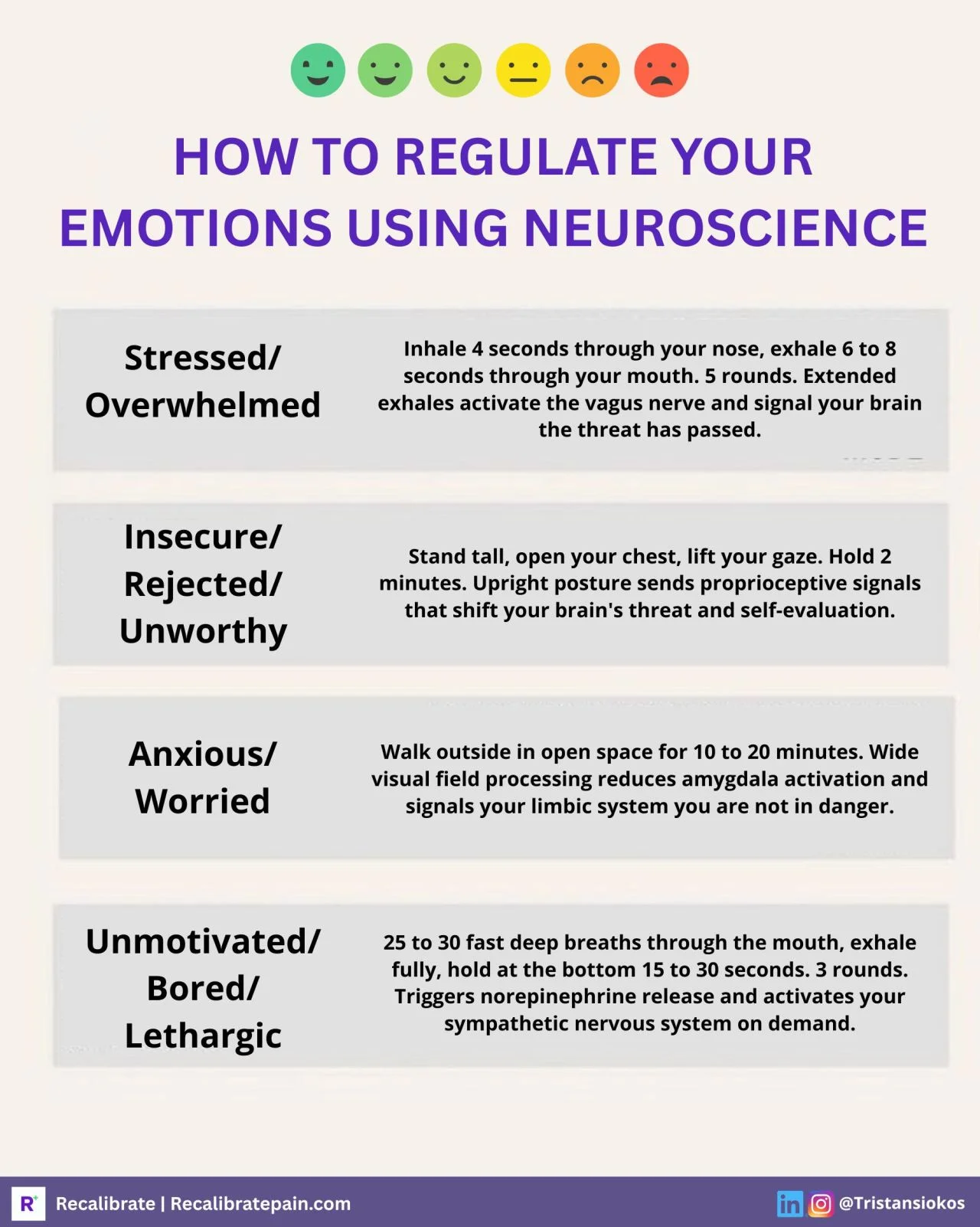
Every feeling has a corresponding autonomic state. And every autonomic state can be shifted deliberately, in minutes, using inputs your body already understands. Here is the neuroscience behind four emotional states and exactly how to move through them.
Your Emotional State Is a Physiological Condition
Most people treat their emotional state as something that happens to them. Something to wait out, think through, or manage with willpower.
The nervous system disagrees. Your emotional state is a physiological condition produced by a specific autonomic configuration - a measurable pattern of heart rate, breathing depth, hormonal balance, and neural activation. And physiological conditions respond to physiological inputs.
This is not a reframing. It is literally how the system works.
Every feeling has a corresponding autonomic state. Stress has a physiological signature. So does insecurity, anxiety, and lethargy. And because each state is produced by a specific configuration of the nervous system, each one has a specific input that can shift it.
Your nervous system has a control panel. Most people just never got the manual.
Why Physiology Works When Thinking Does Not
The reason cognitive approaches to emotional regulation often fail is structural, not motivational.
Your prefrontal cortex - the part of your brain responsible for reasoning, perspective-taking, and conscious self-management - is downstream of your autonomic nervous system. When your sympathetic system is highly activated, blood flow and neural resources are directed away from the PFC and toward the survival circuitry. The very tool you are trying to use to calm down is the one least available when you need it most.
Physiological inputs bypass this problem. They reach the autonomic system directly, through sensory pathways that do not require executive function to work. You do not need to reason your way to calm. You need to send the system a different signal.
The inputs your body already understands: the length of your exhale, the orientation of your spine, the width of your visual field, and the depth and rhythm of your breath. Each one maps directly onto an autonomic state. And each one can change that state within minutes.
Stressed or Overwhelmed: The Exhale Exit
🫁 What is happening physiologically
Your sympathetic nervous system is dominant. Heart rate is elevated, breathing is shallow and fast, cortisol is circulating, and your prefrontal cortex is partially offline. Your brain is in threat-detection mode.
Why the exhale works
Diaphragmatic breathing with a longer exhale than inhale activates the vagus nerve through pulmonary stretch receptors in your lungs. Every extended exhale sends a signal up to your brainstem that the threat has passed. The parasympathetic system engages. Heart rate variability increases. Cortisol drops. The prefrontal cortex comes back online.
The protocol
Four seconds in through the nose. Six to eight seconds out through the mouth. Five rounds. You did not calm down by thinking differently. You changed your physiology and your brain followed.
🧍 Insecure, rejected, or unworthy
Your brain receives constant proprioceptive feedback from your body's position in space. Slouched posture, collapsed chest, and downward gaze send interoceptive signals the brain reads as low status and high threat. The system is bidirectional.
The protocol
Upright posture with an open chest changes that signal. Your vestibular system registers a different orientation. Your visual field opens. The interoceptive feedback shifts, and with it, the brain's threat assessment changes. Stand tall, chest open, gaze level. Hold for two minutes. This is not motivational advice. It is sensory feedback changing a neural evaluation.
Anxious or Worried: The Visual Field Reset
😰 What is happening physiologically
Anxiety is your amygdala reading the environment as dangerous. The amygdala monitors sensory input continuously for threat signals. A narrow or enclosed visual field - eyes focused close, surrounded by walls or a screen - increases amygdala firing. The system interprets restricted visual range as a sign of being cornered or enclosed.
Why wide open space works
A wide visual field activates the peripheral visual system, which has a calming effect on the amygdala. Combined with bilateral movement - left-right alternation - the nervous system has an additional mechanism for discharging the threat signal that anxiety represents.
The protocol
Walk in an open environment for 10 to 20 minutes. Two mechanisms work simultaneously: bilateral movement helps discharge threat signals in the nervous system, and a wide visual field signals to your limbic system that you are not in danger. Cortisol drops. The nervous system settles.
⚡ Unmotivated, bored, or lethargic
Your norepinephrine is low. Norepinephrine is the neuromodulator of alertness, drive and focused attention. It responds to physiological challenge.
The protocol
Cyclic hyperventilation - 25 to 30 fast, deep breaths through the mouth, then exhale fully and hold at the bottom for 15 to 30 seconds, three rounds. This triggers norepinephrine and adrenaline release from the locus coeruleus and adrenal glands. Your sympathetic nervous system activates on demand. Focus sharpens. A 2022 Stanford study confirmed measurable increases in physiological arousal markers within minutes of this protocol.
Why This Works When Other Things Do Not
These interventions share a common mechanism: they change the input your nervous system receives rather than trying to override the output it is producing.
Telling yourself to calm down while your sympathetic system is firing is like trying to slow a car by adjusting the speedometer. The thinking brain is not the control system. It is a passenger who sometimes gets to provide input.
The autonomic nervous system runs on sensory signals. It is constantly reading:
- The rhythm and depth of your breathing
- The orientation and tension of your body in space
- The width and quality of your visual input
- The chemical environment created by your metabolic state
Change those inputs, and the system responds. Not because you have convinced it of anything, but because you have given it different data.
💜 This is also why these techniques can feel strangely powerful the first time you use them. You have been trying to manage your emotional state from inside it. These protocols work from below it, at the level where the state is actually being generated.
Your nervous system was designed to respond to its environment. Give it a different environment, and you will get a different state. That is not a metaphor. It is the manual.
Recalibrate is an education and self-tracking tool, not a diagnostic service or a replacement for medical care.
Related articles
- You Have a Floating Bone in Your Throat. Around It Sits a Control Panel for Your Nervous System.
The hyoid is the only bone in your body that does not articulate with another. Around it converge five cranial nerves. One of them is the vagus. This is why your breath, your exhale, your voice and your swallow can genuinely shift your physiological state - not by suggestion, but through anatomy.
- The Autonomic Nervous System: Sympathetic, Parasympathetic and the Brain in Your Gut
Your heart beats, your gut digests and your blood pressure self-tunes without a single conscious command. That is the autonomic nervous system - sympathetic, parasympathetic and enteric. It is not a switch but a constantly negotiated balance, and when that balance gets stuck you get anxiety, chronic pain, fatigue, digestive problems and dysautonomia. Here is how it actually works and how to work with it.
- Daily Neural Workouts: 8 Science-Backed Techniques to Rewire Your Brain
Your brain is a prediction machine, not an archive. If you do not deliberately train new patterns, it reverts to its oldest, most dominant pathways. Here are 8 daily neural workouts - education, gratitude, curiosity, authenticity, meditation, resilience, connection and self-compassion - that fuel real, mechanism-level neuroplasticity.