You Have a Floating Bone in Your Throat. Around It Sits a Control Panel for Your Nervous System.
By Tristan Siokos · Founder, Recalibrate · July 25, 2026
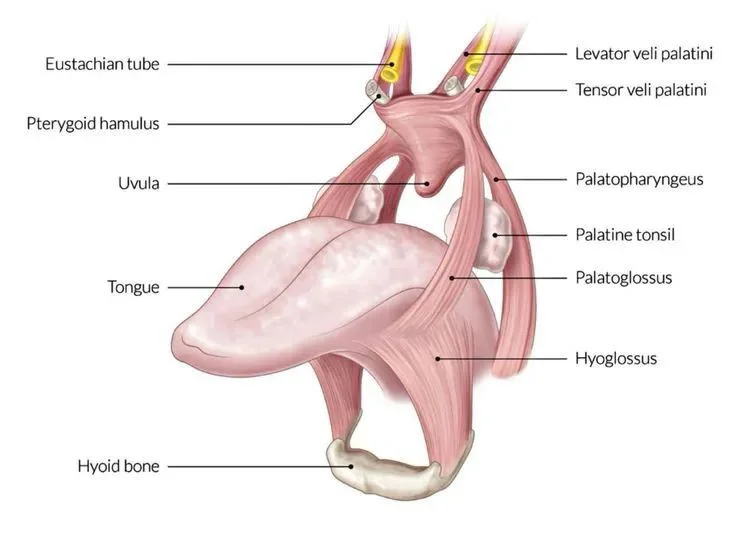
The hyoid is the only bone in your body that does not articulate with another. Around it converge five cranial nerves. One of them is the vagus. This is why your breath, your exhale, your voice and your swallow can genuinely shift your physiological state - not by suggestion, but through anatomy.
A Bone That Floats
Every other bone in your body articulates with at least one other bone. They meet at joints, press against cartilage, attach to the skull or spine or pelvis.
The hyoid does not. It is a small, U-shaped arch suspended in a sling of muscle at the base of your tongue, unattached to anything else in your skeleton. It floats.
This unusual anatomy is exactly what makes the region work. The freedom it gives your tongue, larynx, and throat is what allows you to speak with precision, swallow without choking, and produce the range of sounds you take entirely for granted.
But the hyoid's significance goes beyond mechanics. The region it anchors is one of the most densely innervated structures in your entire body. Five cranial nerves converge here. One of them runs directly to your brainstem and has the authority to shift your entire physiological state.
Most people treat the tongue and throat as plumbing for food and speech. They are closer to a control panel for your nervous system.
Five Cranial Nerves at One Address
The tongue is run by five of your twelve cranial nerves. Very few structures in the body draw on that many simultaneously.
🔵 Trigeminal (V) - Carries sensation from the anterior two-thirds of the tongue. The most widely distributed sensory nerve in the head, covering the entire face, sinuses, teeth, and much of the oral cavity.
🟢 Facial (VII) - Carries taste sensation from the anterior two-thirds of the tongue via the chorda tympani branch. Also controls the muscles of facial expression.
🟠 Glossopharyngeal (IX) - Carries both sensation and taste from the posterior third of the tongue, and plays a key role in the swallowing reflex and the gag reflex.
🔴 Vagus (X) - Contributes to motor and sensory function of the larynx and pharynx. This is the nerve that matters most for nervous system regulation - and it passes directly through this region on its way between your brainstem and every major organ in your body.
🟣 Hypoglossal (XII) - The primary motor nerve of the tongue. Controls the precise, rapid movements that speech and swallowing require.
The convergence of this many cranial nerves at a single region is unusual. It reflects the biological importance of the mouth and throat in both survival function and neurological regulation.
The Vagus Nerve Runs Through Here
The vagus nerve is the main nerve of your parasympathetic nervous system - the rest-and-digest counterpart to fight-or-flight. It travels from your brainstem down through your neck, past your heart, into your lungs, and all the way to your gut, carrying signals in both directions between your brain and your viscera.
The throat is one of the few places where you can deliberately access it.
🌊 Slow exhalation activates vagal tone through pulmonary stretch receptors and the respiratory rhythm generator in the brainstem. The longer the exhale relative to the inhale, the stronger the parasympathetic signal.
🎵 Humming and singing vibrate the larynx and pharynx - structures the vagus innervates. The physical vibration stimulates the nerve directly. This is documented vagal activation, not relaxation metaphor.
💧 Swallowing activates the glossopharyngeal and vagus nerves simultaneously, triggering the swallowing reflex that involves a brief but measurable parasympathetic response.
You are not relaxing by suggestion. You are stimulating a nerve that runs directly through your throat and tells your body it is safe to stand down.
Why Breath and Voice Reach the System Directly
Breathing is normally automatic. Your brainstem runs it continuously without any input from your conscious mind. But you can override it, and when you do, you send input straight into the autonomic control centre this region houses.
This bidirectionality is rare and valuable.
Most of your autonomic nervous system is sealed off from conscious influence. You cannot choose to lower your heart rate through willpower. You cannot decide to reduce cortisol by thinking about it. The autonomic system operates below the threshold of conscious access by design - because survival functions cannot afford to depend on slow, deliberate cognition.
But breathing sits at the boundary. It is both automatic and voluntary. And because it is voluntary, it is one of the few points where your conscious mind has genuine authority over an unconscious system.
⚡ Voice adds another layer. The vocalisations that activate the vagus - slow exhales, humming, singing, low tonal sounds - all require the coordination of structures the vagus innervates. Each one sends an afferent signal up the vagal pathway to the brainstem. Each one nudges the parasympathetic system toward activation.
Every breathing practice, every calming vocal technique, every instruction to sigh or hum works through the anatomy in this region. The diagram is not decoration. It is the mechanism.
For Chronic Stress and Pain: An Access Point That Matters
A nervous system in a sustained threat state is genuinely hard to reason out of. The threat system sits below conscious thought. It does not respond to persuasion, explanation, or understanding - because understanding evolved later and sits upstream of survival circuitry.
But it is not sealed off.
The breath, the exhale, the voice, the swallow: these are physical routes into the autonomic system that operates below cognition. Not metaphors. Not wellness suggestions. Actual afferent pathways running through an anatomy that evolution placed in your throat precisely because it needed to be accessible.
🔥 For fibromyalgia, ME/CFS, long COVID, and central sensitisation, where the nervous system has settled into a persistent threat configuration, this access point is not trivial. The system cannot be argued into safety. But it can be signalled into it - slowly, repeatedly, using inputs it understands.
Extended exhales. Humming. Slow vocalisation. Low tonal sound. Cold water on the face (activating the diving reflex via the vagus and trigeminal). These are not alternative medicine. They are interventions into documented anatomy.
The research on vagal tone, heart rate variability, and parasympathetic activation consistently points to the same region. Not because breath is magical. Because the nerve is there.
The Door In
Most people never learn that the tongue and throat are anything more than tools for eating and talking.
They are one of the few doors your conscious mind has into the system that runs you.
The hyoid holds that door open. The five cranial nerves passing through the region connect it to the brainstem, the face, the ears, the viscera, and the cardiovascular system. The vagus, running through the middle of all of it, carries the authority to shift your body out of threat and into recovery.
You already have this anatomy. You have been using the region for speech and swallowing for your entire life without knowing what else it was doing.
The practical point is simple:
- Extend your exhale longer than your inhale, every time you want to activate the parasympathetic system
- Hum for two minutes when you need to discharge tension without exercise
- Swallow slowly and deliberately when you feel the onset of a threat response
- Use low, slow vocalisation - reading aloud, singing, quiet humming - as a daily maintenance practice
These are not suggestions for managing symptoms. They are instructions for operating the control panel you were never given a manual for.
💜 You have a floating bone in your throat. Around it sits one of the most accessible windows into your own nervous system. Now you know it is there.
Recalibrate is an education and self-tracking tool, not a diagnostic service or a replacement for medical care.
Related articles
- Your Nervous System Has a Control Panel. Here Is the Manual.
Every feeling has a corresponding autonomic state. And every autonomic state can be shifted deliberately, in minutes, using inputs your body already understands. Here is the neuroscience behind four emotional states and exactly how to move through them.
- The 12 Cranial Nerves Explained: The Direct Line From Your Brain to Your World
Sight, sound, smell, taste, balance, facial expression, swallowing, and the entire unconscious regulation of your heart, lungs and gut all run through twelve pairs of cranial nerves. Here is what each one does, why cranial nerve function is a window into brainstem health, and why the tenth - the vagus - sits at the centre of modern thinking about stress and recovery.
- The Autonomic Nervous System: Sympathetic, Parasympathetic and the Brain in Your Gut
Your heart beats, your gut digests and your blood pressure self-tunes without a single conscious command. That is the autonomic nervous system - sympathetic, parasympathetic and enteric. It is not a switch but a constantly negotiated balance, and when that balance gets stuck you get anxiety, chronic pain, fatigue, digestive problems and dysautonomia. Here is how it actually works and how to work with it.