The Neuroscience of Happiness: The 12 Pillars of a Fulfilled Life
By Tristan Siokos · Founder, Recalibrate · May 23, 2026
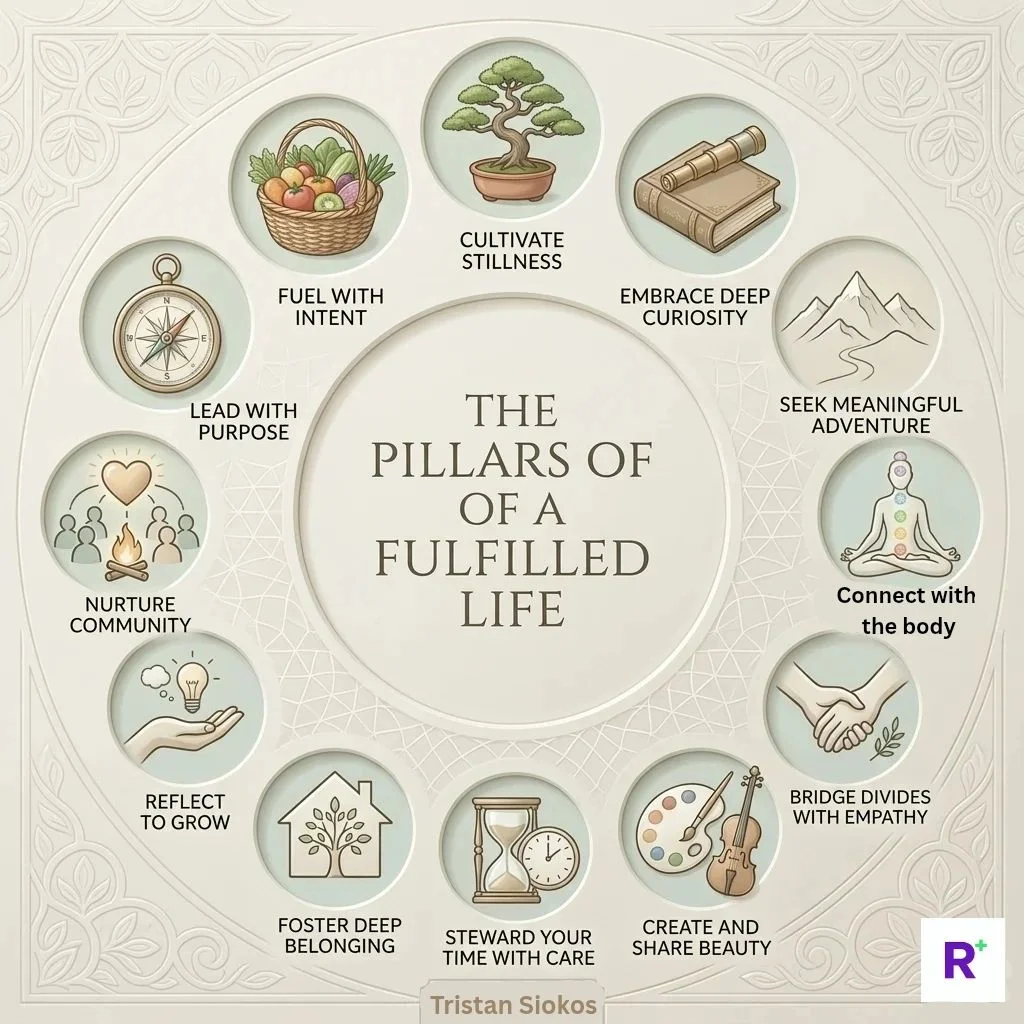
Most happiness frameworks are built on intuition. These twelve are built on neurobiology. From how your default mode network needs silence to how your gut produces 90% of your serotonin, here is the map your brain actually runs on.
The Map Most People Are Missing
Most happiness advice is built on intuition. Feel gratitude. Spend time in nature. Find your purpose. The recommendations are not wrong. But without the underlying biology, they remain aspirational abstractions that most people cannot sustain.
Your brain is not a metaphor. It is a biological system with measurable architecture. And that architecture has consistent patterns when it comes to wellbeing: specific chemicals, circuits, and systems that either support a fulfilled life or quietly undermine it.
There are twelve pillars that neuroscience consistently backs. They cluster around four systems: your dopamine circuit, your serotonin and gut system, your cortisol regulation, and your social brain.
This is not a self-help framework. It is a map of how you are already wired.
Your Brain's Four Wellbeing Systems
Before moving through the twelve pillars, it helps to understand the four systems they run through.
🔵 Dopamine: Your Learning and Drive Circuit
Dopamine is not the pleasure chemical. It is the prediction and learning signal. It fires when you encounter novelty, when you make progress toward a goal, and when your models of the world are updated. Curiosity, adventure, and purpose all run through this system. When it is chronically underfed, motivation erodes and everything flattens.
🟢 Serotonin: Your Gut-Brain Balance System
Roughly 90% of your serotonin is produced in your gut, not your brain. It regulates mood, social behaviour, sleep architecture, and impulse control. It is directly shaped by what you eat, the diversity of your microbiome, and how much stillness you allow. This is why mental health starts below the neck.
🟠 Cortisol: Your Stress Regulation System
Cortisol is not inherently harmful. Its rhythm - rising in the morning and declining through the day - is essential for healthy function. The problem is chronic dysregulation. When cortisol stays elevated, it progressively rewires the prefrontal cortex and impairs the very cognitive systems you need to manage pressure. Time stewardship, hormonal balance, and medical health all operate through this system.
🔴 Social Circuitry: Your Connection and Mirror System
Your brain has dedicated neural architecture for social processing. Social isolation activates the same regions as physical pain. Mirror neurons mean you literally simulate the emotional states of the people around you. Belonging and community are not optional additions to a good life. They are biological necessities.
The Pillars: Mind
🌿 Cultivate Stillness
Your default mode network is the brain system active during rest, quiet reflection, and mind-wandering. It is not a background hum. It is essential for emotional processing, memory consolidation, and the construction of your sense of self. Chronic overstimulation suppresses DMN activity, leaving emotional material unprocessed and memory encoding shallow. Silence is not laziness. It is maintenance.
📚 Embrace Deep Curiosity
Dopamine is your brain's learning signal. Every time you encounter a genuinely novel idea - one that updates your model of the world - dopamine fires. This is why intellectual curiosity feels intrinsically motivating. Feed it with real novelty: new domains, hard questions, unfamiliar perspectives. Passive scrolling does not trigger the same circuit.
💡 Reflect to Grow
Journaling and structured self-reflection consistently increase prefrontal cortex activity while reducing amygdala reactivity. Writing about difficult experiences gives the PFC regulatory access to emotional material the amygdala is holding. Self-awareness is a trainable neural skill, not a fixed personality trait.
🧭 Lead With Purpose
People with a clearly articulated sense of purpose show measurably lower cortisol, higher grey matter volume in key prefrontal regions, and better long-term health outcomes across the board. Purpose does not have to be grand. It has to be real. The neurological protection comes from having a consistent answer to: what am I working toward?
The Pillars: Body
⚖️ Balance Your Hormones
Cortisol dysregulation does not stay contained to stress response. Over time it rewires your prefrontal cortex, reduces your capacity for executive function, and progressively impairs the cognitive systems you need to manage pressure. Hormonal health - thyroid, sex hormones, adrenal function - shapes the chemical environment your brain operates in every single day.
🩺 Prioritise Medical Health
Inflammation is the common thread behind depression, fatigue, cognitive decline, and chronic pain. A body in chronic low-grade inflammation cannot produce a brain running at capacity. Bloodwork is not vanity. It is data. Unaddressed metabolic issues and nutritional deficiencies are quietly shaping your neurological baseline in ways no happiness framework can override.
📓 Nurture Biological Balance
Your gut houses 500 million neurons and produces 90% of your serotonin. The composition of your microbiome directly influences your mood, anxiety levels, and stress resilience. Diversity of diet, fermented foods, and reduced processed inputs are not wellness trends. They are microbiome maintenance - and through it, brain maintenance.
🥗 Fuel With Intent
Ultraprocessed foods disrupt dopamine receptors through the same mechanism as addictive substances. They flood the reward circuit with hyper-stimulation, progressively reduce receptor sensitivity, and make ordinary experiences feel unrewarding by comparison. You are not what you eat in a motivational sense. You are what you eat at the level of receptor density, neurotransmitter synthesis, and inflammatory load.
The Pillars: Connection
🏠 Foster Deep Belonging
Social isolation activates the anterior cingulate cortex and the dorsal anterior insula - the same regions that process physical pain. Loneliness is not a feeling. It is a biological threat signal. The brain registers the absence of social connection as a survival risk and responds accordingly: elevated cortisol, heightened threat detection, disrupted sleep. Even one or two genuinely secure relationships measurably reduces this load.
🔥 Nurture Community
Mirror neurons fire both when you perform an action and when you observe someone else performing it. You do not just witness the emotional states of the people around you. You neurologically simulate them. The community you inhabit shapes your baseline emotional state, your stress reactivity, and your sense of what is normal. Choose your environment with the same intentionality you choose your diet.
🏔️ Seek Meaningful Adventure
Neurogenesis - the growth of new neurons - is significantly enhanced by novel, demanding, and physically engaging environments. When you enter genuinely new territory, your hippocampus creates new spatial maps, your dopamine circuit fires learning signals, and your brain literally grows. Routine without challenge degrades the novelty-seeking circuitry over time.
⏳ Steward Your Time With Care
Decision fatigue is not a metaphor. The prefrontal cortex draws on a finite pool of cognitive resources, and every decision - regardless of its importance - draws from the same reservoir. Trivial choices drain the same executive circuits you need for meaningful ones. Time stewardship is not about productivity. It is about protecting the neural resources that make deliberate living possible.
Building the Map Into Your Life
The twelve pillars are not a checklist. They are a system.
Each one reinforces the others. Stillness improves cortisol regulation, which improves sleep, which improves gut function, which stabilises serotonin, which reduces amygdala reactivity, which makes reflection easier, which deepens purpose. The whole structure is interconnected. Neglecting one pillar long enough creates pressure on the rest.
This is also why piecemeal interventions often disappoint. Taking a mindfulness app seriously while living in social isolation, eating ultraprocessed food, and carrying unresolved hormonal dysregulation is like patching one hole in a leaking vessel. The biology overrides the intention.
The practical starting point is not to do all twelve. It is to identify which pillar is creating the most systemic drag on the others, and start there.
For most people the answer is one of three: chronic cortisol dysregulation (the stress system is stuck), gut and nutritional neglect (the biological substrate is compromised), or social deficit (the connection circuitry is running on empty).
Get your bloodwork done. Build one stillness practice and do it daily. Choose one person and go deeper. These are not inspirational suggestions. They are interventions in measurable biology.
💜 The map already exists. Your nervous system is already running on it. The only question is whether you are working with it or against it.
Recalibrate is an education and self-tracking tool, not a diagnostic service or a replacement for medical care.
Related articles
- Daily Neural Workouts: 8 Science-Backed Techniques to Rewire Your Brain
Your brain is a prediction machine, not an archive. If you do not deliberately train new patterns, it reverts to its oldest, most dominant pathways. Here are 8 daily neural workouts - education, gratitude, curiosity, authenticity, meditation, resilience, connection and self-compassion - that fuel real, mechanism-level neuroplasticity.
- How Self-Talk Physically Changes Your Brain: The Neuroscience of Your Internal Dialogue
Neuroscience confirms your thoughts change your neurons. Every thought triggers a neurochemical cascade. Repeat it enough and you do not just feel different. You become different. At a cellular level. Here is what is actually happening inside your brain when you talk to yourself.
- The Panic You Feel in Your Head Is Not Adrenaline. Adrenaline Cannot Get Into Your Brain at All.
Adrenaline never reaches your brain. Neither do circulating endorphins. Dopamine fires hardest before you get the thing, not after. Ninety percent of your serotonin is in your gut. Here is what each of the ten major molecules genuinely does, where it is produced, and why the popular version of brain chemistry gets the anatomy wrong.