What You Eat Directly Changes Your Nervous System's Chemistry
By Tristan Siokos · Founder, Recalibrate · July 07, 2026
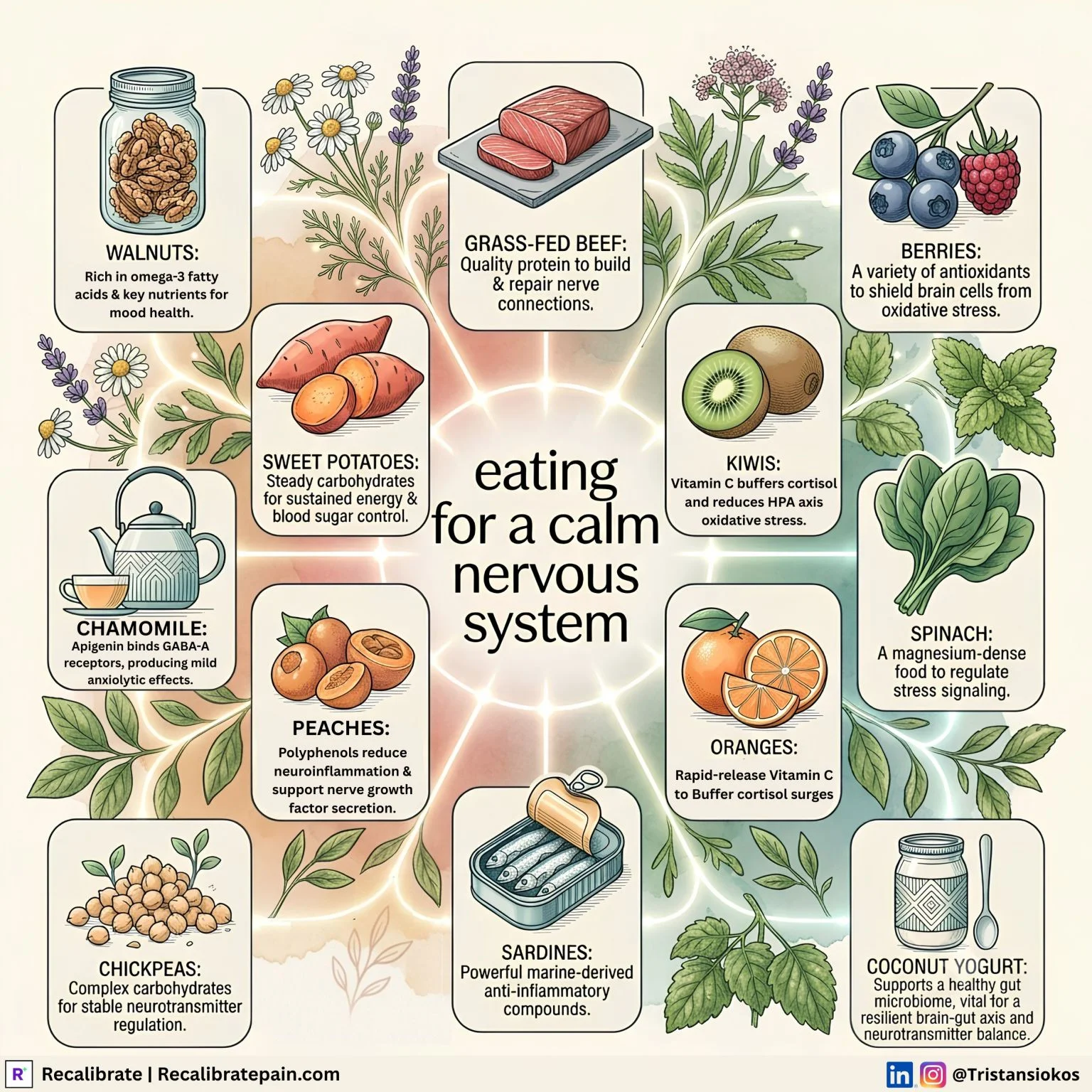
Food is not just fuel. Every meal is a set of molecular signals your nervous system uses to build neurotransmitters, regulate inflammation, maintain myelin, and manage stress. Here is the science behind 12 foods that directly support the system.
Every Meal Is a Molecular Signal
Food is not just fuel. Every meal is a set of molecular instructions your nervous system uses to synthesise neurotransmitters, build myelin, regulate inflammation, and manage the stress response.
The brain is the most metabolically expensive organ in the body. It consumes roughly 20% of your total energy intake on approximately 2% of your body weight. It does not store energy. It depends entirely on a continuous supply of specific nutrients to run the chemistry of thought, mood, pain, memory, and regulation.
This means what you eat does not eventually affect your nervous system. It affects your nervous system today, at the level of receptor function, neurotransmitter availability, and neuroinflammatory load.
Here are twelve foods where the mechanism is well-characterised. Not superfoods. Not trends. Molecular signals with documented pathways.
How Food Becomes Brain Chemistry
Before looking at specific foods, it helps to understand the four pathways through which diet shapes the nervous system.
🔵 Neurotransmitter precursor supply. Serotonin, dopamine, and GABA cannot be synthesised without specific dietary inputs. Tryptophan (for serotonin), tyrosine (for dopamine), and B6 as a cofactor for both - none of these are made by the body at meaningful rates. They come from food.
🟢 Neuroinflammation regulation. The brain has its own immune system mediated by microglia. Chronic neuroinflammation is a primary driver of depression, cognitive decline, and pain sensitisation. Omega-3 fatty acids, polyphenols, and antioxidants directly modulate this system.
🟠 Blood sugar and cortisol stability. The brain runs on glucose. Unstable blood sugar triggers cortisol release, which over time rewires the prefrontal cortex and disrupts hippocampal function. Stable carbohydrate sources and B6 cofactors protect this axis.
🔴 Gut microbiome and the serotonin axis. Approximately 90% of serotonin is produced in the gut, not the brain. The composition of your microbiome directly shapes the serotonin available to your nervous system - which in turn shapes mood, impulse control, and stress resilience.
The Twelve Foods and What They Actually Do
🥜 Walnuts
ALA omega-3 incorporates directly into neuronal membranes, maintaining synaptic fluidity and reducing neuroinflammation. Walnuts are also rich in polyphenols and vitamin E that protect brain tissue from oxidative damage - one of the most consistent dietary findings across brain health research.
🥩 Grass-fed beef
Complete protein providing tryptophan, the dietary precursor your brain converts into serotonin, plus B12 for myelin synthesis and nerve conduction. B12 deficiency is among the most common and most overlooked drivers of neurological symptoms.
🫐 Berries
Anthocyanins - the compounds that give berries their colour - cross the blood-brain barrier and directly reduce neuroinflammation while supporting BDNF, the protein that maintains neurons and drives synaptic plasticity. One of the most studied dietary interventions for cognitive ageing.
🍠 Sweet potatoes
Stable glucose prevents the cortisol spikes that hypoglycaemia triggers. Vitamin B6 is a required cofactor in both serotonin and dopamine synthesis. Without it, you have the precursor amino acids but the conversion stalls.
🥝 Kiwis
Among the highest dietary sources of vitamin C, which buffers cortisol by supporting adrenal function and reducing oxidative stress along the HPA axis. The adrenal glands have the highest concentration of vitamin C of any organ - they need it to regulate the stress response.
🌿 Spinach
Magnesium acts as a natural calcium channel blocker at NMDA receptors, reducing neuronal excitability and dampening the stress response at the receptor level. Low magnesium is strongly associated with heightened anxiety and disrupted sleep.
🍵 Chamomile
Apigenin, chamomile's primary bioactive compound, binds directly to GABA-A receptor complexes, producing mild anxiolytic effects on the central nervous system. The same receptor type targeted by benzodiazepines - at a much gentler, non-addictive level.
🍑 Peaches
Polyphenols reduce neuroinflammation and support glial cell secretion of nerve growth factor, protecting dopaminergic neurons. Glial cells maintain and protect neurons - their secretory function depends heavily on the inflammatory environment you create through diet.
🐟 Sardines
Among the richest direct sources of EPA and DHA. EPA reduces pro-inflammatory cytokines in the central nervous system. DHA is a structural component of neuronal membranes and myelin sheaths - not a supplement, a building material.
🍊 Oranges
Vitamin C is the most concentrated antioxidant in brain tissue and a required cofactor for dopamine synthesis via dopamine beta-hydroxylase. Without adequate vitamin C, dopamine conversion is impaired even when the precursor amino acids are available.
🫘 Chickpeas
Provide tryptophan and B6 for serotonin synthesis, plus magnesium and folate to support the methylation pathways that regulate neurotransmitter balance. Folate deficiency is consistently associated with depression and is routinely overlooked in standard blood panels.
🥥 Coconut yogurt
Live cultures support the gut microbiome, which produces approximately 90% of your serotonin and communicates bidirectionally with the brain via the vagus nerve. The gut is not downstream of the brain. It is a co-regulator of it.
The Gut-Brain Axis: Why 90% of Serotonin Lives Below Your Neck
The gut-brain axis is not a metaphor. It is a bidirectional communication system running along the vagus nerve, connecting 500 million enteric neurons in the gut to the central nervous system.
The enteric nervous system - sometimes called the second brain - operates largely independently, but it is in constant conversation with the brain above it. The gut monitors luminal contents, hormonal signals, and microbial metabolites and reports upstream in real time.
The microbiome shapes this signal. Different bacterial species produce different neurotransmitter precursors, short-chain fatty acids, and inflammatory signals. A disrupted microbiome - one low in diversity or colonised by inflammatory species - sends a different message to the brain than a healthy one.
This is why dietary change can produce measurable shifts in mood, anxiety, and stress resilience that go beyond what calorie or macronutrient content would predict. You are not just feeding yourself. You are feeding the ecosystem that regulates your nervous system's chemistry.
Fermented foods, diverse plant intake, and reduced ultra-processed inputs are the three most evidence-backed dietary levers for microbiome health - and through it, nervous system regulation.
What This Looks Like in Practice
You do not need to eat all twelve foods daily. You need to understand that food is a lever - one you are pulling multiple times a day, in one direction or the other.
The practical framework is simple:
Anchor protein at every meal. Tryptophan, tyrosine, and the B vitamins that convert them are the rate-limiting factors in neurotransmitter synthesis. Without adequate protein, precursor supply drops regardless of everything else.
Prioritise dietary omega-3 over supplementation where possible. EPA and DHA from whole food sources (sardines, salmon, mackerel) come packaged with the cofactors the body needs for absorption. Supplementation is a reasonable addition, not a replacement.
Reduce ultra-processed foods as a primary intervention. They disrupt dopamine receptor sensitivity, increase neuroinflammatory load, and destabilise blood sugar - three of the four core pathways simultaneously. No combination of beneficial foods fully compensates for a high ultra-processed baseline.
Support the microbiome with diversity and fermentation. Aim for 30 or more different plant species per week - a threshold associated with significantly higher microbiome diversity. Include at least one fermented food daily.
💜 Your nervous system is built from what you give it. Every meal is either supporting the system or asking it to work with less. That is not a moral statement. It is a mechanistic one.
Recalibrate is an education and self-tracking tool, not a diagnostic service or a replacement for medical care.
Related articles
- Cortisol Is Called the Stress Hormone. It Is Really a Fuel Hormone - and It Makes Fuel by Taking Your Muscle Apart.
Cortisol does not give you energy. It dismantles part of your body to make some - pulling amino acids from muscle and fat from fat stores so your liver can build new glucose. That single fact explains the 3pm slump, the 3am wake-up after drinking, why under-eating raises it, and why the goal is the shape of the curve, not a lower number.
- The Panic You Feel in Your Head Is Not Adrenaline. Adrenaline Cannot Get Into Your Brain at All.
Adrenaline never reaches your brain. Neither do circulating endorphins. Dopamine fires hardest before you get the thing, not after. Ninety percent of your serotonin is in your gut. Here is what each of the ten major molecules genuinely does, where it is produced, and why the popular version of brain chemistry gets the anatomy wrong.
- Nature Has Been Making Painkillers for Millions of Years. Here Is the Actual Chemistry Inside Them.
Eugenol in cloves is a real local anaesthetic. Salicin in willow bark is what aspirin was built from. Every item on this list contains a compound we can name, measure and study - which is exactly why they can help you and why they can interact with your medication. Here is what each one is actually good for.