Why Sitting All Day Undoes Your Workout: The Neuroscience of Movement
By Tristan Siokos · Founder, Recalibrate · July 03, 2026
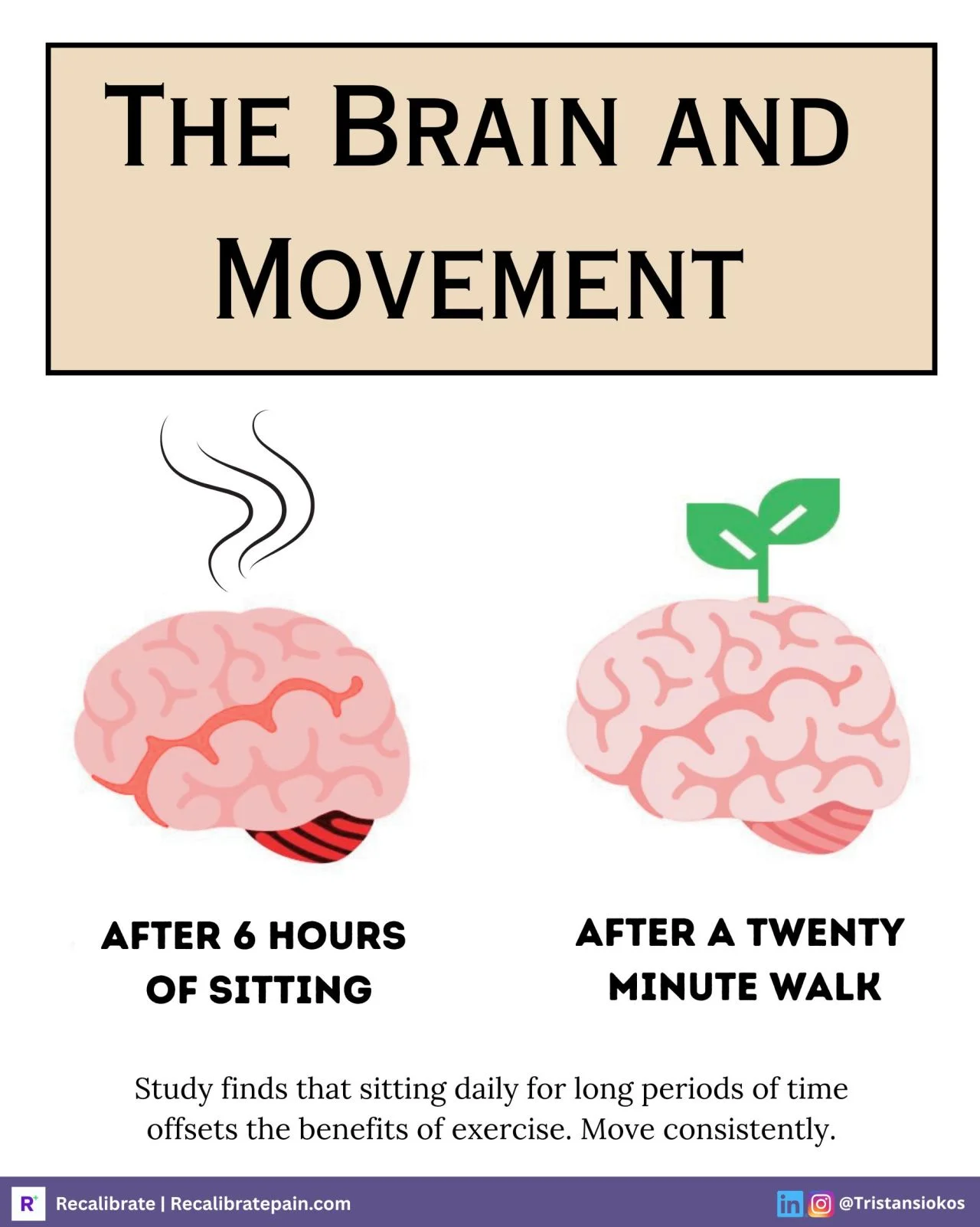
This is not about fitness. It is about what your nervous system requires throughout the day, not just in one window of it. BDNF, cerebral blood flow, proprioceptive input and the chronic illness nuance that most movement advice misses.
Explore the research
The Problem Is Not Your Exercise Routine
Most people who exercise regularly assume they have the movement side of health covered. One session, whether it is a gym workout, a run, or a yoga class, feels like it should be enough.
The research says something different. A 2025 study of nearly 90,000 people found cardiovascular risk persisted even in those meeting standard weekly exercise recommendations - if the rest of their day was sedentary. A Lancet analysis concluded that offsetting eight hours of daily sitting requires closer to sixty minutes of moderate activity per day.
This is not an argument about fitness. It is about the distinction between an acute movement dose and the distributed signal your nervous system needs throughout the day.
Your brain is not waiting until after your workout to respond to movement. It responds in real time, at intervals, to input it was designed to receive continuously. One hour cannot offset eleven hours of stillness - not because of calories, but because of how your nervous system processes proprioceptive and vascular input.
What Movement Does to the Brain in Real Time
🩸 Cerebral blood flow increases within minutes.
Within minutes of walking, cerebral blood flow increases to the prefrontal cortex - the region responsible for decision-making, emotional regulation, and executive function. This is not a delayed effect. It begins while you are moving.
🧠 BDNF rises rapidly in sessions as short as twenty minutes.
Brain-derived neurotrophic factor is the protein that supports neuron survival, drives hippocampal neurogenesis, and underpins synaptic plasticity. It is the mechanism by which exercise improves memory, mood, and cognitive resilience. Significant BDNF increases have been measured after twenty-minute moderate-intensity sessions. You do not need to train hard. You need to move.
⚡ The prefrontal cortex responds almost immediately.
Acute exercise temporarily increases activity in the prefrontal cortex and reduces amygdala reactivity. This is why a walk can break a thought loop or diffuse a stress response in a way that sitting quietly cannot - the neurochemistry is different, not just the change of scene.
The brain is not waiting for you to finish. It is responding while you go.
What Prolonged Sitting Does
The neurological disruption of prolonged sitting does not wait until the end of the day. It happens during the sitting itself.
🪑 Cerebral blood flow drops. Sitting reduces the hydrostatic pressure that drives cerebral circulation. Concentration, processing speed, and working memory all degrade with reduced perfusion. This is measurable within an hour or two of sustained sitting.
📉 BDNF is suppressed. The same protein that rises with movement falls with sedentary behaviour. Chronically low BDNF is associated with depression, anxiety, reduced stress resilience, and impaired hippocampal volume over time.
🔴 Cerebrovascular resistance increases. Prolonged sitting increases arterial stiffness and cerebrovascular resistance - the resistance against which the heart must pump to maintain brain perfusion. This is the mechanism by which sedentary behaviour independently increases cardiovascular and cognitive risk even in people who exercise.
The critical insight: a single exercise session before or after does not undo the neurological impact of the hours in between. The disruption happens continuously during the sitting, not as a cumulative total at the end of the day.
Why Variation Matters More Than Intensity
Your sensorimotor cortex holds a detailed map of your body and its movements. That map is maintained by input - by the proprioceptive signals arriving from joints, muscles, and tendons as they move through different positions.
The same posture, held for hours, narrows that input. Even if you exercised that morning, the sensorimotor map is receiving a restricted signal during the hours of sustained static posture.
🔄 Your brain registers signal diversity. Changes in load, angle, joint position, and muscle recruitment all generate distinct proprioceptive signals. Standing after sitting, shifting weight, changing desk height, walking instead of calling - these are not trivial fidgets. They are movement signals arriving at intervals, which is what the nervous system was built to receive.
⚙️ Posture is neurological input, not aesthetics. The posture you hold determines which proprioceptive signals reach the brain and which stabilising muscles fire to maintain it. Sustained static posture - even ergonomically correct static posture - progressively fatigues deep stabilising muscles in the neck, shoulders, back, and hips, and reduces proprioceptive variety simultaneously.
Changing position before you feel the need to is not restlessness. It is the nervous system receiving the input it needs to maintain its map.
The Nuance for Chronic Illness
For fibromyalgia, ME/CFS, long COVID, and central sensitisation, the research above does not apply straightforwardly.
Post-exertional malaise means exceeding a movement threshold - even a modest one - worsens the nervous system state, sometimes for hours or days afterwards. The boom-bust cycle is a documented physiological pattern driven by energy envelope dysregulation, not a motivational failure or deconditioning response.
In these conditions, the goal is different.
The aim is not volume, intensity, or meeting any standard recommendation. It is signal diversity at a dose the nervous system can absorb without triggering a protective response.
💜 Small, varied, frequent movement distributed across the day - gentle position changes, brief walks, slow stretching at irregular intervals - may do more for nervous system regulation than one sustained effort followed by hours of collapse. This is not the same thing as being sedentary. It is pacing applied to movement as a neurological input, not as exercise.
If you are managing a chronic condition, the question is not whether you exercise enough. It is whether you can create a distributed movement signal your system can process without cost. That is a different metric entirely, and it requires a different strategy.
Movement as Signal, Not Volume
The reframe that changes how this feels practically: movement is not something you do once and bank. It is an ongoing signal your nervous system expects throughout the day.
What this looks like:
- Stand up every 30-45 minutes before you feel stiff, not after
- Walk for 5 minutes after meals (blood sugar stabilisation and BDNF both benefit)
- Take calls walking when possible - the movement signal during a mentally demanding task is additive
- Change posture across three or four positions rather than optimising one
- For chronic illness: define your safe movement envelope first, then distribute within it
None of this replaces structured exercise where that is accessible. It supplements it with the distributed neurological input that structured exercise, even excellent structured exercise, cannot provide across an entire day.
💜 Your nervous system was not designed for one hour of high intensity and eleven hours of stillness. It was designed for continuous, varied, low-level movement signal interrupted by rest, not the other way around. Understanding that changes what you do between workouts as much as what you do during them.
Recalibrate is an education and self-tracking tool, not a diagnostic service or a replacement for medical care.
Related articles
- Your Nervous System Has a Control Panel. Here Is the Manual.
Every feeling has a corresponding autonomic state. And every autonomic state can be shifted deliberately, in minutes, using inputs your body already understands. Here is the neuroscience behind four emotional states and exactly how to move through them.
- The Neuroscience of Chronic Illness: A Patient-Friendly Guide
A clear explanation of how threat detection, autonomic regulation, sleep, stress and neuroplasticity shape the lived experience of chronic illness.
- Your Person Is More Complicated Than Almost Anyone Tells You: The Systems Biology Perspective
Most healthcare only sees one or two systems at a time, which is why so many people feel unheard and unable to explain what is actually happening to them. Here is what is going on in the amazing world of you, eleven systems, all running simultaneously, all talking to each other.