Your Person Is More Complicated Than Almost Anyone Tells You: The Systems Biology Perspective
By Tristan Siokos · Founder, Recalibrate · June 5, 2026
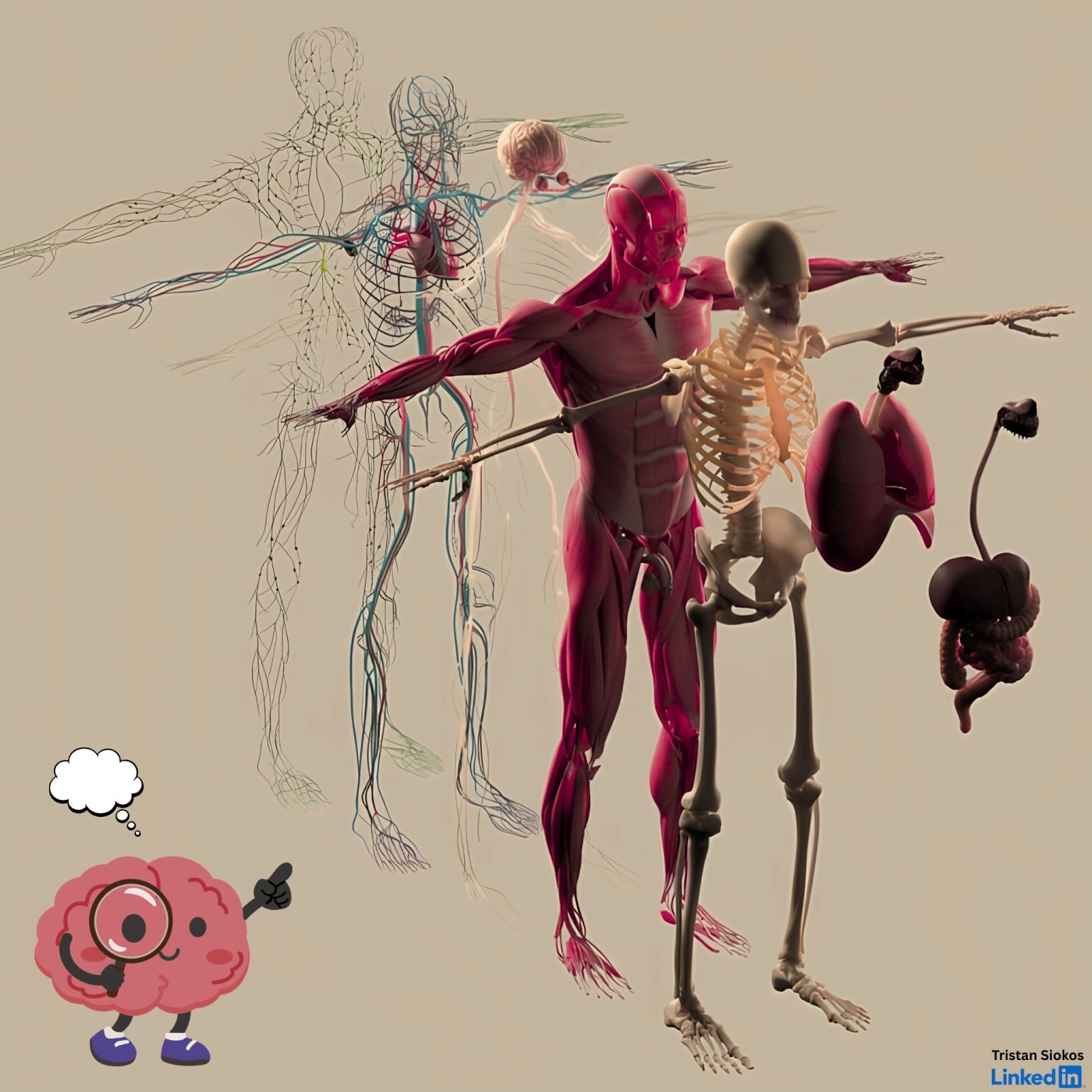
Most healthcare only sees one or two systems at a time, which is why so many people feel unheard and unable to explain what is actually happening to them. Here is what is going on in the amazing world of you, eleven systems, all running simultaneously, all talking to each other.
You Are Not One System. You Are Eleven, Running Simultaneously.
When something goes wrong in the body, medicine tends to ask: which system? Which organ? Which specialty?
It is a reasonable question. It is also, in many cases, the wrong question.
You are not a body with independent parts that occasionally malfunction one at a time. You are eleven organ systems running in continuous parallel, each with its own logic, each transmitting signals to and receiving signals from the others, each shaping the terrain in which every other system operates.
This is the systems biology perspective. And it is not a philosophical point. It is a practical one with real clinical consequences, particularly for anyone living with a condition that does not fit neatly into one specialty's domain.
Most medicine is designed around single-system diagnosis. A cardiologist looks at the cardiovascular system. A neurologist looks at the nervous system. A gastroenterologist looks at the digestive system. Each discipline has extraordinary depth within its domain. The problem is that chronic conditions are often cross-domain phenomena. They do not respect the boundaries between specialties. And so a person whose illness arises from the interaction of multiple systems can spend years in a referral loop, with each specialist finding something but no one seeing the whole.
Understanding your own systems does not replace specialist care. But it gives you the map that medicine often fails to hand you.
The Nervous System: Where Everything Either Starts or Eventually Arrives
Approximately 86 billion neurons. Roughly 100 trillion synaptic connections. Twelve cranial nerves, 31 pairs of spinal nerves, and an autonomic nervous system that governs every organ in the body without your conscious input.
The nervous system does not just process sensation and generate movement. It regulates every other organ system. Cardiac rhythm, respiratory rate, digestive motility, immune cell activation, hormonal release, immune surveillance, vascular tone, all of these are under continuous nervous system modulation.
This is why nervous system dysfunction does not produce clean, single-system symptoms. When the autonomic nervous system is dysregulated, as it is in conditions like POTS, ME/CFS, fibromyalgia, long COVID, and many others, the effects cascade across every system the autonomic nerves govern. Heart rate instability. Digestive disruption. Temperature dysregulation. Immune abnormality. Cognitive impairment. Sleep disruption. All from one dysregulated control system.
The peripheral nervous system extends to the skin, joints, muscles, and viscera, carrying sensory information back to the brain constantly. Central sensitisation, a state where the central nervous system processes sensory input with amplified gain, produces pain and symptoms across the whole body without requiring tissue damage to be present at every site.
Almost every chronic condition either originates in the nervous system or eventually involves it. Understanding this is not optional for anyone trying to understand why they feel the way they do.
The Systems That Sustain You: Cardiovascular, Respiratory, Musculoskeletal
The Cardiovascular System
The cardiovascular system is a vast transport network reaching every cell in the body. Its primary function, delivering oxygenated blood and nutrients while removing metabolic waste, sounds mechanical. The downstream implications are profound.
Every neuron in your brain requires its own dedicated blood supply. Interruption for even seconds produces cell death. Chronic low cerebral blood flow, as seen in conditions like POTS and orthostatic hypotension, produces cognitive symptoms, fatigue, and dysautonomia that look neurological but originate in circulatory failure to maintain adequate brain perfusion upright.
The endothelium, the single-cell lining of all blood vessels, is an active organ producing signalling molecules that regulate inflammation, blood pressure, clotting, and immune cell trafficking. Endothelial dysfunction, a feature of cardiovascular disease, metabolic syndrome, long COVID, and autoimmune conditions, disrupts all of these functions simultaneously.
The Respiratory System
Up to 20,000 breaths a day, almost all unconscious. The respiratory system is the only autonomic system you can also override on demand, and this is one of the most underutilised levers for nervous system regulation available.
Breathing pattern directly modulates the autonomic nervous system via the vagus nerve. Extended exhale activates the parasympathetic branch. Rapid, shallow breathing activates the sympathetic branch. Chronic dysfunctional breathing patterns, common in people with chronic pain, anxiety, and dysautonomia, sustain sympathetic dominance and lower carbon dioxide tolerance, producing a cycle of symptoms that extends far beyond the lungs.
The Musculoskeletal System
206 bones, over 600 muscles, and a fascial network that wraps every structure in the body into a single continuous tensional web. Force applied anywhere in the body is transmitted throughout the fascial web. Dysfunction in one region pulls through the whole.
Chronic musculoskeletal pain is one of the leading causes of disability globally. It is also one of the most misunderstood, because the tissue model of pain, the idea that pain magnitude maps to tissue damage extent, has been comprehensively falsified by neuroscience. Pain is a brain output, not a tissue input. Understanding the nervous system's role in musculoskeletal pain changes everything about how to approach it.
The Chemical and Cellular Architects: Endocrine, Immune, Lymphatic
The Endocrine System
The endocrine system is a chemical messaging network parallel to and deeply entwined with the nervous system. Where the nervous system communicates in milliseconds via electrical signals, the endocrine system communicates in minutes to hours via hormones circulating in the blood. The effects are slower but longer-lasting, and they touch everything.
Cortisol regulates immune function, metabolism, inflammation, cognitive function, and the stress response. Thyroid hormones set the metabolic rate of every cell in the body. Insulin governs glucose utilisation. Sex hormones, oestrogen, progesterone, and testosterone, influence bone density, cardiovascular health, immune function, mood, cognitive function, and pain sensitivity. Growth hormone governs tissue repair.
Disruption in any of these hormones cascades across the body in ways that rarely fit neatly within a single specialty. Thyroid dysfunction, for example, produces fatigue, cognitive slowing, mood changes, muscle pain, cardiovascular effects, and gastrointestinal changes simultaneously. Treating it as a single organ problem misses the systemic nature of the dysfunction.
The Immune System
Hundreds of millions of cells. An adaptive memory system capable of recognising specific pathogens encountered years earlier. The capacity to distinguish self from non-self across the entire body, continuously, in real time.
When this distinction fails, autoimmunity results. The immune system begins attacking the body's own tissues. What makes autoimmunity particularly complex from a systems perspective is that immune dysregulation does not stay contained to the target tissue. Systemic inflammation affects the brain, the cardiovascular system, the endocrine system, and the musculoskeletal system. The joint inflammation of rheumatoid arthritis and the cognitive symptoms of brain fog are not separate problems. They are the same inflammatory process affecting different tissues.
Chronic low-grade inflammation, even without autoimmunity, drives dysfunction across multiple systems simultaneously. It is now understood as a primary mechanism underlying depression, cardiovascular disease, metabolic syndrome, neurodegenerative conditions, and accelerated ageing.
The Lymphatic System
The body's drainage network, running parallel to the cardiovascular system. The lymphatic system clears cellular debris, transports immune cells, and returns interstitial fluid to circulation. When it is sluggish, the accumulation of inflammatory mediators in tissues rises, compounding the dysfunction of every system it serves.
The recently discovered glymphatic system in the brain is a specialised lymphatic network that clears metabolic waste, including beta-amyloid and tau proteins, primarily during sleep. Poor sleep impairs glymphatic clearance, contributing to neuroinflammation and cognitive decline. This is a direct link between sleep, immune function, and brain health via a lymphatic mechanism that was unknown until 2013.
The Interior Systems: Digestive, Urinary, Integumentary, Reproductive
The Digestive System and the Enteric Nervous System
The gut contains approximately 500 million neurons in its enteric nervous system, more than the entire spinal cord. These neurons coordinate digestion, gut motility, nutrient absorption, and immune surveillance without input from the brain. The gut talks to the brain via the vagus nerve in both directions, every second.
Roughly 90% of the body's serotonin is produced in the gut. Gut microbiome composition influences neurotransmitter precursor availability, inflammatory tone, immune regulation, and mood. Dysbiosis, increased intestinal permeability, and gut inflammation produce systemic effects that manifest as mood disturbance, cognitive impairment, fatigue, and immune dysregulation, far beyond the GI tract.
The gut-brain axis is one of the best-characterised multi-system interaction pathways in the human body. It is also one of the most persistently underweighted in chronic illness management.
The Urinary System
The kidneys filter roughly 180 litres of blood per day, regulating fluid balance, electrolyte concentrations, blood pressure, and acid-base chemistry. This is not a background task. The cellular function of every system in the body depends on the precise chemical environment the urinary system maintains. Disruptions in potassium, sodium, magnesium, or phosphate produce neurological, cardiovascular, and muscular dysfunction that can be profound and poorly understood without understanding the renal context.
The Integumentary System
The skin is the body's largest organ and its primary interface with the external environment. It is a sensory surface carrying information about touch, temperature, pain, and pressure via the pseudounipolar neurons of the dorsal root ganglia to the central nervous system. It is also an immune organ, with resident immune cells continuously sampling the external environment. Skin conditions are frequently markers of systemic inflammatory dysregulation, not isolated organ pathology.
The Reproductive System
The hormones produced by the reproductive system, particularly oestrogen and progesterone in cycling individuals, influence virtually every other system. Oestrogen modulates pain sensitivity, immune function, cardiovascular risk, bone density, mood, cognitive function, and sleep architecture. Menstrual cycle phase significantly alters the symptom experience of conditions including migraine, epilepsy, autoimmune conditions, and chronic pain. Menopause, with its abrupt oestrogen withdrawal, produces effects across the nervous system, cardiovascular system, bones, and immune function simultaneously.
The Connective Web Underneath Everything
Beneath and between every organ system is the fascial and connective tissue network: a continuous web of collagen, elastin, and ground substance that wraps, separates, and connects every structure in the body from the surface of the skin to the innermost organs.
Fascia is not passive packaging. It is mechanosensitive, meaning it responds to and transmits mechanical forces. It contains sensory neurons, including pain-sensing nociceptors, making it a significant source of chronic pain when chronically stressed or damaged. It communicates with the immune and nervous systems through the signals it generates under mechanical load.
Under chronic stress, inflammation, or injury, fascial tissue undergoes remodelling that increases density, reduces mobility, and amplifies pain sensitisation across the regions it traverses. The concept that a shoulder injury can eventually produce low back pain through fascial tension transmission is not speculative. It is mechanically predictable from the architecture of the fascial web.
Why This Matters for Chronic Illness, And for You
The reason complex chronic conditions are so difficult to diagnose, so difficult to treat, and so easy to dismiss is not a mystery once you understand the systems perspective.
A single-system diagnostic lens cannot reliably identify a condition whose mechanism spans multiple systems. A cardiologist may find nothing wrong with the heart. A neurologist may find nothing wrong with the nervous system in isolation. A gastroenterologist may find nothing structurally wrong with the gut. Each observation is technically accurate within its domain. None of them captures the cross-system dysfunction that is actually producing the person's experience.
This is why so many people with ME/CFS, long COVID, POTS, fibromyalgia, mast cell activation syndrome, and many autoimmune conditions spend years or decades in the diagnostic wilderness. The illness is real. The evidence, viewed through the right lens, is consistent. The lens medicine has traditionally provided is simply not wide enough to see it.
Understanding your own systems is not about self-diagnosing or replacing clinical care. It is about:
- Asking more precise questions in medical appointments
- Understanding why a change in sleep affects pain, which affects mood, which affects cardiovascular function, which affects gut motility
- Recognising that your symptom complexity is not evidence of nothing being wrong, it is evidence of something being wrong across multiple interacting systems
- Building a self-management approach that addresses multiple systems rather than chasing isolated symptoms
You are not making it up. You are walking around in eleven simultaneous systems, doing eleven simultaneous jobs, and most of medicine is looking at one of them at a time.
The body that holds all of this together is remarkable. And it deserves a perspective wide enough to see it whole.
Recalibrate is an education and self-tracking tool, not a diagnostic service or a replacement for medical care.
Related articles
- Daily Neural Workouts: 8 Science-Backed Techniques to Rewire Your Brain
Your brain is a prediction machine, not an archive. If you do not deliberately train new patterns, it reverts to its oldest, most dominant pathways. Here are 8 daily neural workouts - education, gratitude, curiosity, authenticity, meditation, resilience, connection and self-compassion - that fuel real, mechanism-level neuroplasticity.
- Why You Get Sick the Moment You Stop: The Neuroscience of Leisure Sickness
It is called leisure sickness, and the underlying mechanism is parasympathetic rebound. First identified in 2001, it explains why people crash with illness, migraines, and exhaustion the moment a deadline ends or a holiday begins. This is not weakness. This is your nervous system finally believing it is safe enough to send the bill.
- The Neuroscience of Chronic Illness: A Patient-Friendly Guide
A clear explanation of how threat detection, autonomic regulation, sleep, stress and neuroplasticity shape the lived experience of chronic illness.