The 4 Types of Glial Cells: The Other Half of Your Brain Nobody Talks About
By Tristan Siokos · Founder, Recalibrate · June 15, 2026
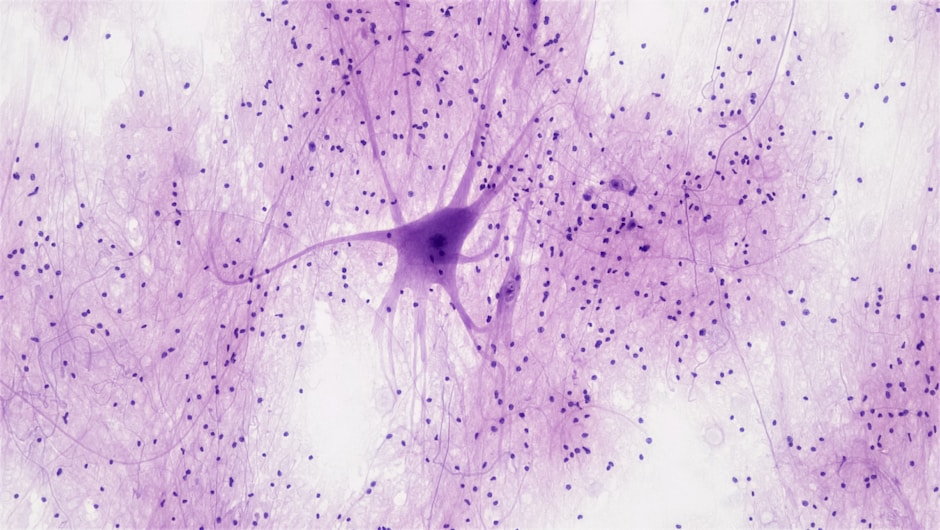
For every neuron in your nervous system there is roughly one glial cell, and for a century they were dismissed as "glue". They are nothing of the sort. Astrocytes, oligodendrocytes, microglia and ependymal cells regulate, insulate, defend and maintain your entire brain, and when they malfunction the result is pain, fog, fatigue and mood change. Here is what each type actually does.
The Other Half of Your Brain Nobody Talks About
When people picture the brain, they picture neurons. Firing, connecting, computing. But neurons are not working alone, and they are not even the majority of the story.
For every neuron in your nervous system there is roughly one glial cell, and in many regions glia outnumber neurons several times over. For most of the twentieth century they were dismissed as "glue" - the literal meaning of the Greek word glia - passive packing material holding the important cells in place.
That view is now completely obsolete. Glial cells actively shape how you think, feel, sleep, learn and recover. They regulate the chemical environment every neuron depends on, they build the insulation that makes fast thought possible, they defend the brain against injury, and they decide which connections survive and which are pruned away.
If neurons are the wiring, glia are the entire support infrastructure: the electricians, the immune system, the maintenance crew and the architects. And when glia malfunction, the consequences show up as pain, fatigue, brain fog and mood changes that no amount of "neuron-only" thinking can explain.
There are four principal types. Learn what each one does and the brain stops looking like a bundle of wires and starts looking like a living city.
Astrocytes: The Regulators That Keep Neurons Alive
Astrocytes are the most abundant glial cell in the central nervous system, named for their characteristic star shape. Their branching processes reach out and touch almost everything: neurons, synapses, and blood vessels.
What they do: Astrocytes maintain the entire chemical environment neurons need to function. They control the concentration of ions, especially potassium, in the fluid around neurons - a job that directly determines whether neurons can fire reliably. They recycle neurotransmitters after each signal, clearing glutamate from the synapse so it does not build up to toxic levels.
The blood-brain barrier: Astrocyte end-feet wrap around the blood vessels of the brain and help form and regulate the blood-brain barrier, the selective wall that decides what gets in from the bloodstream and what stays out. This is why the brain is so tightly protected from circulating toxins - and why delivering medication into the brain is so difficult.
Metabolic support: Astrocytes take up glucose from the blood and pass energy substrates to neurons. When neurons are working hard, astrocytes ramp up local blood flow to match demand. This coupling between activity and blood flow is the entire basis of functional MRI.
In chronic pain and illness: Astrocytes become "reactive" in response to injury and sustained stress, a state called astrogliosis. Reactive astrocytes in the spinal cord amplify pain signalling and are a recognised driver of central sensitisation - one of the core mechanisms behind pain that persists long after tissue has healed. Astrocyte dysfunction is also implicated in the way inflammation translates into brain fog and low mood.
Oligodendrocytes: The Insulation That Makes Fast Thought Possible
Oligodendrocytes have one primary job in the central nervous system, and it is an extraordinary one: they build myelin.
Myelin is a fatty, insulating sheath wrapped around axons - the long output cables of neurons. A single oligodendrocyte extends multiple processes and myelinates segments of many different axons at once, up to fifty in some cases.
Why insulation matters: An unmyelinated axon conducts a signal slowly, as a continuous wave. A myelinated axon conducts it by "saltatory conduction" - the signal jumps between gaps in the myelin called nodes of Ranvier, accelerating transmission dramatically. Myelinated fibres can carry signals more than a hundred times faster than unmyelinated ones. Everything that depends on speed - reflexes, coordinated movement, rapid cognition - depends on oligodendrocytes doing their job.
Learning is myelination: Myelin is not fixed after childhood. When you practise a skill repeatedly, oligodendrocytes add myelin to the circuits you are using, making them faster and more efficient. This is a physical, cellular basis for why practice works. Learning does not just strengthen synapses; it rewires the insulation of your white matter.
When it fails: Multiple sclerosis is the archetypal oligodendrocyte disease - the immune system attacks myelin, and signals slow, scatter or fail entirely, producing the fatigue, weakness, numbness and cognitive changes characteristic of the condition. Subtler white-matter changes are increasingly linked to the cognitive fog reported in chronic illness.
Microglia: The Immune System of the Brain
Microglia are the resident immune cells of the central nervous system. They arise from a completely different origin than the other glia - they migrate into the brain early in development from the same lineage as the body's macrophages - and they act as the brain's dedicated defence and surveillance force.
Constant surveillance: Even in a resting state, microglia are never truly at rest. Their fine processes constantly extend and retract, sampling the environment, checking on synapses, and detecting the first sign of damage or infection. The entire brain is surveyed by microglia every few hours.
Response to threat: When microglia detect injury, pathogens or cellular debris, they transform - retracting their fine branches, becoming mobile and amoeboid, migrating to the site, and engulfing debris and dead cells. They release signalling molecules that coordinate the brain's inflammatory response.
Synaptic pruning: One of the most remarkable discoveries in modern neuroscience is that microglia physically prune synapses. During development they eliminate weak or unused connections, sculpting neural circuits. This same machinery, when dysregulated later in life, is implicated in neurodegenerative and neuropsychiatric conditions.
In chronic pain, fatigue and mood: Microglia are central to the concept of neuroinflammation. When they become chronically activated - by sustained stress, systemic inflammation, or ongoing pain input - they release pro-inflammatory molecules that sensitise pain pathways, disrupt sleep, blunt motivation and generate the heavy, foggy, unwell feeling so common in chronic conditions. Persistent microglial activation is one of the most important bridges between the immune system and the brain.
Ependymal Cells and the Peripheral Glia: The Rest of the Crew
The fourth central category is the ependymal cell. These cells line the fluid-filled ventricles of the brain and the central canal of the spinal cord. Their surfaces are covered in cilia that beat rhythmically to circulate cerebrospinal fluid - the clear fluid that cushions the brain, delivers nutrients and clears waste. A specialised group of ependymal cells forms the choroid plexus, which actually produces cerebrospinal fluid.
The overnight clearance of metabolic waste from the brain - the glymphatic system - depends on this fluid flow, which is one of the reasons sleep is so non-negotiable for brain health.
Glia beyond the brain: The peripheral nervous system has its own glial cells.
- Schwann cells are the peripheral equivalent of oligodendrocytes. They myelinate the axons of peripheral nerves - but unlike oligodendrocytes, each Schwann cell myelinates a single segment of a single axon, and crucially, they can support nerve regeneration after injury. This is why a damaged peripheral nerve has some capacity to recover while central nervous system damage generally does not.
- Satellite glial cells surround the cell bodies of sensory neurons in the ganglia, including the dorsal root ganglia where pain-carrying neurons live. After nerve injury, satellite glial cells become activated and contribute directly to the development of neuropathic pain.
Together, the peripheral glia explain both why nerve injuries can sometimes heal and why they can sometimes turn into chronic, burning, persistent pain.
Why This Changes How You Understand Your Own Symptoms
The old model - symptoms come from neurons and neurons alone - cannot explain the lived reality of chronic illness. The glial model can.
When pain persists after an injury has healed, reactive astrocytes and activated microglia in the spinal cord are amplifying and sustaining the signal. When a bout of inflammation or a poor night's sleep leaves you foggy, heavy and flat, glial signalling is a major part of the mechanism. When practice makes a movement automatic, oligodendrocytes have physically upgraded your wiring. When nerve damage turns into burning neuropathic pain, satellite glia and Schwann cells are involved.
This matters practically. Many of the levers that genuinely move chronic symptoms - sleep, which drives glymphatic clearance and myelin maintenance; managing systemic inflammation; nervous-system regulation that calms glial activation; consistent, graded practice that promotes healthy myelination - act at least partly through glia, not neurons.
You are not imagining your symptoms, and they are not "just in your head" in any dismissive sense. They are in the cells that make up the majority of your brain - cells whose entire job is to regulate, defend, insulate and maintain the nervous system. Understanding them turns a confusing set of symptoms into a system you can actually work with.
Recalibrate is an education and self-tracking tool, not a diagnostic service or a replacement for medical care.
Related articles
- The 4 Types of Neurons Running Your Entire Nervous System
Most people think of a neuron as one shape. There are actually four. Each one is built differently because each one does a different job, and the architecture of each cell tells you exactly what kind of work it was made for. Here is what they are and what they actually do for you.
- The 12 Cranial Nerves Explained: The Direct Line From Your Brain to Your World
Sight, sound, smell, taste, balance, facial expression, swallowing, and the entire unconscious regulation of your heart, lungs and gut all run through twelve pairs of cranial nerves. Here is what each one does, why cranial nerve function is a window into brainstem health, and why the tenth - the vagus - sits at the centre of modern thinking about stress and recovery.
- Perspective Is Everything: The Neuroscience of How Your Brain Predicts Reality
The same event can produce panic in one person and calm in another. The difference is not the situation. It is the prediction your brain makes before the body reacts. This is predictive processing, one of the most established findings in modern neuroscience, and the reason perspective is biological, not just cognitive.