Vagus Nerve Exercises for Chronic Pain: 6 Techniques That Actually Work
By Tristan Siokos · Founder, Recalibrate · February 22, 2026
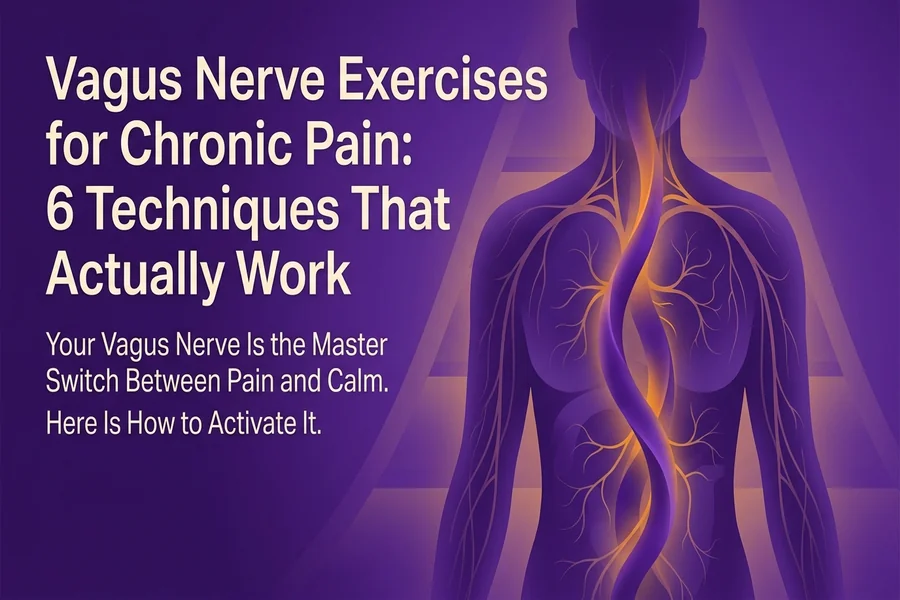
Vagus nerve stimulation is one of the fastest-growing trends in chronic pain management. But you do not need a device. These 6 evidence-based exercises activate your parasympathetic nervous system and turn down the pain volume from home.
Why Everyone Is Talking About the Vagus Nerve
Vagus nerve stimulation is one of the fastest-growing trends in chronic pain management. And for good reason.
The vagus nerve is the longest cranial nerve in your body. It runs from your brainstem through your neck, chest, and abdomen, connecting your brain to your heart, lungs, gut, and immune system. It is the primary pathway of the parasympathetic nervous system, your body's rest-digest-repair system.
In chronic pain, the sympathetic nervous system (fight-or-flight) is chronically overactivated. Your nervous system is stuck in threat mode. The vagus nerve is the brake pedal.
The Science: Vagal tone, how active and responsive your vagus nerve is, directly correlates with pain sensitivity, inflammation levels, heart rate variability (HRV), and emotional regulation. Low vagal tone is consistently found in fibromyalgia, ME-CFS, long COVID, and chronic pain conditions.
Higher vagal tone means lower pain sensitivity. Lower inflammation. Better sleep. More emotional resilience.
And the best part: vagal tone is trainable. You do not need a device. You need consistent practice.
Exercise 1: Extended Exhale Breathing (The Most Powerful Tool You Have)
The Science: The exhale phase of breathing directly activates the vagus nerve via the vagal brake mechanism. Longer exhales than inhales force a parasympathetic shift, lowering heart rate, reducing cortisol, and decreasing pain sensitivity within minutes.
The Protocol:
- Inhale through your nose for 4 counts
- Exhale through your mouth for 8 counts
- Repeat for 5-10 minutes
When to use it: Before sleep, during pain flares, before stressful situations, any time you notice your body is in fight-or-flight mode.
The Evidence: A 2023 Stanford study found that cyclic sighing (extended exhale breathing) outperformed mindfulness meditation for reducing anxiety and improving mood when practiced for just 5 minutes daily. The mechanism is vagal activation.
This is the single most accessible, most evidence-backed vagus nerve exercise available. If you do nothing else from this article, do this.
Exercise 2: Cold Water Exposure (The Dive Reflex)
The Science: When cold water touches your face, it triggers the mammalian dive reflex. This is an involuntary parasympathetic response that slows heart rate by 10-25%, redirects blood flow, and powerfully activates the vagus nerve.
The Protocol:
- Splash cold water on your face and neck for 15-30 seconds
- Or hold a cold pack against the sides of your neck (where the vagus nerve runs)
- Or end your shower with 30 seconds of cold water on your face and chest
Important: Do not submerge your head or use ice-cold water if you have heart conditions. Cool water on the face is sufficient to trigger the reflex.
Why it works for chronic pain: The dive reflex produces an immediate parasympathetic shift that interrupts the sympathetic overactivation driving pain sensitivity. It is fast-acting, unlike breathing exercises which take a few minutes to produce effects.
Exercise 3: Humming, Singing, and Gargling
The Science: The vagus nerve innervates the muscles of the throat and vocal cords. Any activity that engages these muscles, humming, singing, gargling, chanting, directly stimulates the vagus nerve through mechanical vibration.
The Protocols:
- Humming: Hum at a comfortable pitch for 5 minutes. You should feel the vibration in your chest and throat. Bhramari (bee breath) from yoga uses this mechanism.
- Singing: Any singing activates the vagus nerve. Singing in groups has additional social bonding benefits that further support vagal tone.
- Gargling: Gargle water vigorously for 30-60 seconds, enough to make your eyes water slightly. This indicates vagal activation.
Why it matters: These are some of the most accessible vagal exercises. You can hum in the car, sing in the shower, or gargle while brushing your teeth. No special equipment. No special time set aside.
Exercise 4: Gentle Neck and Ear Massage
The Science: The vagus nerve has superficial branches that run through the neck and the outer ear (specifically the tragus and cymba conchae). Gentle massage of these areas provides direct mechanical stimulation to the nerve.
The Protocol:
- Neck massage: Use gentle circular pressure along the sides of your neck, from just below the ear down to the collarbone. 2-3 minutes per side.
- Ear massage: Gently massage the tragus (the small pointed flap in front of your ear canal) and the inner curve of the outer ear. 1-2 minutes per ear.
The evidence: Transcutaneous auricular vagus nerve stimulation (taVNS), which targets the same ear region, is FDA-cleared for certain conditions. Manual massage provides a less intense but more accessible version of the same mechanism.
Combine with extended exhale breathing for compounding parasympathetic activation.
Exercise 5: The Rosenberg Basic Exercise (Neck Reset)
The Science: This exercise, developed by Dr. Stanley Rosenberg, targets the ventral vagal complex through specific neck and eye movements that release tension in the suboccipital muscles and stimulate vagal pathways.
The Protocol:
1. Interlace your fingers and place them behind your head
2. Keep your head facing forward
3. Move only your eyes to look to the right
4. Hold for 30-60 seconds until you notice a sigh, yawn, or swallow (signs of parasympathetic activation)
5. Return eyes to center
6. Repeat looking to the left
Why it works: The suboccipital muscles at the base of the skull are intimately connected to vagal function. Chronic tension here (extremely common in pain patients who spend time in fight-or-flight) inhibits vagal tone. This exercise releases that tension and signals safety to the nervous system.
Building a Daily Vagal Tone Practice
Vagal tone is not something you activate once and forget. It is a fitness metric for your nervous system. Like cardiovascular fitness, it improves with consistent training and declines without it.
A Practical Daily Protocol:
- Morning: 5 minutes extended exhale breathing + 30 seconds cold water on face
- Midday: 2 minutes humming or singing + gentle neck massage
- Before bed: 5 minutes extended exhale breathing + Rosenberg exercise
Tracking your progress: Heart rate variability (HRV) is the most accessible measure of vagal tone. Many wearables track it. Higher resting HRV over time indicates improving vagal tone. Track it alongside your pain levels in Recalibrate to see the correlation.
The compound effect: Each of these exercises individually produces a modest parasympathetic shift. Practiced consistently over weeks and months, they produce measurable changes in vagal tone, pain sensitivity, sleep quality, and emotional regulation.
Your vagus nerve is not broken. It is deconditioned. These exercises are the gym membership for your parasympathetic nervous system.
Recalibrate is an education and self-tracking tool, not a diagnostic service or a replacement for medical care.
Related articles
- Your Nervous System Has a Control Panel. Here Is the Manual.
Every feeling has a corresponding autonomic state. And every autonomic state can be shifted deliberately, in minutes, using inputs your body already understands. Here is the neuroscience behind four emotional states and exactly how to move through them.
- The Neuro-Vagal Approach to POTS Self-Management
A patient-friendly look at POTS self-management through autonomic regulation, vagal tone, pacing, hydration, compression and clinician-guided planning.
- You Have a Floating Bone in Your Throat. Around It Sits a Control Panel for Your Nervous System.
The hyoid is the only bone in your body that does not articulate with another. Around it converge five cranial nerves. One of them is the vagus. This is why your breath, your exhale, your voice and your swallow can genuinely shift your physiological state - not by suggestion, but through anatomy.