The Neuroscience of Inflammation and Mood: Why Your Low Days Are Rarely Just Psychological
By Tristan Siokos · Founder, Recalibrate · June 3, 2026
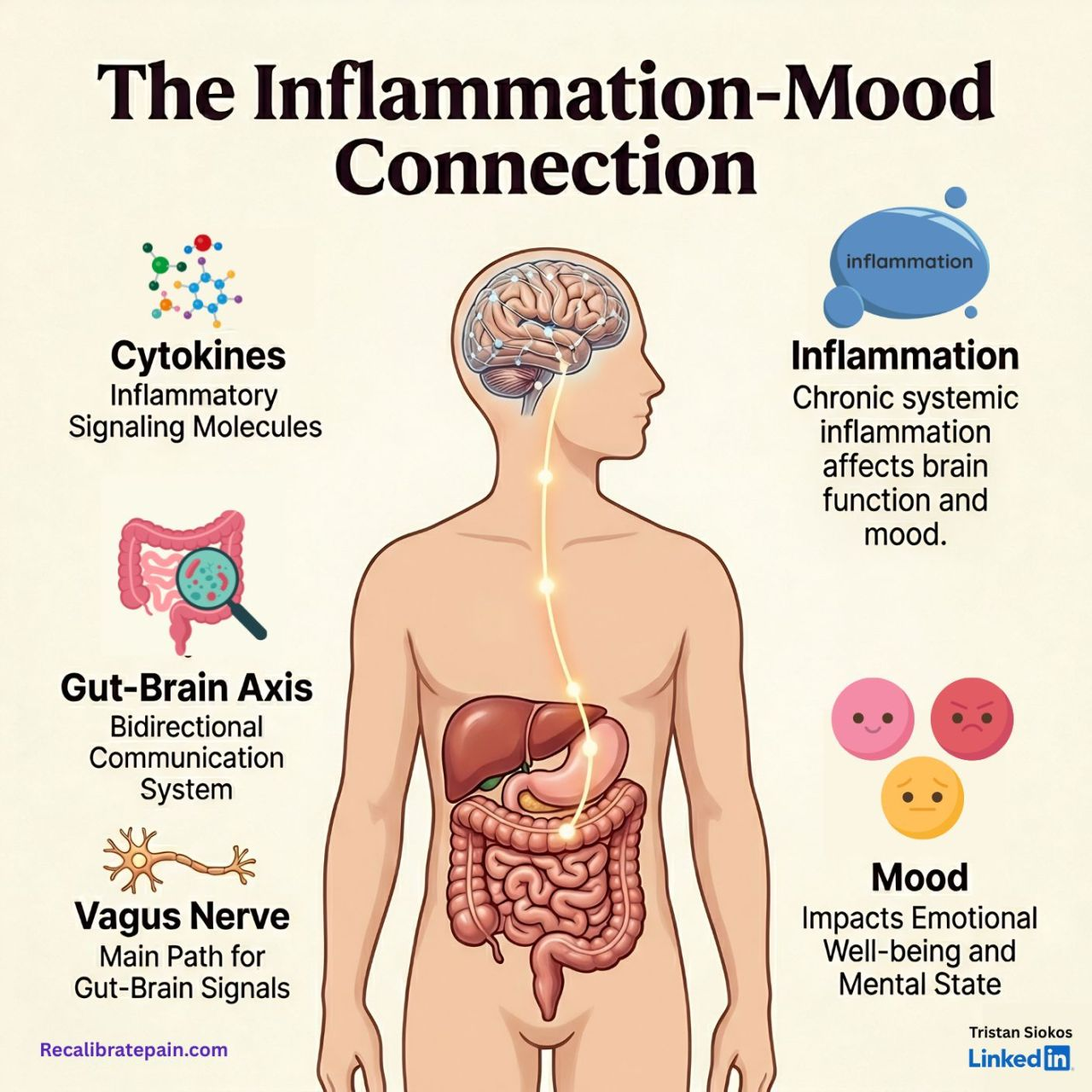
Most people think mood is built in the mind. Stress, thoughts, willpower. The research tells a different story. Mood is also built in the immune system, and when that system is inflamed, your psychology cannot outrun the chemistry. This is one of the most significant shifts in modern neuroscience.
Your Low Days Are Not Just in Your Head. They Are in Your Blood.
Most people think mood is built in the mind. Stress, thoughts, willpower, perspective.
The research tells a different story. Mood is also built in the immune system. And when that system is inflamed, your psychology cannot outrun the chemistry.
This is one of the most consequential shifts in modern neuroscience. Psychiatry and immunology used to be treated as entirely separate disciplines. The brain was sealed off. The immune system was peripheral. The mind was abstract.
We now know that is wrong.
The brain is immunologically active. The gut communicates directly with the brainstem via the vagus nerve. Immune signalling molecules called cytokines cross or bypass the blood-brain barrier and change how the brain functions. Inflammation is not just a body problem. It is a brain problem. And because the brain manufactures mood, it is a mood problem.
Understanding this does not eliminate the psychological, genetic, social, or circumstantial dimensions of mental health. It adds a layer that most people are not being told about. And for a meaningful subset of people experiencing depression, anxiety, fatigue, and cognitive fog, this layer is not peripheral. It is central.
How Inflammation Talks to the Brain
Cytokines are the immune system's primary signalling molecules. When the immune system activates, whether from infection, injury, chronic stress, poor sleep, gut dysbiosis, or visceral fat, it releases cytokines including interleukin-6 (IL-6), tumour necrosis factor-alpha (TNF-alpha), and interleukin-1 beta (IL-1β).
These molecules talk to the brain through several routes:
1. The Blood-Brain Barrier
The blood-brain barrier is selectively permeable, not absolute. Certain cytokines cross it directly. Others activate endothelial cells in the brain's blood vessels, which then release their own local inflammatory signals. Still others enter at circumventricular organs, specialised brain regions where the barrier is less strict.
2. The Vagus Nerve
The vagus nerve is the primary information highway between the body and the brain. Roughly 80% of its fibres run upward (afferent), from gut and viscera to brainstem. Peripheral inflammation signals travel this route rapidly, arriving at the nucleus tractus solitarius in the brainstem before being relayed to higher brain centres including the hypothalamus, amygdala, and prefrontal cortex.
3. The Hypothalamus and HPA Axis
Once cytokine signals reach the hypothalamus, they activate the HPA axis, raising cortisol. Sustained cytokine-driven HPA activation produces the same downstream neurochemical effects as chronic psychological stress: disrupted serotonin and dopamine synthesis, reduced prefrontal function, heightened amygdala reactivity.
The result is a specific cluster of changes in mood, cognition, and behaviour. Neuroscientists call it sickness behaviour.
Sickness Behaviour: Why This Evolved and What Goes Wrong
Sickness behaviour is not a malfunction. It is one of the most ancient and adaptive programmes in biology.
When your immune system detects a genuine infection, it signals the brain to implement a behavioural strategy optimised for recovery: conserve energy, rest, withdraw from social demands, suppress appetite, reduce exploratory behaviour, lower motivation. Every one of those outputs serves the goal of directing maximum resources to the immune response and tissue repair.
The problem: chronic low-grade inflammation triggers the same programme without an infection to recover from.
In acute infection, sickness behaviour lasts days and resolves with the illness. In chronic low-grade inflammation, the signal never fully turns off. The brain keeps receiving inputs that say something is wrong, conserve, withdraw, rest and keeps generating the corresponding behavioural outputs: low mood, fatigue, social withdrawal, cognitive slowing, loss of motivation.
You are not sick with an acute infection. But your brain is behaving as if you are.
What produces chronic low-grade inflammation:
- Poor sleep quality and quantity
- Ultra-processed diet and high glycaemic load
- Chronic psychological stress
- Sedentary behaviour
- Visceral adipose tissue (which is metabolically active and pro-inflammatory)
- Gut dysbiosis and increased intestinal permeability
- Loneliness and social isolation (measurably raises CRP and IL-6)
- Smoking and alcohol
- Untreated chronic pain or infection
- Autoimmune and inflammatory conditions
Many of these are the same factors that are already associated with depression, anxiety, and poor mental health. This is not coincidence. The pathway connecting them runs through the immune system.
The Depression-Inflammation Overlap: What the Research Shows
The relationship between inflammation and depression is now one of the most replicated findings in biological psychiatry.
The epidemiological evidence:
Meta-analyses consistently show elevated inflammatory markers, particularly CRP, IL-6, and TNF-alpha, in people with major depressive disorder compared to healthy controls. This finding holds across different populations, diagnostic criteria, and measurement timepoints.
The intervention evidence:
Anti-inflammatory treatments, including COX-2 inhibitors, omega-3 supplementation, and cytokine-blocking drugs originally developed for rheumatoid arthritis, show antidepressant effects specifically in patients with high baseline inflammation. Infliximab, a TNF-alpha inhibitor, showed no antidepressant benefit in unselected depression patients but produced significant improvement in those with elevated CRP.
The direction of causality:
The relationship is likely bidirectional. Depression can raise inflammatory markers through its effects on sleep, stress hormones, health behaviour, and HPA axis activation. Inflammation can produce depression through its effects on serotonin synthesis, dopamine signalling, glutamate activity, and neuroplasticity. The two systems are in constant dialogue.
The important nuance:
Not all depression is inflammatory. Multiple biological and psychological pathways lead to the same diagnostic category. Research suggests perhaps 30-45% of depressed patients show the inflammatory subtype, characterised by elevated CRP and cytokines, greater somatic symptoms, fatigue, cognitive slowing, and reduced treatment response to standard antidepressants. Identifying this subtype matters because it changes what works.
Treating inflammatory depression with psychological therapy alone or SSRIs alone, without addressing the underlying inflammatory drivers, often produces partial response. Addressing the inflammatory drivers directly can produce changes that psychological intervention cannot achieve while inflammation is running.
The Gut-Brain Axis: 500 Million Neurons You Were Not Told About
Your gut contains approximately 500 million neurons, more than the entire spinal cord. It houses trillions of microorganisms whose collective genome is roughly 150 times larger than the human genome. It produces roughly 90% of the body's serotonin and significant quantities of dopamine precursors, GABA, and other neuroactive compounds.
And roughly 80% of the vagal fibres running between gut and brain run upward, carrying information from gut to brain rather than the other way round.
The gut is not just a digestion organ. It is a primary input to the brain's mood-regulation architecture.
The microbiome and mood:
Specific gut bacteria strains produce or modulate neurotransmitter precursors. Others produce short-chain fatty acids that reduce gut inflammation and systemic inflammatory tone. Microbiome diversity is consistently associated with lower inflammatory markers and better mental health outcomes. Gut dysbiosis, an imbalance in microbial composition, is associated with increased intestinal permeability, systemic endotoxaemia, elevated cytokines, and mood disturbance.
Gut inflammation and the brain:
Inflammatory bowel conditions like Crohn's disease and ulcerative colitis show dramatically elevated rates of depression and anxiety. A significant proportion of this is not a psychological reaction to living with a difficult condition. It is the direct neurological effect of sustained gut-origin inflammation on the brain via the vagus nerve and systemic cytokine circulation.
What shifts the gut toward better inflammatory tone:
- Fibre diversity: aim for 30+ different plant foods per week. Microbial diversity tracks plant diversity.
- Fermented foods: yogurt, kefir, kimchi, sauerkraut, miso. Clinical trials show measurable improvement in microbiome diversity and reduction in inflammatory markers.
- Reducing ultra-processed food: emulsifiers, artificial sweeteners, and certain additives are associated with gut dysbiosis and increased permeability.
- Prebiotics: inulin, resistant starch, pectin feed the beneficial microbial populations directly.
- Reducing chronic stress: the HPA axis directly alters gut motility, permeability, and microbial composition.
Chronic Conditions, Inflammation, and the Mood That Comes With Them
People with autoimmune diseases, chronic pain conditions, chronic infections, and metabolic conditions show substantially higher rates of depression and anxiety than the general population.
The standard narrative is that this is a psychological response: the emotional burden of living with a chronic condition. And that is partially true.
But it is incomplete.
Rheumatoid arthritis, lupus, multiple sclerosis, fibromyalgia, inflammatory bowel disease, POTS, ME/CFS, and long COVID are all conditions characterised by sustained immune activation and elevated cytokine profiles. The mood disturbance in these conditions is not exclusively a psychological reaction to difficulty. A significant portion is the direct neurological effect of sustained inflammation on the brain.
This distinction matters clinically because it changes the treatment target.
If the low mood is primarily a psychological reaction to chronic illness, psychological intervention is the primary tool. If the low mood is partly driven by sustained cytokine-mediated sickness behaviour, then addressing the inflammatory drivers, sleep, gut health, stress regulation, movement, anti-inflammatory nutrition, is a primary treatment target, not an adjunct.
It also matters for self-understanding. Knowing that your low mood during a flare is partly a direct immune system output, not a failure of attitude or resilience, changes the relationship you have with that mood. It is not a sign that you are giving up or responding badly. It is your brain receiving an inflammatory signal and generating a sickness behaviour response. That signal can be measured. It can be targeted. And it does not define what is possible in remission.
What Actually Lowers Inflammatory Tone
Chronic low-grade inflammation is not fixed biology. It is a state your immune system entered. Most of its drivers are modifiable.
Sleep is the most powerful single intervention for inflammatory tone. Sleep deprivation raises IL-6, CRP, and TNF-alpha measurably after a single night. Consistent quality sleep is the baseline for everything else.
Movement at moderate intensity, performed consistently, reduces CRP and IL-6 over time. High-intensity exercise transiently raises inflammation. Moderate, consistent movement lowers it. The goal is regularity over intensity.
Anti-inflammatory nutrition means a dietary pattern high in omega-3 fatty acids, polyphenols, dietary fibre, and plant diversity, and low in ultra-processed foods, refined carbohydrates, and trans fats. The Mediterranean dietary pattern has the strongest evidence base. No single food is the answer; the overall pattern is.
Vagal stimulation directly engages the cholinergic anti-inflammatory pathway: the vagus nerve, when activated, releases acetylcholine, which suppresses macrophage production of TNF-alpha and other cytokines. Extended exhale breathing, cold water face exposure, humming, and singing all activate this pathway. So does social connection and laughter.
Stress regulation matters because psychological stress is itself pro-inflammatory via the HPA axis. Chronic cortisol elevation causes cortisol receptor downregulation, which paradoxically reduces the anti-inflammatory effects of cortisol and allows cytokine activity to rise.
Social connection measurably lowers CRP and IL-6. Loneliness measurably raises them. The biology of connection is not metaphorical. The vagus nerve, the social nervous system, and the immune system are structurally linked.
Nature exposure produces reductions in cortisol, blood pressure, and inflammatory markers at durations as short as 20 minutes. The mechanism is partially through stress reduction and partially through phytoncide exposure from trees, which has direct immune-modulating effects.
Your mood is not just in your head. It is in your blood, your gut, and your nervous system.
Understanding that layer does not remove the work of managing thoughts, building supportive relationships, or addressing trauma and circumstance. It adds the biological substrate that those efforts sit on. And when that substrate is inflamed, you deserve tools that address the inflammation directly, not just the psychology it produces.
Recalibrate is an education and self-tracking tool, not a diagnostic service or a replacement for medical care.
Related articles
- The Autonomic Nervous System: Sympathetic, Parasympathetic and the Brain in Your Gut
Your heart beats, your gut digests and your blood pressure self-tunes without a single conscious command. That is the autonomic nervous system - sympathetic, parasympathetic and enteric. It is not a switch but a constantly negotiated balance, and when that balance gets stuck you get anxiety, chronic pain, fatigue, digestive problems and dysautonomia. Here is how it actually works and how to work with it.
- Your Nervous System Has a Control Panel. Here Is the Manual.
Every feeling has a corresponding autonomic state. And every autonomic state can be shifted deliberately, in minutes, using inputs your body already understands. Here is the neuroscience behind four emotional states and exactly how to move through them.
- Why You Get Sick the Moment You Stop: The Neuroscience of Leisure Sickness
It is called leisure sickness, and the underlying mechanism is parasympathetic rebound. First identified in 2001, it explains why people crash with illness, migraines, and exhaustion the moment a deadline ends or a holiday begins. This is not weakness. This is your nervous system finally believing it is safe enough to send the bill.